PHY 150 PROJECT THREE NEW ROLLER COASTER DESIGN MATHEW DAWSON A&L ENGINEERING
PHY 150 Project Three New Roller Coaster Design
Mathew Dawson A&L Engineering
A&L Engineering
New Roller Coaster Track Design
The Design:
A
P1
75 m P2
60 m
V2
25 m 45 m
10 m
V1
10 m
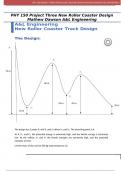
The design has 2 peaks P1 and P2 and 2 valleys V1 and V2. The launching point is A.
At A, P1, and P2, the potential energy is extremely high, and the kinetic energy is extremely
low. At the valleys, V1 and V2 the kinetic energies are extremely high, and the potential
energies are low.
Let the mass of the cart be 500 kg (represented as m).
®™
, PHY 150 PROJECT THREE NEW ROLLER COASTER DESIGN MATHEW DAWSON A&L ENGINEERING
Energies and Momenta at the peaks and
valleys:
V1
The potential energy at A:
PEA=mgh
m
PEA =(5 50 kg)(9.80 )(75 m)
2
s
PEA=40425 0 J =404 . 25 kJ
This energy is purely potential energy since the cart starts from rest.
When the cart drops to V1, the potential energy lost is equal to the kinetic energy at V1.
The potential energy at V1:
PEV =mgh 1
m
=(5 50 kg)(9.80 )(10 m)
PEV 1
2
s
PE =53900 J =53.90 kJ
1
V
Let the velocity of the roller coaster cart at V1 be v1.
Therefore, the kinetic energy is:
1
KE = mv 2
V1 1
2
KEV =PE A −PEV =404250 J −539 0 0 J
1 1
KE V =35 0 35 0 J =35 0.35 kJ
1
Therefore, the velocity is:
vV = 1
√2 KEV 1
m
√
2(350350 J )
v = 550
kg
v
V 1
√
=
m
1274 s
vV 1=3 5. 693 m / s
®™
PHY 150 Project Three New Roller Coaster Design
Mathew Dawson A&L Engineering
A&L Engineering
New Roller Coaster Track Design
The Design:
A
P1
75 m P2
60 m
V2
25 m 45 m
10 m
V1
10 m
The design has 2 peaks P1 and P2 and 2 valleys V1 and V2. The launching point is A.
At A, P1, and P2, the potential energy is extremely high, and the kinetic energy is extremely
low. At the valleys, V1 and V2 the kinetic energies are extremely high, and the potential
energies are low.
Let the mass of the cart be 500 kg (represented as m).
®™
, PHY 150 PROJECT THREE NEW ROLLER COASTER DESIGN MATHEW DAWSON A&L ENGINEERING
Energies and Momenta at the peaks and
valleys:
V1
The potential energy at A:
PEA=mgh
m
PEA =(5 50 kg)(9.80 )(75 m)
2
s
PEA=40425 0 J =404 . 25 kJ
This energy is purely potential energy since the cart starts from rest.
When the cart drops to V1, the potential energy lost is equal to the kinetic energy at V1.
The potential energy at V1:
PEV =mgh 1
m
=(5 50 kg)(9.80 )(10 m)
PEV 1
2
s
PE =53900 J =53.90 kJ
1
V
Let the velocity of the roller coaster cart at V1 be v1.
Therefore, the kinetic energy is:
1
KE = mv 2
V1 1
2
KEV =PE A −PEV =404250 J −539 0 0 J
1 1
KE V =35 0 35 0 J =35 0.35 kJ
1
Therefore, the velocity is:
vV = 1
√2 KEV 1
m
√
2(350350 J )
v = 550
kg
v
V 1
√
=
m
1274 s
vV 1=3 5. 693 m / s
®™