2
PHY 150 Final Project Report: Roller Coaster Design
Analysis, A&L Engineering
A&L ENGINEERING
Roller Coaster Design Report
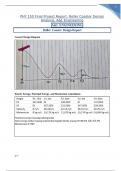
Coaster Design Diagram
Kinetic Energy, Potential Energy, and Momentum Calculations
Potential energy (mass)(gravity)(gravity)
Total energy (initial mass)(gravity)(initial height) Kinetic energy TE=KE+PE KE=TE-PE
Momentum P+MV
®™
, 2
Energy Descriptions
• At each of the identified points, how was kinetic energy transferred to potential energy,
and vice versa?
Before the cart starts, it has stored energy and very little kinetic energy. As the it starts
to go down that’s when it starts to convert its stored energy into kinetic energy.
• What happens to the total energy of the cart as it moves along the track? Why?
Since there is no friction on the actual track, the energy remains constant when its
going down the track. It only goes back and forth between potential energy and kinetic
energy.
• How is the principle of conservation of energy applied in this situation?
The principle of energy conservation states that energy can neither be created nor
destroyed, but can only be transformed from one form to another. The potential and
kinetic energy is being transferred back and forth the whole time the cart is going back
and forth so there is no actual creation or destruction of energy which is exactly what
the principle of energy conservation states.
Collision Calculations
Assuming both carts at one point will meet together and continue rolling down the track
because of the inelastic collision, the following calculations will give us the energy transfers
between the carts.
Momentum
Before Collision: Mass * Initial Velocity + Mass * 0
After Collision: 2 * Mass * Final Velocity
Using the conservation of momentum, we can set the momentum before the collision to get the
final velocity.
Mvi + M(0) = 2Mvf
500(38.34) + 500(0) = 2(500)(vf)
19,170 = 1,000vf
vf = 19.17 m/s
Mvi + M(0) = 2Mvf
500(38.34) + 500(0) =
2(500)
(vf)
®™
PHY 150 Final Project Report: Roller Coaster Design
Analysis, A&L Engineering
A&L ENGINEERING
Roller Coaster Design Report
Coaster Design Diagram
Kinetic Energy, Potential Energy, and Momentum Calculations
Potential energy (mass)(gravity)(gravity)
Total energy (initial mass)(gravity)(initial height) Kinetic energy TE=KE+PE KE=TE-PE
Momentum P+MV
®™
, 2
Energy Descriptions
• At each of the identified points, how was kinetic energy transferred to potential energy,
and vice versa?
Before the cart starts, it has stored energy and very little kinetic energy. As the it starts
to go down that’s when it starts to convert its stored energy into kinetic energy.
• What happens to the total energy of the cart as it moves along the track? Why?
Since there is no friction on the actual track, the energy remains constant when its
going down the track. It only goes back and forth between potential energy and kinetic
energy.
• How is the principle of conservation of energy applied in this situation?
The principle of energy conservation states that energy can neither be created nor
destroyed, but can only be transformed from one form to another. The potential and
kinetic energy is being transferred back and forth the whole time the cart is going back
and forth so there is no actual creation or destruction of energy which is exactly what
the principle of energy conservation states.
Collision Calculations
Assuming both carts at one point will meet together and continue rolling down the track
because of the inelastic collision, the following calculations will give us the energy transfers
between the carts.
Momentum
Before Collision: Mass * Initial Velocity + Mass * 0
After Collision: 2 * Mass * Final Velocity
Using the conservation of momentum, we can set the momentum before the collision to get the
final velocity.
Mvi + M(0) = 2Mvf
500(38.34) + 500(0) = 2(500)(vf)
19,170 = 1,000vf
vf = 19.17 m/s
Mvi + M(0) = 2Mvf
500(38.34) + 500(0) =
2(500)
(vf)
®™