

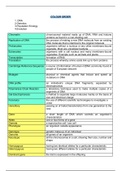
COLOUR ORDER
1. DNA
2.Genetics
3.Population Ecology
4.Evolution
Chromatin chromosomal material made up of DNA, RNA and histone
proteins as found in a non-dividing cell
Replication of DNA the process of making a new DNA molecule from an existing
DNA molecule that is identical to the original molecule
Prokaryotes organisms without a nucleus or any other membrane-bound
organelle. Most are unicellular bacteria
Eukaryotes organisms with a cell nucleus and many membrane-bound
organelles. Example such as animals and plants
Transcription formation of RNA
Translation the process whereby amino acids link up to form proteins
Cambridge Reference Sequence a source of information of human mtDNA commonly found in
people of European descent
Mutagen physical or chemical agents that induce and speed up
mutations in DNA
DNA profile an individual’s unique DNA fragments, separated by
electrophoresis
Polymerase Chain Reaction a laboratory technique used to make multiple copies of a
segments of DNA
Gel Electrophoresis a method to separate large molecules mainly on the basis of
size and electrical charge
Forensics the use of different scientific technologies to investigate a
crime
Hereditary passing on of traits/characteristics from one generation to the
next
Gene a short length of DNA which controls an organism’s
characteristics
Allele one or two forms of a gene
Gamete a reproductive cell / sex cell
Phenotype an organism outside appearance
Genotype genetic make-up of an individual
Genome all genes of an organism
Karyotype all the chromosomes in a cell, showing their size, number and
shape
Homozygous having two identical alleles for a particular characteristic
Heterozygous having two different alleles for a particular characteristic
Dominant gene the trait is expressed in the offspring
1. DNA
2.Genetics
3.Population Ecology
4.Evolution
Chromatin chromosomal material made up of DNA, RNA and histone
proteins as found in a non-dividing cell
Replication of DNA the process of making a new DNA molecule from an existing
DNA molecule that is identical to the original molecule
Prokaryotes organisms without a nucleus or any other membrane-bound
organelle. Most are unicellular bacteria
Eukaryotes organisms with a cell nucleus and many membrane-bound
organelles. Example such as animals and plants
Transcription formation of RNA
Translation the process whereby amino acids link up to form proteins
Cambridge Reference Sequence a source of information of human mtDNA commonly found in
people of European descent
Mutagen physical or chemical agents that induce and speed up
mutations in DNA
DNA profile an individual’s unique DNA fragments, separated by
electrophoresis
Polymerase Chain Reaction a laboratory technique used to make multiple copies of a
segments of DNA
Gel Electrophoresis a method to separate large molecules mainly on the basis of
size and electrical charge
Forensics the use of different scientific technologies to investigate a
crime
Hereditary passing on of traits/characteristics from one generation to the
next
Gene a short length of DNA which controls an organism’s
characteristics
Allele one or two forms of a gene
Gamete a reproductive cell / sex cell
Phenotype an organism outside appearance
Genotype genetic make-up of an individual
Genome all genes of an organism
Karyotype all the chromosomes in a cell, showing their size, number and
shape
Homozygous having two identical alleles for a particular characteristic
Heterozygous having two different alleles for a particular characteristic
Dominant gene the trait is expressed in the offspring





