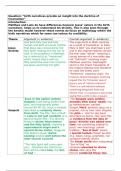
Question: “birth narratives provide an insight into the doctrine of
incarnation”
Introduction:
Matthew and Luke do have differences however Jesus’ nature in the birth
narratives helps us to understand his divinity. This is also seen through
the kenotic model however these events do focus on mythology within the
birth narratives which for some can reduce its credibility.
Theme Argument (+ evidence) Counter-argument (+ evidence)
God both fully God and fully The virgin birth in Mark could be
human and both accounts confirm as a result of translation. In Isiah,
Jesus that Jesus was conceived by the Mary is told “you shall bear a son”
divinity holy spirit making him the son of and in the original Hebrew version
God. In the prophecy in Matthew, the text uses “almah” meaning a
he is referred to as “Immanuel” young woman of a marriable age
which means God is with us. not “bethulah” meaning virgin.
Why would the wise men travel to Matthew used the ‘Septuagint’
see Jesus and bring him gifts. which is the Greek translation of
the original Hebrew text therefore
he used the Greek word
“Parthenos” meaning virgin. The
Unitarian liberal theologian Channing
argued that the Trinitarian view of
Jesus is one of “infinite confusion”.
There is a contradiction between
something being both finite and
infinite. Hick = to say Jesus is God is like
saying that a circle is also a square.
Even in the earlier written The Gospels were written
Gospels (Luke being earlier than decades after Jesus' death, not
John, and traditionally dated by eyewitnesses. earliest
around 80–90 CE), Jesus is already Gospel, Mark, presents Jesus as a
Gospels described as uniquely divine prophet, not as God. later Gospels,
from birth. The title “Son of God” like John = start to see Jesus
in Luke is not just symbolic or a described as divine. Hick sees this
general Jewish title—it is directly as evidence that the idea of
linked to divine intervention Jesus’ divinity was added over
and the Holy Spirit, implying a time, not something original to
supernatural origin and a Jesus’ own teachings. Jewish
special divine status. Suggests tradition, “Son of God” meant
that belief in Jesus’ divine a special human chosen by God
sonship existed well before the (e.g. Adam, kings, prophets), not
later Church councils someone literally divine.
The Greek world later interpreted
“The Holy Spirit will come upon “Son of God” as
you… therefore the child to be someone elevated to divine
born will be called holy, the Son status. Hick says the
of God.” Church combined these two
, meanings during the Council of
Chalcedon (451 CE), leading to
the doctrine that Jesus is
both fully God and fully man.
Kenotic in biblical text = answers N.T. Wright said that it was
questions regarding the nature of “completely untrue of what Paul
Kenotic God’s incarnation. had in mind”
model Philippians = God both fully God Paul = Jesus stopped being divine
and fully human – “emptied when he came to earth and
himself…taking the form of a became human.
slave” His point was that Jesus was equal
Keno = to empty – the idea that to God before becoming human
Jesus emptied himself of his and he said the decision was not
divinity therefore we can to stop becoming divine but rather
understand that Jesus took human it was what it actually meant to be
form on earth. divine.
Luke = Mary’s response has The pre existent son did not think
themes of humility and obedience he was exempt from suffering and
which is central to the kenotic pain and according to Pope Pius XII
model “Here, I am the servant of kenotic model was not the
the lord”. lessening of God.
Kenotic model = Jesus was never The model was criticized by the
diving, no mention of God’s orthodox church for undermining
divinity in Matthew, this comes in the perfection and immutability of
John the latest gospel according to God.
John Hick.
Conclusion:
Specialist Terminology:
Synoptic Links:
,Question: “redaction criticism is essential to understanding the birth
narratives”
Introduction:
Redaction criticism = authors of the bible writing based on context at the
time
Matthew = Jewish audience trying to prove Davidic descent of Jesus
Luke = Greek and gentile audience trying to focus on the marginalized and
the oppressed.
Helps us to understand the audience and motives behind the birth
narratives.
Theme Argument (+ evidence) Counter-argument (+ evidence)
Clear differences between We do not have any evidence of
Evidence chronology, events and this pre-existing material therefore
perspectives in Matthew and Luke. this theory requires more
Redaction criticism explains this evidence.
because it claims that the authors Redaction critics would say that
were working with pre-existing the birth narratives provide
material and editing and enough evidence. Both gospel
emphasizing some points. writers heavily use Hebrew Scripture to
S.L. Quelle frame Jesus’ birth. These are often
called “fulfilment quotations.” Therefore
could be that the writers shaped their
accounts to fit the prophetic expectation
e.g. both having Jesus born in Bethlehem
but in different ways.
Redaction criticism focuses on the
One main Yes there are differences but theological perspectives therefore
story overall the key message of the the readers attention is shifted
narratives is the same. from the ‘one story’ to the many
The desire of God to save differences.
humanity and therefore the focus If we focus on the differences then
of the story is the birth of God. it does weaken the power of the
The similarities are the most narratives.
important part of the narratives
because it is likely that differences
will occur due to different authors.
Christians = the bible is a
The authors are human and it revelation of God including the
Human gives us an indication of how the birth narratives therefore the
book story has been told. human authorship has little
e.g. Matthew making references to significance in comparison to god
Hebrew scriptures implies that he as the author.
is writing to a Jewish audience So why are there differences then?
, whilst Luke focuses on the S.L. biblical inspiration
universal relevance of Jesus birth
by focusing on the marginalized.
Conclusion:
Specialist Terminology:
Synoptic Links:
Question: “the resurrection has historical reliability”
Introduction:
Theme Argument (+ evidence) Counter-argument (+ evidence)
Supernatural ‘historical’ facts are Bultmann says that we need to
not needed and we need faith so demythologize (“committing at
that we can be free to love and worship”) the resurrection story
Mytholog live in hope. and understand the meaning
y Sanders influenced by Bultmann to behind it which is that God was
put a stop to real history done by victorious over death.
theologians. The bible is full of myths and can
Wright = we can learn about the reduce credibility.
historical events through the The deep truths that come from
gospels. demythologization need to be
There is a danger of having a interpreted which causes a
sense of Jesus uprooted in history subjectivity issue. The theological
because it fits the politics and methods that developed ‘objective
history of the time e.g. Nazis and methods’ advanced theological,
Jesus’ non Jewishness. political agendas.
Chiasm John 20 = more of concern The events described differently
for theology than for historical in Matthew, mark and Luke. E.g.
objectivity. john = only Mary Magdalene goes
The to the tomb but in the other
gospels Craig = inconsistencies are not at accounts there are other women
the heart. present.
The failure to recognize due to John = resurrection appearance in
incarnation”
Introduction:
Matthew and Luke do have differences however Jesus’ nature in the birth
narratives helps us to understand his divinity. This is also seen through
the kenotic model however these events do focus on mythology within the
birth narratives which for some can reduce its credibility.
Theme Argument (+ evidence) Counter-argument (+ evidence)
God both fully God and fully The virgin birth in Mark could be
human and both accounts confirm as a result of translation. In Isiah,
Jesus that Jesus was conceived by the Mary is told “you shall bear a son”
divinity holy spirit making him the son of and in the original Hebrew version
God. In the prophecy in Matthew, the text uses “almah” meaning a
he is referred to as “Immanuel” young woman of a marriable age
which means God is with us. not “bethulah” meaning virgin.
Why would the wise men travel to Matthew used the ‘Septuagint’
see Jesus and bring him gifts. which is the Greek translation of
the original Hebrew text therefore
he used the Greek word
“Parthenos” meaning virgin. The
Unitarian liberal theologian Channing
argued that the Trinitarian view of
Jesus is one of “infinite confusion”.
There is a contradiction between
something being both finite and
infinite. Hick = to say Jesus is God is like
saying that a circle is also a square.
Even in the earlier written The Gospels were written
Gospels (Luke being earlier than decades after Jesus' death, not
John, and traditionally dated by eyewitnesses. earliest
around 80–90 CE), Jesus is already Gospel, Mark, presents Jesus as a
Gospels described as uniquely divine prophet, not as God. later Gospels,
from birth. The title “Son of God” like John = start to see Jesus
in Luke is not just symbolic or a described as divine. Hick sees this
general Jewish title—it is directly as evidence that the idea of
linked to divine intervention Jesus’ divinity was added over
and the Holy Spirit, implying a time, not something original to
supernatural origin and a Jesus’ own teachings. Jewish
special divine status. Suggests tradition, “Son of God” meant
that belief in Jesus’ divine a special human chosen by God
sonship existed well before the (e.g. Adam, kings, prophets), not
later Church councils someone literally divine.
The Greek world later interpreted
“The Holy Spirit will come upon “Son of God” as
you… therefore the child to be someone elevated to divine
born will be called holy, the Son status. Hick says the
of God.” Church combined these two
, meanings during the Council of
Chalcedon (451 CE), leading to
the doctrine that Jesus is
both fully God and fully man.
Kenotic in biblical text = answers N.T. Wright said that it was
questions regarding the nature of “completely untrue of what Paul
Kenotic God’s incarnation. had in mind”
model Philippians = God both fully God Paul = Jesus stopped being divine
and fully human – “emptied when he came to earth and
himself…taking the form of a became human.
slave” His point was that Jesus was equal
Keno = to empty – the idea that to God before becoming human
Jesus emptied himself of his and he said the decision was not
divinity therefore we can to stop becoming divine but rather
understand that Jesus took human it was what it actually meant to be
form on earth. divine.
Luke = Mary’s response has The pre existent son did not think
themes of humility and obedience he was exempt from suffering and
which is central to the kenotic pain and according to Pope Pius XII
model “Here, I am the servant of kenotic model was not the
the lord”. lessening of God.
Kenotic model = Jesus was never The model was criticized by the
diving, no mention of God’s orthodox church for undermining
divinity in Matthew, this comes in the perfection and immutability of
John the latest gospel according to God.
John Hick.
Conclusion:
Specialist Terminology:
Synoptic Links:
,Question: “redaction criticism is essential to understanding the birth
narratives”
Introduction:
Redaction criticism = authors of the bible writing based on context at the
time
Matthew = Jewish audience trying to prove Davidic descent of Jesus
Luke = Greek and gentile audience trying to focus on the marginalized and
the oppressed.
Helps us to understand the audience and motives behind the birth
narratives.
Theme Argument (+ evidence) Counter-argument (+ evidence)
Clear differences between We do not have any evidence of
Evidence chronology, events and this pre-existing material therefore
perspectives in Matthew and Luke. this theory requires more
Redaction criticism explains this evidence.
because it claims that the authors Redaction critics would say that
were working with pre-existing the birth narratives provide
material and editing and enough evidence. Both gospel
emphasizing some points. writers heavily use Hebrew Scripture to
S.L. Quelle frame Jesus’ birth. These are often
called “fulfilment quotations.” Therefore
could be that the writers shaped their
accounts to fit the prophetic expectation
e.g. both having Jesus born in Bethlehem
but in different ways.
Redaction criticism focuses on the
One main Yes there are differences but theological perspectives therefore
story overall the key message of the the readers attention is shifted
narratives is the same. from the ‘one story’ to the many
The desire of God to save differences.
humanity and therefore the focus If we focus on the differences then
of the story is the birth of God. it does weaken the power of the
The similarities are the most narratives.
important part of the narratives
because it is likely that differences
will occur due to different authors.
Christians = the bible is a
The authors are human and it revelation of God including the
Human gives us an indication of how the birth narratives therefore the
book story has been told. human authorship has little
e.g. Matthew making references to significance in comparison to god
Hebrew scriptures implies that he as the author.
is writing to a Jewish audience So why are there differences then?
, whilst Luke focuses on the S.L. biblical inspiration
universal relevance of Jesus birth
by focusing on the marginalized.
Conclusion:
Specialist Terminology:
Synoptic Links:
Question: “the resurrection has historical reliability”
Introduction:
Theme Argument (+ evidence) Counter-argument (+ evidence)
Supernatural ‘historical’ facts are Bultmann says that we need to
not needed and we need faith so demythologize (“committing at
that we can be free to love and worship”) the resurrection story
Mytholog live in hope. and understand the meaning
y Sanders influenced by Bultmann to behind it which is that God was
put a stop to real history done by victorious over death.
theologians. The bible is full of myths and can
Wright = we can learn about the reduce credibility.
historical events through the The deep truths that come from
gospels. demythologization need to be
There is a danger of having a interpreted which causes a
sense of Jesus uprooted in history subjectivity issue. The theological
because it fits the politics and methods that developed ‘objective
history of the time e.g. Nazis and methods’ advanced theological,
Jesus’ non Jewishness. political agendas.
Chiasm John 20 = more of concern The events described differently
for theology than for historical in Matthew, mark and Luke. E.g.
objectivity. john = only Mary Magdalene goes
The to the tomb but in the other
gospels Craig = inconsistencies are not at accounts there are other women
the heart. present.
The failure to recognize due to John = resurrection appearance in