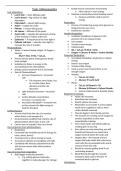
Topic 7: Ecology Trophic Levels
Ecosystems Order of energy levels as you go up the food
Ecosystem: Interaction of a community of living chain
organisms (biotic) with non-living organisms Level 1 – Producers (plants & algae that transfer
(Abiotic) parts of their environment about 1% of incident energy from light from
Community: All individuals of different species photosynthesis)
living in the same place at the same time Level 2 – Primary consumers
Population: Group of organisms of the same Level 3 – Secondary consumers
species living in a habitat at the same time Level 4 – Tertiary consumers
Individual: One member of a particular species Apex predator – carnivore with no predators
Habitat: Environment in which an organism lives
Abiotic & Biotic Factors
Abiotic factors – effect the survival of organisms
o Light intensity
o Temperature
o Moisture Levels
o Soil pH and Mineral Content Levels of Organisation & Food Chains & Biomass
o Wind Intensity and Direction – strong winds = Feeding relationships within a community can be
lose water represented by food chains
o Carbon Dioxide Levels for Plants Photosynthetic organisms are the producers of
o Oxygen Levels for Aquatic Animals biomass for life on Earth
Biotic Factors All food chains begin with a producer which
o Availability of food synthesises molecules - usually a green plant or
o New predators arriving alga which makes glucose by photosynthesis
o New pathogens Producers are eaten by primary consumers, which
o One species outcompeting another so the in turn may be eaten by secondary consumers and
then tertiary consumers
numbers are no longer sufficient to breed
Consumers that kill and eat other animals are
predators, and those eaten are prey. In a stable
Competition
community the numbers of predators and prey
To survive and reproduce, organisms require a
rise and fall in cycles
supply of materials from their surroundings and
from the other living organisms there
To determine the distribution and abundance of
Plants in a community/habitat often compete for
species in an ecosystem - experimental methods
• Light
using transects and quadrats are used by
• Space
ecologists
• Water
Biomass – kill animals & weigh them (dry)
• Mineral ions from the soil
Dry biomass is better than wet as animals have
Animals compete with each other for
different levels of moistures
• Food / Water
• Mates
• Territory
Interdependence
If 1 species is removed or becomes very numerous
– it can affect the whole community
In a community each species depends on other
species for
o Food
o Shelter (e.g. a tree sheltering an animal)
o Pollination (e.g. for plant reproduction)
o Seed dispersal
Stable community - all the species and
environmental factors are in balance so that
population sizes remain fairly constant
, Increase in predators = decline in prey
population
Prey decrease = Predator decrease as less food
Fewer predators = prey increase
In a stable population
Adaptations
A feature that helps an animal/plant to survive in
the environment
The better adapted to its environment an
organism is, the better its chance of survival
Structural adaptations (physical features)
o Shape
o Colour
o Broad leaves
o Thorns/ Stinging hairs on plant stems
Behavioural adaptions
o Flapping ears to keep cool
Loss of energy o Hunting at night
Only approx. 10% of biomass from each trophic o Migrating in summer or winter
level is transferred to the level above it o Using tools to obtain food
Biomass is lost due to: o Basking in the sun/Sitting in the shade
o Not all ingested material is absorbed – some is Functional adaptations (processes inside an
egested as faeces organism)
o Some absorbed material lost as waste – CO2 o Reproduction mechanism
and water in respiration + water and urea in o Metabolism
urine o Hibernation
o Large amounts of glucose are used in o E.g. little sweat, & concentrated urine in
respiration hot environments to minimise water loss
Camel adaptations
Predator-Prey Relationships o Hump stores fats which can be broken
Autotroph = Producer down
Heterotroph = Consumer o Fat is a thermal insulator – in one place
Prey increase = Predator increase as more reduces heat loss of other parts of the
food, more resources, less competition, can live body & reduces water loss by sweating
longer to survive & reproduce o Leathery lips protect if eating cacti for
Prey decrease = Predator decrease as not water
enough food for them to live o Thick eyelashes keep sand out of their
Prey tends to always be higher than the predator eyes
Competition o Can close their nostrils keeps sand out
o Interspecific Competition – competition of their eyes
between different species e.g. for food o Yellow colour camouflage in the sand
o Intraspecific Competition – competition o Splayed feed walk on sand
between members of the same species e.g. for o Conc urine & dried faeces reduce
finding a mate water loss
Polar bear adaptations
Rise o Thick layer of fur to keep warm
in prey o Paws have a wide surface area to walk on
= Rise snow
in o Camouflaged in snow to attack seals
o Small ears – less surface area to lose heat
by
Cacti adaptations
o Small leaves/no leaves prevent water
predator loss
o Spines protect from animals
Ecosystems Order of energy levels as you go up the food
Ecosystem: Interaction of a community of living chain
organisms (biotic) with non-living organisms Level 1 – Producers (plants & algae that transfer
(Abiotic) parts of their environment about 1% of incident energy from light from
Community: All individuals of different species photosynthesis)
living in the same place at the same time Level 2 – Primary consumers
Population: Group of organisms of the same Level 3 – Secondary consumers
species living in a habitat at the same time Level 4 – Tertiary consumers
Individual: One member of a particular species Apex predator – carnivore with no predators
Habitat: Environment in which an organism lives
Abiotic & Biotic Factors
Abiotic factors – effect the survival of organisms
o Light intensity
o Temperature
o Moisture Levels
o Soil pH and Mineral Content Levels of Organisation & Food Chains & Biomass
o Wind Intensity and Direction – strong winds = Feeding relationships within a community can be
lose water represented by food chains
o Carbon Dioxide Levels for Plants Photosynthetic organisms are the producers of
o Oxygen Levels for Aquatic Animals biomass for life on Earth
Biotic Factors All food chains begin with a producer which
o Availability of food synthesises molecules - usually a green plant or
o New predators arriving alga which makes glucose by photosynthesis
o New pathogens Producers are eaten by primary consumers, which
o One species outcompeting another so the in turn may be eaten by secondary consumers and
then tertiary consumers
numbers are no longer sufficient to breed
Consumers that kill and eat other animals are
predators, and those eaten are prey. In a stable
Competition
community the numbers of predators and prey
To survive and reproduce, organisms require a
rise and fall in cycles
supply of materials from their surroundings and
from the other living organisms there
To determine the distribution and abundance of
Plants in a community/habitat often compete for
species in an ecosystem - experimental methods
• Light
using transects and quadrats are used by
• Space
ecologists
• Water
Biomass – kill animals & weigh them (dry)
• Mineral ions from the soil
Dry biomass is better than wet as animals have
Animals compete with each other for
different levels of moistures
• Food / Water
• Mates
• Territory
Interdependence
If 1 species is removed or becomes very numerous
– it can affect the whole community
In a community each species depends on other
species for
o Food
o Shelter (e.g. a tree sheltering an animal)
o Pollination (e.g. for plant reproduction)
o Seed dispersal
Stable community - all the species and
environmental factors are in balance so that
population sizes remain fairly constant
, Increase in predators = decline in prey
population
Prey decrease = Predator decrease as less food
Fewer predators = prey increase
In a stable population
Adaptations
A feature that helps an animal/plant to survive in
the environment
The better adapted to its environment an
organism is, the better its chance of survival
Structural adaptations (physical features)
o Shape
o Colour
o Broad leaves
o Thorns/ Stinging hairs on plant stems
Behavioural adaptions
o Flapping ears to keep cool
Loss of energy o Hunting at night
Only approx. 10% of biomass from each trophic o Migrating in summer or winter
level is transferred to the level above it o Using tools to obtain food
Biomass is lost due to: o Basking in the sun/Sitting in the shade
o Not all ingested material is absorbed – some is Functional adaptations (processes inside an
egested as faeces organism)
o Some absorbed material lost as waste – CO2 o Reproduction mechanism
and water in respiration + water and urea in o Metabolism
urine o Hibernation
o Large amounts of glucose are used in o E.g. little sweat, & concentrated urine in
respiration hot environments to minimise water loss
Camel adaptations
Predator-Prey Relationships o Hump stores fats which can be broken
Autotroph = Producer down
Heterotroph = Consumer o Fat is a thermal insulator – in one place
Prey increase = Predator increase as more reduces heat loss of other parts of the
food, more resources, less competition, can live body & reduces water loss by sweating
longer to survive & reproduce o Leathery lips protect if eating cacti for
Prey decrease = Predator decrease as not water
enough food for them to live o Thick eyelashes keep sand out of their
Prey tends to always be higher than the predator eyes
Competition o Can close their nostrils keeps sand out
o Interspecific Competition – competition of their eyes
between different species e.g. for food o Yellow colour camouflage in the sand
o Intraspecific Competition – competition o Splayed feed walk on sand
between members of the same species e.g. for o Conc urine & dried faeces reduce
finding a mate water loss
Polar bear adaptations
Rise o Thick layer of fur to keep warm
in prey o Paws have a wide surface area to walk on
= Rise snow
in o Camouflaged in snow to attack seals
o Small ears – less surface area to lose heat
by
Cacti adaptations
o Small leaves/no leaves prevent water
predator loss
o Spines protect from animals