NU 664 FNP Midterm Exam – Questions With
Expert Solutions
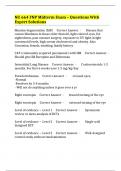
Macular degeneration (MD) Correct Answer - Disease that
causes blindness in those older than 60, light colored eyes, far-
sightedness, past cataract surgery, exposure to UV light, height
carotenoid levels, high serum cholesterol and obesity. Also
Caucasian, female, smoking, family history
CAP (community acquired pneumonia) with DM Correct Answer -
Should give IM Rocephin and Zithromax
Interstitial Lung Disease Correct Answer - Corticosteroids 1-2
months. For first 6 weeks uses 1-2 mg/kg/day
Pseudotrabismus Correct Answer - -crossed eyes,
-Normal
-Resolves by 3-4 months
- Will not do anything unless it goes over a yr
Right esotropia Correct Answer - inward turning of the eye
Right exotropia Correct Answer - outward turning of the eye
Level of evidence ~ Level 1 Correct Answer - Systematic
review or meta-analysis of RCTs
Level of evidence ~ Level 2 Correct Answer - Single well
designed RCT
Level of evidence ~ Level 3 Correct Answer - Well-designed
control study without randomization
,Level of evidence Level 4 Correct Answer - Well designed case-
control or cohort studies. Usually initiated after the disease starts.
Level of evidence ~ Level 5 Correct Answer - Systematic
review or descriptive and qualitative studies.
Level of evidence ~ Level 6 Correct Answer - Single
descriptive or qualitative study
Level of evidence ~ Level 7 Correct Answer - opinion of
respected authorities
Cranial nerve I Correct Answer - Olfactory (smell)
Cranial nerve II Correct Answer - Optic (visual acuity, gross
visual fields, fundoscopic exam)
Cranial nerve III Correct Answer - Oculomotor (pupillary
response, eye movement, upward and medial gaze)
Cranial nerve IV Correct Answer - Trochlear (eye movement
downward and medial gaze)
Cranial nerve V Correct Answer - Trigeminal (teeth clenching,
corneal reflex, respnsible for trigeminal neuralgia)
Cranial nerve VI Correct Answer - Abducens (lateral eye
movement)
Cranial nerve VII Correct Answer - Facial (frown, smile, puff
out cheeks, assess symmetry)
Cranial nerve VIII Correct Answer - Acoustic (Hearing and
balance) (vestibular)
, Cranial nerve IX Correct Answer - Glossopharyngeal (gag
reflex)
Cranial nerve X Correct Answer - Vagus - swallowing and
speaking, gag reflex
Cranial nerve XI Correct Answer - Spinal Accessory - controls
trapezius & sternocleidomastoid & controls swallowing movements,
shrug shoulder and turn head
Cranial nerve XII Correct Answer - Hypoglossal Articulation.
And tongue movement
Gross motor strength Correct Answer - Upper and lower
extremities, look for symmetry and strength
Cerebella Function Correct Answer - Romberg test,
coordination, reflexes
Subdural acute Correct Answer - Less than 72 hours
Subdural subacute Correct Answer - 3-20 days
Subdural chronic Correct Answer - > 20 days
Epidural hematoma Correct Answer - Bleeding from the
middle meninges arteries
Basilar skull fracture Correct Answer - Can cause leaking of
CSF
Pneumocephalus Correct Answer - Air entry into the CSF filled
space
Expert Solutions
Macular degeneration (MD) Correct Answer - Disease that
causes blindness in those older than 60, light colored eyes, far-
sightedness, past cataract surgery, exposure to UV light, height
carotenoid levels, high serum cholesterol and obesity. Also
Caucasian, female, smoking, family history
CAP (community acquired pneumonia) with DM Correct Answer -
Should give IM Rocephin and Zithromax
Interstitial Lung Disease Correct Answer - Corticosteroids 1-2
months. For first 6 weeks uses 1-2 mg/kg/day
Pseudotrabismus Correct Answer - -crossed eyes,
-Normal
-Resolves by 3-4 months
- Will not do anything unless it goes over a yr
Right esotropia Correct Answer - inward turning of the eye
Right exotropia Correct Answer - outward turning of the eye
Level of evidence ~ Level 1 Correct Answer - Systematic
review or meta-analysis of RCTs
Level of evidence ~ Level 2 Correct Answer - Single well
designed RCT
Level of evidence ~ Level 3 Correct Answer - Well-designed
control study without randomization
,Level of evidence Level 4 Correct Answer - Well designed case-
control or cohort studies. Usually initiated after the disease starts.
Level of evidence ~ Level 5 Correct Answer - Systematic
review or descriptive and qualitative studies.
Level of evidence ~ Level 6 Correct Answer - Single
descriptive or qualitative study
Level of evidence ~ Level 7 Correct Answer - opinion of
respected authorities
Cranial nerve I Correct Answer - Olfactory (smell)
Cranial nerve II Correct Answer - Optic (visual acuity, gross
visual fields, fundoscopic exam)
Cranial nerve III Correct Answer - Oculomotor (pupillary
response, eye movement, upward and medial gaze)
Cranial nerve IV Correct Answer - Trochlear (eye movement
downward and medial gaze)
Cranial nerve V Correct Answer - Trigeminal (teeth clenching,
corneal reflex, respnsible for trigeminal neuralgia)
Cranial nerve VI Correct Answer - Abducens (lateral eye
movement)
Cranial nerve VII Correct Answer - Facial (frown, smile, puff
out cheeks, assess symmetry)
Cranial nerve VIII Correct Answer - Acoustic (Hearing and
balance) (vestibular)
, Cranial nerve IX Correct Answer - Glossopharyngeal (gag
reflex)
Cranial nerve X Correct Answer - Vagus - swallowing and
speaking, gag reflex
Cranial nerve XI Correct Answer - Spinal Accessory - controls
trapezius & sternocleidomastoid & controls swallowing movements,
shrug shoulder and turn head
Cranial nerve XII Correct Answer - Hypoglossal Articulation.
And tongue movement
Gross motor strength Correct Answer - Upper and lower
extremities, look for symmetry and strength
Cerebella Function Correct Answer - Romberg test,
coordination, reflexes
Subdural acute Correct Answer - Less than 72 hours
Subdural subacute Correct Answer - 3-20 days
Subdural chronic Correct Answer - > 20 days
Epidural hematoma Correct Answer - Bleeding from the
middle meninges arteries
Basilar skull fracture Correct Answer - Can cause leaking of
CSF
Pneumocephalus Correct Answer - Air entry into the CSF filled
space