Summary Health Economics week 5
5.1 Non-communicable diseases (NCD’s)
= chronic lifestyle diseases: contribute to more than half to the global burden of disease
– #1 is Cardiovascular diseases
mortality due to CVD is highest in low- and middle income countries and higher for
woman
– Only a fraction of the global health spending goes to NCD’s (1,81%), although it accounts for
more than half of the global burden of disease and the trend is increasing!
Double burden: infectious diseases and NCD’s increases (mostly in low- and middle income
countries)
Four key NCD’s are: CVD, diabetes, cancer and chronic lung disease. (#5= depression)
What leads to this trend in NCD’s?
a. Aging population (leads to a higher
prevalence of NCD’s)
b. Rapid and unplanned urbanisation (more
slums, higher density of population, less
access to healthy and fresh food)
c. Globalisation, incl. irresponsible marketing
(KFC outlet in Nigeria)
d. Increase in sedentary lifestyle
a+b+c changes in lifestyle and behaviour, they are underlying drivers of NCD’s
5.2 The aging population
In recent decades the population of the developed world (and much of the developing world)
has been aging. There are two major trends with as result an aging population
1. Life expectancies have been increasing around the world and mortality rates have declined
2. Fertility rates have been falling around the world
Increased life expectancy
In pre-industrial times, low life expectancies were driven by sky-high child mortality rates. If you
survived to age 5 you would probably live a long life, but surviving to that age was difficult. Possible
explanations:
– Better sanitation: innovations like clean drinking water, and indoor plumbing
– Improved nutrition: improved standards of living (agricultural productivity) before 1800s,
many deaths were attributable to periodic famines
– Medical advances: antibiotics, obstetrics
Declined fertility rates
In order for a population to maintain its size from generation to generation, each woman must give
birth to about 2.1 children during her lifetime = population replacement fertility rate
In the last few decades, however, the total fertility rate in the developed world has fallen below that
level. Possible explanations:
– Availability of contraception
– Increased women’s labour force participation
, – Declining infant mortality (less need for “extras”)
– Decreased need for children as breadwinners or caretakers (old-age income security
hypothesis)
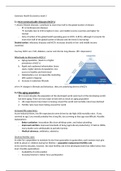
Demographic Transition
1. Malthus 2. Population explosion 3. reduced fertility 4. aging population
(reduced mortality):
Standards of living improved (agricultural productivity)
Public health policies (sanitation)
Advances in medicine
Malthus was famous because of his knowledge about the dangers of population growth: "The power
of population is indefinitely greater than the power in the earth to produce subsistence for man”
Sustainability of health care systems
Many current health care systems are pyramid schemes: Debts of the current generation are borne
by the larger generation that follows, whose even greater debts are in turn borne by the even larger
generation after that.
This sort of health system financing can succeed in a 1950- style world, with high birthrates and
ever-expanding populations, but not when populations are shrinking. * US Medicare, Japan Long-
Term Care
In the following decades, governments around the world will need to make difficult decisions about
how to reform their health care systems. Governments require accurate estimates of future health
expenditures. For this, they need projections of:
– Trends in aging
– Trends in overall health:
– Future medical technology
– Competing risk problem= In a sense, cancer and other diseases compete with each
other to be the cause of mortality. Since death is inevitable, reducing e.g. cancer
mortality increases the sum of the mortality risks from all the other causes
combined.
Given competing risks, health care expenditures might even rise as a consequence of
new lifesaving treatments, even if the treatments themselves are costless.
5.1 Non-communicable diseases (NCD’s)
= chronic lifestyle diseases: contribute to more than half to the global burden of disease
– #1 is Cardiovascular diseases
mortality due to CVD is highest in low- and middle income countries and higher for
woman
– Only a fraction of the global health spending goes to NCD’s (1,81%), although it accounts for
more than half of the global burden of disease and the trend is increasing!
Double burden: infectious diseases and NCD’s increases (mostly in low- and middle income
countries)
Four key NCD’s are: CVD, diabetes, cancer and chronic lung disease. (#5= depression)
What leads to this trend in NCD’s?
a. Aging population (leads to a higher
prevalence of NCD’s)
b. Rapid and unplanned urbanisation (more
slums, higher density of population, less
access to healthy and fresh food)
c. Globalisation, incl. irresponsible marketing
(KFC outlet in Nigeria)
d. Increase in sedentary lifestyle
a+b+c changes in lifestyle and behaviour, they are underlying drivers of NCD’s
5.2 The aging population
In recent decades the population of the developed world (and much of the developing world)
has been aging. There are two major trends with as result an aging population
1. Life expectancies have been increasing around the world and mortality rates have declined
2. Fertility rates have been falling around the world
Increased life expectancy
In pre-industrial times, low life expectancies were driven by sky-high child mortality rates. If you
survived to age 5 you would probably live a long life, but surviving to that age was difficult. Possible
explanations:
– Better sanitation: innovations like clean drinking water, and indoor plumbing
– Improved nutrition: improved standards of living (agricultural productivity) before 1800s,
many deaths were attributable to periodic famines
– Medical advances: antibiotics, obstetrics
Declined fertility rates
In order for a population to maintain its size from generation to generation, each woman must give
birth to about 2.1 children during her lifetime = population replacement fertility rate
In the last few decades, however, the total fertility rate in the developed world has fallen below that
level. Possible explanations:
– Availability of contraception
– Increased women’s labour force participation
, – Declining infant mortality (less need for “extras”)
– Decreased need for children as breadwinners or caretakers (old-age income security
hypothesis)
Demographic Transition
1. Malthus 2. Population explosion 3. reduced fertility 4. aging population
(reduced mortality):
Standards of living improved (agricultural productivity)
Public health policies (sanitation)
Advances in medicine
Malthus was famous because of his knowledge about the dangers of population growth: "The power
of population is indefinitely greater than the power in the earth to produce subsistence for man”
Sustainability of health care systems
Many current health care systems are pyramid schemes: Debts of the current generation are borne
by the larger generation that follows, whose even greater debts are in turn borne by the even larger
generation after that.
This sort of health system financing can succeed in a 1950- style world, with high birthrates and
ever-expanding populations, but not when populations are shrinking. * US Medicare, Japan Long-
Term Care
In the following decades, governments around the world will need to make difficult decisions about
how to reform their health care systems. Governments require accurate estimates of future health
expenditures. For this, they need projections of:
– Trends in aging
– Trends in overall health:
– Future medical technology
– Competing risk problem= In a sense, cancer and other diseases compete with each
other to be the cause of mortality. Since death is inevitable, reducing e.g. cancer
mortality increases the sum of the mortality risks from all the other causes
combined.
Given competing risks, health care expenditures might even rise as a consequence of
new lifesaving treatments, even if the treatments themselves are costless.