KRM 310 Study unit 9
Erin Polyblank
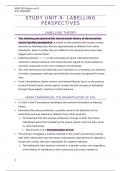
STUDY UNIT 9- LABELLING
PERSPECTIVES
LABELLING THEORY
The labelling perspective/the interactional theory of deviance/the
social reaction perspective: Is based on the premise that society creates
deviants by labeling those who are apprehended as different from other
individuals, when in reality they are different only because they have been
tagged with a deviant label.
Labeling theorists focus on the processes by which individuals become
involved in deviant behavior and stress the part played by social audiences
and their responses to the norm violations of individuals.
The view that formal and informal social reactions to criminality can influence
criminals' subsequent attitudes and behaviors has been recognized for some
time.
Frank Tannenbaum, Edwin Lemert, and Howard Becker focus on the process
by which formal social control agents change the self-concept of individuals
through these agents' reactions to their behavior.
FRANK TANNENBAUM: THE DRAMATISATION OF EVIL
In 1938, Frank Tannenbaum developed the earliest formulation of labeling
theory.
Examined the process whereby a juvenile came to the attention of the
authorities and was labeled as different from other juveniles.
o He theorized that this process produced a change in both how those
individuals were then handled by the justice system and how they came
to view themselves.
This process is the Dramatization of evil.
The process of tagging a juvenile resulted in the youth's becoming involved
with other delinquents and that these associations represented an attempt to
escape the society that was responsible for negative labeling.
o The delinquent then became involved in a deviant career, and regardless
of the efforts of individuals in the community and justice system to
1
Erin Polyblank
STUDY UNIT 9- LABELLING
PERSPECTIVES
LABELLING THEORY
The labelling perspective/the interactional theory of deviance/the
social reaction perspective: Is based on the premise that society creates
deviants by labeling those who are apprehended as different from other
individuals, when in reality they are different only because they have been
tagged with a deviant label.
Labeling theorists focus on the processes by which individuals become
involved in deviant behavior and stress the part played by social audiences
and their responses to the norm violations of individuals.
The view that formal and informal social reactions to criminality can influence
criminals' subsequent attitudes and behaviors has been recognized for some
time.
Frank Tannenbaum, Edwin Lemert, and Howard Becker focus on the process
by which formal social control agents change the self-concept of individuals
through these agents' reactions to their behavior.
FRANK TANNENBAUM: THE DRAMATISATION OF EVIL
In 1938, Frank Tannenbaum developed the earliest formulation of labeling
theory.
Examined the process whereby a juvenile came to the attention of the
authorities and was labeled as different from other juveniles.
o He theorized that this process produced a change in both how those
individuals were then handled by the justice system and how they came
to view themselves.
This process is the Dramatization of evil.
The process of tagging a juvenile resulted in the youth's becoming involved
with other delinquents and that these associations represented an attempt to
escape the society that was responsible for negative labeling.
o The delinquent then became involved in a deviant career, and regardless
of the efforts of individuals in the community and justice system to
1