

WGU D459 Task 3 Complete Study Solutions 2025 Updates
WGU's Four-Step Tool (based on "Six Steps to Thinking Systemically" by Michael Goodman and
Richard Karash)
The Iceberg Tool is a way to see how the structure (that is, the background of the case) ties together the individual
events and the patterns and trends that emerge from recurring events. Using the Iceberg Tool allows you to see the
basic facts and interconnections, an important first step.
STEP 1: Complete an Iceberg Tool for this case study.
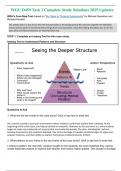
Iceberg Tool to Understand Patterns and Structure
Questions to Ask
1. What are the key events in this case study? Click or tap here to enter text.
Ms. Jackson created a classroom environment where children could freely explore their creativity. At the
beginning of the school year, she had purchased art materials. However, as the year went on, some students
began to make more elaborate art projects that used materials quickly. The class, including Ms. Jackson,
became frustrated as the materials depleted. Due to the shortage of supplies, students began to argue over
popular materials, and their ability to express themselves creatively became limited.
2. What patterns do you notice in the key events of this case study? Click or tap here to enter text.
I noticed a pattern: the more Ms. Jackson bought for her students, the more materials they used to
create elaborate projects to impress their teacher and receive higher grades. This caused a shortage
WGU's Four-Step Tool (based on "Six Steps to Thinking Systemically" by Michael Goodman and
Richard Karash)
The Iceberg Tool is a way to see how the structure (that is, the background of the case) ties together the individual
events and the patterns and trends that emerge from recurring events. Using the Iceberg Tool allows you to see the
basic facts and interconnections, an important first step.
STEP 1: Complete an Iceberg Tool for this case study.
Iceberg Tool to Understand Patterns and Structure
Questions to Ask
1. What are the key events in this case study? Click or tap here to enter text.
Ms. Jackson created a classroom environment where children could freely explore their creativity. At the
beginning of the school year, she had purchased art materials. However, as the year went on, some students
began to make more elaborate art projects that used materials quickly. The class, including Ms. Jackson,
became frustrated as the materials depleted. Due to the shortage of supplies, students began to argue over
popular materials, and their ability to express themselves creatively became limited.
2. What patterns do you notice in the key events of this case study? Click or tap here to enter text.
I noticed a pattern: the more Ms. Jackson bought for her students, the more materials they used to
create elaborate projects to impress their teacher and receive higher grades. This caused a shortage


