LSP1501Assignment 7 2025
Unique Number:
Due date: 30 July 2025
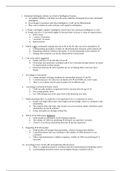
QUESTION 1
Definition of Perceptual Motor
Perceptual motor refers to a child’s ability to receive, process (interpret), and respond
effectively to sensory information through movement. It involves coordinating the brain and
body to perform tasks efficiently, supporting the child’s spatial and temporal understanding
of their environment.
Perceptual Ability 1: Body Awareness
Body awareness is the understanding of where the body is in space and how its parts
move in relation to each other.
Link to Learning and Movement Programme
Body awareness is essential for controlling movements and understanding how to use the
body effectively during classroom activities such as sitting upright, writing, and participating
in group tasks. In movement programmes, it helps learners refine posture and motor control,
DISCLAIMER & TERMS OF USE
Educational Aid: These study notes are intended to be used as educational resources and should not be seen as a
replacement for individual research, critical analysis, or professional consultation. Students are encouraged to perform
their own research and seek advice from their instructors or academic advisors for specific assignment guidelines.
Personal Responsibility: While every effort has been made to ensure the accuracy and reliability of the information in
these study notes, the seller does not guarantee the completeness or correctness of all content. The buyer is
responsible for verifying the accuracy of the information and exercising their own judgment when applying it to their
assignments.
Academic Integrity: It is essential for students to maintain academic integrity and follow their institution's policies
regarding plagiarism, citation, and referencing. These study notes should be used as learning tools and sources of
inspiration. Any direct reproduction of the content without proper citation and acknowledgment may be considered
academic misconduct.
Limited Liability: The seller shall not be liable for any direct or indirect damages, losses, or consequences arising from
the use of these notes. This includes, but is not limited to, poor academic performance, penalties, or any other negative
consequences resulting from the application or misuse of the information provided.
, For additional support +27 81 278 3372
QUESTION 1
Definition of Perceptual Motor
Perceptual motor refers to a child’s ability to receive, process (interpret), and
respond effectively to sensory information through movement. It involves
coordinating the brain and body to perform tasks efficiently, supporting the child’s
spatial and temporal understanding of their environment.
Perceptual Ability 1: Body Awareness
Body awareness is the understanding of where the body is in space and how its
parts move in relation to each other.
Link to Learning and Movement Programme
Body awareness is essential for controlling movements and understanding how to
use the body effectively during classroom activities such as sitting upright, writing,
and participating in group tasks. In movement programmes, it helps learners refine
posture and motor control, which are foundational for fine motor skills like
handwriting and drawing.
Perceptual Ability 2: Eye-Hand Coordination
Eye-hand coordination refers to the ability to coordinate visual input with hand
movement to carry out tasks.
Link to Learning and Movement Programme
Eye-hand coordination is critical for fine motor activities such as copying from the
board, cutting with scissors, and writing. Movement programmes that include
catching, throwing, or tracing activities help children build this ability, directly
supporting tasks in literacy and writing.
Perceptual Ability 3: Spatial Awareness
, For additional support +27 81 278 3372
Spatial awareness is the ability to understand the position of one’s body in space
and in relation to other objects and people.
Link to Learning and Movement Programme
Spatial awareness enables children to navigate classrooms, understand maps in
geography, and use correct spacing between words when writing. Movement
activities such as obstacle courses, jumping from one place to another, and
directional games help reinforce spatial understanding needed for reading and
maths.
Perceptual Ability 4: Figure-Ground Perception
Figure-ground perception is the ability to focus on a specific object (figure) in a
complex background (ground).
Link to Learning and Movement Programme
This skill helps learners concentrate on specific visual tasks, like identifying letters on
a busy page or finding a word in a paragraph. In movement programmes, games that
require selecting items or focusing on objects among distractions (like a ball in a
group) help develop this ability, which enhances reading and visual attention in the
classroom.
QUESTION 2
The Need for Open-Ended Questions in a Multi-Station PE Lesson
Open-ended questions are important in a multi-station physical education (PE)
lesson because they allow learners to explore and solve movement challenges in
their own creative way. Instead of giving strict instructions, the teacher uses
questions to guide discovery, encourage thinking, and promote problem-solving. This
approach supports the development of perceptual abilities by helping learners
become more aware of their bodies, movements, and surroundings. Open-ended
questions also boost confidence, initiative, and participation because there is no
Unique Number:
Due date: 30 July 2025
QUESTION 1
Definition of Perceptual Motor
Perceptual motor refers to a child’s ability to receive, process (interpret), and respond
effectively to sensory information through movement. It involves coordinating the brain and
body to perform tasks efficiently, supporting the child’s spatial and temporal understanding
of their environment.
Perceptual Ability 1: Body Awareness
Body awareness is the understanding of where the body is in space and how its parts
move in relation to each other.
Link to Learning and Movement Programme
Body awareness is essential for controlling movements and understanding how to use the
body effectively during classroom activities such as sitting upright, writing, and participating
in group tasks. In movement programmes, it helps learners refine posture and motor control,
DISCLAIMER & TERMS OF USE
Educational Aid: These study notes are intended to be used as educational resources and should not be seen as a
replacement for individual research, critical analysis, or professional consultation. Students are encouraged to perform
their own research and seek advice from their instructors or academic advisors for specific assignment guidelines.
Personal Responsibility: While every effort has been made to ensure the accuracy and reliability of the information in
these study notes, the seller does not guarantee the completeness or correctness of all content. The buyer is
responsible for verifying the accuracy of the information and exercising their own judgment when applying it to their
assignments.
Academic Integrity: It is essential for students to maintain academic integrity and follow their institution's policies
regarding plagiarism, citation, and referencing. These study notes should be used as learning tools and sources of
inspiration. Any direct reproduction of the content without proper citation and acknowledgment may be considered
academic misconduct.
Limited Liability: The seller shall not be liable for any direct or indirect damages, losses, or consequences arising from
the use of these notes. This includes, but is not limited to, poor academic performance, penalties, or any other negative
consequences resulting from the application or misuse of the information provided.
, For additional support +27 81 278 3372
QUESTION 1
Definition of Perceptual Motor
Perceptual motor refers to a child’s ability to receive, process (interpret), and
respond effectively to sensory information through movement. It involves
coordinating the brain and body to perform tasks efficiently, supporting the child’s
spatial and temporal understanding of their environment.
Perceptual Ability 1: Body Awareness
Body awareness is the understanding of where the body is in space and how its
parts move in relation to each other.
Link to Learning and Movement Programme
Body awareness is essential for controlling movements and understanding how to
use the body effectively during classroom activities such as sitting upright, writing,
and participating in group tasks. In movement programmes, it helps learners refine
posture and motor control, which are foundational for fine motor skills like
handwriting and drawing.
Perceptual Ability 2: Eye-Hand Coordination
Eye-hand coordination refers to the ability to coordinate visual input with hand
movement to carry out tasks.
Link to Learning and Movement Programme
Eye-hand coordination is critical for fine motor activities such as copying from the
board, cutting with scissors, and writing. Movement programmes that include
catching, throwing, or tracing activities help children build this ability, directly
supporting tasks in literacy and writing.
Perceptual Ability 3: Spatial Awareness
, For additional support +27 81 278 3372
Spatial awareness is the ability to understand the position of one’s body in space
and in relation to other objects and people.
Link to Learning and Movement Programme
Spatial awareness enables children to navigate classrooms, understand maps in
geography, and use correct spacing between words when writing. Movement
activities such as obstacle courses, jumping from one place to another, and
directional games help reinforce spatial understanding needed for reading and
maths.
Perceptual Ability 4: Figure-Ground Perception
Figure-ground perception is the ability to focus on a specific object (figure) in a
complex background (ground).
Link to Learning and Movement Programme
This skill helps learners concentrate on specific visual tasks, like identifying letters on
a busy page or finding a word in a paragraph. In movement programmes, games that
require selecting items or focusing on objects among distractions (like a ball in a
group) help develop this ability, which enhances reading and visual attention in the
classroom.
QUESTION 2
The Need for Open-Ended Questions in a Multi-Station PE Lesson
Open-ended questions are important in a multi-station physical education (PE)
lesson because they allow learners to explore and solve movement challenges in
their own creative way. Instead of giving strict instructions, the teacher uses
questions to guide discovery, encourage thinking, and promote problem-solving. This
approach supports the development of perceptual abilities by helping learners
become more aware of their bodies, movements, and surroundings. Open-ended
questions also boost confidence, initiative, and participation because there is no