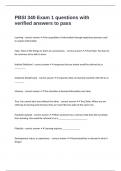
PBSI 340 Exam 1 questions with
verified answers to pass
Learning - correct answer ✔✔the acquisition of information through experience/process used
to acquire information
False. Most of the things we learn are unconscious. - correct answer ✔✔True/False: You have to
be conscious to be able to learn.
Nativist (Nativism) - correct answer ✔✔responses that are innate would be referred to as
_________
Empiricist (Empiricism) - correct answer ✔✔responses that are learned would be referred to as
________
Memory - correct answer ✔✔The retention of learned information over time
True. You cannot have one without the other. - correct answer ✔✔True/False: When you are
referring to learning and memory, they are much like two sides of the same coin.
Psychotic episode - correct answer ✔✔When someone has a memory that they did not obtain
from learning, this would be referred to as a _________ ______________.
Plasticity - correct answer ✔✔Learning requires ______________.
Development, injury, or experience. - correct answer ✔✔Neural plasticity is relevant in what 3
things?
,1. The behavioral modification depends on a form of neural plasticity.
2. The modification depends on the organism's experiential history.
3. (a) The modification outlasts the environmental contingencies used to induce it. (b) The
experience has a lasting effect on performance. - correct answer ✔✔What are the 3 common
criteria for learning?
A. Efficient - correct answer ✔✔What is the form of explanation that describes eliciting
conditions?
a. efficient
b. formal
c. material
d. final
B. Formal - correct answer ✔✔What is the form of explanation that provides a logical map or
model?
a. efficient
b. formal
c. material
d. final
C. Material - correct answer ✔✔What is the form of explanation that describes the underlying
substrate?
a. efficient
b. formal
c. material
d. final
, D. Final - correct answer ✔✔What is the form of explanation that explains why the system
works in this way?
a. efficient
b. formal
c. material
d. final
False. They are opposites of each other. - correct answer ✔✔True/False: Proximate cause and
ultimate cause are the same.
1. Cognitive
2. Behavioral
3. Biological
4. Ethological - correct answer ✔✔What are the 4 approaches to the study of learning?
Plato - correct answer ✔✔Who was the early philosopher that valued nativism meaning all
knowledge is innate?
Aristotle - correct answer ✔✔Who was the early philosopher that valued empiricism meaning
all knowledge is acquired?
Descartes (1588-1679) - correct answer ✔✔Who was the philosopher who studied dualism.
Unextended - correct answer ✔✔A(n) ___________ substance is non-physical, focuses on soul
and free will, and does not abide by scientific rules.
Extended - correct answer ✔✔A(n) ____________ substance is physical, focuses on the body,
and abides by scientific rules.
verified answers to pass
Learning - correct answer ✔✔the acquisition of information through experience/process used
to acquire information
False. Most of the things we learn are unconscious. - correct answer ✔✔True/False: You have to
be conscious to be able to learn.
Nativist (Nativism) - correct answer ✔✔responses that are innate would be referred to as
_________
Empiricist (Empiricism) - correct answer ✔✔responses that are learned would be referred to as
________
Memory - correct answer ✔✔The retention of learned information over time
True. You cannot have one without the other. - correct answer ✔✔True/False: When you are
referring to learning and memory, they are much like two sides of the same coin.
Psychotic episode - correct answer ✔✔When someone has a memory that they did not obtain
from learning, this would be referred to as a _________ ______________.
Plasticity - correct answer ✔✔Learning requires ______________.
Development, injury, or experience. - correct answer ✔✔Neural plasticity is relevant in what 3
things?
,1. The behavioral modification depends on a form of neural plasticity.
2. The modification depends on the organism's experiential history.
3. (a) The modification outlasts the environmental contingencies used to induce it. (b) The
experience has a lasting effect on performance. - correct answer ✔✔What are the 3 common
criteria for learning?
A. Efficient - correct answer ✔✔What is the form of explanation that describes eliciting
conditions?
a. efficient
b. formal
c. material
d. final
B. Formal - correct answer ✔✔What is the form of explanation that provides a logical map or
model?
a. efficient
b. formal
c. material
d. final
C. Material - correct answer ✔✔What is the form of explanation that describes the underlying
substrate?
a. efficient
b. formal
c. material
d. final
, D. Final - correct answer ✔✔What is the form of explanation that explains why the system
works in this way?
a. efficient
b. formal
c. material
d. final
False. They are opposites of each other. - correct answer ✔✔True/False: Proximate cause and
ultimate cause are the same.
1. Cognitive
2. Behavioral
3. Biological
4. Ethological - correct answer ✔✔What are the 4 approaches to the study of learning?
Plato - correct answer ✔✔Who was the early philosopher that valued nativism meaning all
knowledge is innate?
Aristotle - correct answer ✔✔Who was the early philosopher that valued empiricism meaning
all knowledge is acquired?
Descartes (1588-1679) - correct answer ✔✔Who was the philosopher who studied dualism.
Unextended - correct answer ✔✔A(n) ___________ substance is non-physical, focuses on soul
and free will, and does not abide by scientific rules.
Extended - correct answer ✔✔A(n) ____________ substance is physical, focuses on the body,
and abides by scientific rules.