

Anatomy and physiology – HUB1019F
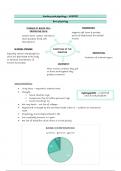
Bone physiology
STORAGE OF BLOOD CELL- FRAMEWORK:
PRODUCING CELLS:
Supports soft tissue & provides
Certain bones contain red marrow points of attachment for skeletal
which produces blood cells muscles
(hemopoiesis)
MINERAL STORAGE: FUNCTIONS OF THE
SKELETON PROTECTION:
Especially calcium and phosphorus
which are distributed to the body Protection of internal organs
on demand, maintenance of
mineral homeostasis MOVEMENT:
When muscles contract, they pull
on bones and together they
produce movement
BONE PROPERTIES:
• Living tissue – responds to external stress
• Strength Hydroxyapatite – crystallised
o Tensile (stretch): high calcium and phosphate
o Compression (top to bottom pressure): high
o Torsion (twisting): low
• Not very elastic – not lots of collagen
• Shaped and re-shaped by the cells that resides within it – conforms to mechanical
needs
• Morphology (size & shape) altered in life
• Can completely turnover in 3 years
• Has lots of blood flow which allows it to heal quickly
BONE COMPOSITION
MINERAL PROTEIN WATER
8%
22%
70%
, HISTOLOGY OF BONE:
Bone is not completely solid – it has lots of spaces which provide channels for blood vessels that
supply the bone with nutrients
The spaces also make the bone lighter
The size and location of bone determine whether it is cortical or trabecular bone
CORTICAL BONE – COMPACT TRABECULAR BONE – CANCELLOUS
• Few spaces – dense & solid • Large spaces filled with red marrow
• Concentric ring structure • Irregular latticework
• Provides protection & support • Lots of blood vessels
• Largely mechanical role • More metabolically active
The membrane that covers bone is called periosteum
The distribution of bone
throughout the skeleton
Vertebral column >75% trabecular
because it is more metabolically
active
Pelvis and femur 75% cortical
because it needs to be strong and
withstand force
CLASSIFICATION OF BONE:
Bone physiology
STORAGE OF BLOOD CELL- FRAMEWORK:
PRODUCING CELLS:
Supports soft tissue & provides
Certain bones contain red marrow points of attachment for skeletal
which produces blood cells muscles
(hemopoiesis)
MINERAL STORAGE: FUNCTIONS OF THE
SKELETON PROTECTION:
Especially calcium and phosphorus
which are distributed to the body Protection of internal organs
on demand, maintenance of
mineral homeostasis MOVEMENT:
When muscles contract, they pull
on bones and together they
produce movement
BONE PROPERTIES:
• Living tissue – responds to external stress
• Strength Hydroxyapatite – crystallised
o Tensile (stretch): high calcium and phosphate
o Compression (top to bottom pressure): high
o Torsion (twisting): low
• Not very elastic – not lots of collagen
• Shaped and re-shaped by the cells that resides within it – conforms to mechanical
needs
• Morphology (size & shape) altered in life
• Can completely turnover in 3 years
• Has lots of blood flow which allows it to heal quickly
BONE COMPOSITION
MINERAL PROTEIN WATER
8%
22%
70%
, HISTOLOGY OF BONE:
Bone is not completely solid – it has lots of spaces which provide channels for blood vessels that
supply the bone with nutrients
The spaces also make the bone lighter
The size and location of bone determine whether it is cortical or trabecular bone
CORTICAL BONE – COMPACT TRABECULAR BONE – CANCELLOUS
• Few spaces – dense & solid • Large spaces filled with red marrow
• Concentric ring structure • Irregular latticework
• Provides protection & support • Lots of blood vessels
• Largely mechanical role • More metabolically active
The membrane that covers bone is called periosteum
The distribution of bone
throughout the skeleton
Vertebral column >75% trabecular
because it is more metabolically
active
Pelvis and femur 75% cortical
because it needs to be strong and
withstand force
CLASSIFICATION OF BONE:


