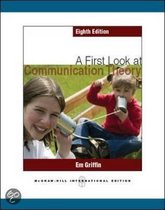
Chapter 1: Launching your study of communication theory
What is a theory?
Theory: set of systematic, informed hunches about the way things work
• Set of hunches
• Systematic hunches (specifies the relationship among the theorist’s ideas)
• Informed hunches (The theorist is familiar with alternative explanations for the topic of interest)
o Theories grow and mature over time!
Theories as:
• Nets: samengeweven informatie die allesomvattend is
• Lenses: manier van kijken naar de wereld met een specifieke focus (subjectief)
• Maps: van punt a naar b met ondersteunende theorieën
What is communication?
Communication: the relational process of creating and interpreting messages that elicit a response
• Relational process
• Creating messages
• Interpreting messages
• Messages
• Messages that elicit a response
Communication is the relational process of creating and interpreting messages that elicit a response
• It takes place between two or more persons
• It affects the nature of the connections among those people
Communication is the relational process of creating and interpreting messages that elicit a response
• A message is constructed, invented, planned, crafted, constituted, selected, or adopted by the
communicator
• Either conscious or unconscious. But they always have a meaning (lichaamstaal, woorden zoals
‘bedankt’ of ‘sorry’)
Communication is the relational process of creating and interpreting messages that elicit a response
• The receiver has to decode the message (uitwerken, uitzoeken, samenvoegen)
• Messages are polysemic, they’re open to multiple interpretations (emojis)
Communication is the relational process of creating and interpreting messages that elicit a response
• Messages (or texts) are central to communication scholars.
• A text is a record of a message that can be analyzed by others (boeken, films, een sms of een lied)
Communication is the relational process of creating and interpreting messages that elicit a response
• When communicating, it is all about the response (effecten van een reclame, huilen om een
romantische scene uit een film)
• If a message fails to stimulate any cognitive, emotional, or behavioral reaction, it seems pointless to
refer to it as communication.
, What is communication science?
• Communication: the relational process of creating and interpreting messages that elicit a response
• Theory: a set of systematic, informed hunches about the way things work
Compared to other disciplines, communication science is
• Object oriented
• Inter-disciplinary
Chapter 2: Talk about theory
Talk about theory
Different perspectives on theory:
• Objective theories
o The assumption that truth is singular and is accessible through unbiased sensory observation;
committed to uncovering cause-and-effect relationships.
▪ Behavioral scientist: A scholar who applies the scientific method to describe, predict,
and explain recurring forms of human behavior.
• Interpretive theories
o The linguistic work of assigning meaning or value to texts and assumes that multiple
meanings or truths are possible.
▪ Rhetorician: A scholar who studies the ways in which symbolic forms can be used to
identify with people, or to persuade them toward a certain point of view.
• Metatheory: Theory about theory; the stated or inherent assumptions made when creating a theory.
Commercial Budweiser
Objective
The commercial uses the resonance principle of communication:
• The message evokes past experiences, creating resonance between the message content and the
person’s thoughts or feelings: it’s not arguments but memories that are effective for persuasion.
• Elements in commercial → positive attitude towards product → increased likelihood viewer will buy
product
• And, this can also be tested:
o Does the commercial lead to a positive attitude?
o Does this positive attitude lead to increased likelihood of buying?
Interpretive
• The story follows an archetypal mythic pattern of “birth-death-rebirth”:
• Young colt in barn (birth)
• Taken care of by breeder (feeding, stroking coat, sleeping together)
• Maturing to grown horse
• Taken away by Budweiser truck (death)
• Years later they are reunited (rebirth)
o Interpreting what we see in the “text” (compare to reviewers of art, movies, books)
Objective vs. interpretive approach to communication
• Ways of knowing: discovering truth or creating multiple realities?
• Human nature: determinism or free will?
• The highest value: objectivity or emancipation?
• Purpose of theory: universal laws or interpretive guides?
1: Ways of knowing: discovering truth or creating multiple realities?
• Objective:
o Epistemology is the philosophy of how we obtain knowledge
▪ How do we know what we know, if we know it at all?
o There is one truth that only needs to be discovered
o Oorzaak – gevolg
o Example: the earth is round
What is a theory?
Theory: set of systematic, informed hunches about the way things work
• Set of hunches
• Systematic hunches (specifies the relationship among the theorist’s ideas)
• Informed hunches (The theorist is familiar with alternative explanations for the topic of interest)
o Theories grow and mature over time!
Theories as:
• Nets: samengeweven informatie die allesomvattend is
• Lenses: manier van kijken naar de wereld met een specifieke focus (subjectief)
• Maps: van punt a naar b met ondersteunende theorieën
What is communication?
Communication: the relational process of creating and interpreting messages that elicit a response
• Relational process
• Creating messages
• Interpreting messages
• Messages
• Messages that elicit a response
Communication is the relational process of creating and interpreting messages that elicit a response
• It takes place between two or more persons
• It affects the nature of the connections among those people
Communication is the relational process of creating and interpreting messages that elicit a response
• A message is constructed, invented, planned, crafted, constituted, selected, or adopted by the
communicator
• Either conscious or unconscious. But they always have a meaning (lichaamstaal, woorden zoals
‘bedankt’ of ‘sorry’)
Communication is the relational process of creating and interpreting messages that elicit a response
• The receiver has to decode the message (uitwerken, uitzoeken, samenvoegen)
• Messages are polysemic, they’re open to multiple interpretations (emojis)
Communication is the relational process of creating and interpreting messages that elicit a response
• Messages (or texts) are central to communication scholars.
• A text is a record of a message that can be analyzed by others (boeken, films, een sms of een lied)
Communication is the relational process of creating and interpreting messages that elicit a response
• When communicating, it is all about the response (effecten van een reclame, huilen om een
romantische scene uit een film)
• If a message fails to stimulate any cognitive, emotional, or behavioral reaction, it seems pointless to
refer to it as communication.
, What is communication science?
• Communication: the relational process of creating and interpreting messages that elicit a response
• Theory: a set of systematic, informed hunches about the way things work
Compared to other disciplines, communication science is
• Object oriented
• Inter-disciplinary
Chapter 2: Talk about theory
Talk about theory
Different perspectives on theory:
• Objective theories
o The assumption that truth is singular and is accessible through unbiased sensory observation;
committed to uncovering cause-and-effect relationships.
▪ Behavioral scientist: A scholar who applies the scientific method to describe, predict,
and explain recurring forms of human behavior.
• Interpretive theories
o The linguistic work of assigning meaning or value to texts and assumes that multiple
meanings or truths are possible.
▪ Rhetorician: A scholar who studies the ways in which symbolic forms can be used to
identify with people, or to persuade them toward a certain point of view.
• Metatheory: Theory about theory; the stated or inherent assumptions made when creating a theory.
Commercial Budweiser
Objective
The commercial uses the resonance principle of communication:
• The message evokes past experiences, creating resonance between the message content and the
person’s thoughts or feelings: it’s not arguments but memories that are effective for persuasion.
• Elements in commercial → positive attitude towards product → increased likelihood viewer will buy
product
• And, this can also be tested:
o Does the commercial lead to a positive attitude?
o Does this positive attitude lead to increased likelihood of buying?
Interpretive
• The story follows an archetypal mythic pattern of “birth-death-rebirth”:
• Young colt in barn (birth)
• Taken care of by breeder (feeding, stroking coat, sleeping together)
• Maturing to grown horse
• Taken away by Budweiser truck (death)
• Years later they are reunited (rebirth)
o Interpreting what we see in the “text” (compare to reviewers of art, movies, books)
Objective vs. interpretive approach to communication
• Ways of knowing: discovering truth or creating multiple realities?
• Human nature: determinism or free will?
• The highest value: objectivity or emancipation?
• Purpose of theory: universal laws or interpretive guides?
1: Ways of knowing: discovering truth or creating multiple realities?
• Objective:
o Epistemology is the philosophy of how we obtain knowledge
▪ How do we know what we know, if we know it at all?
o There is one truth that only needs to be discovered
o Oorzaak – gevolg
o Example: the earth is round