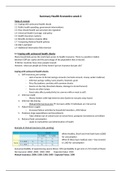
Summary Health Economics week 2
Table of content
1.1 Coping with uninsured health shocks
1.2 Public health spending: government interventions
1.3 How should health care provision be regulated
1.4 Universal Health Coverage and policy
1.5 Health insurance systems
1.6 Benefits Incidence Analysis (BIA)
1.7 Comparing National health policies
1.8 DALY and QALY
1.9 Additional information Risk Aversion
1.1 Coping with uninsured health shocks
Many households across the world lack access to health insurance. There is a positive relation
between GDP per capita and the percentage of the population that is insured.
Richer countries have more people insured.
However, what can people do if they haven’t got an insurance but get sick?
Coping with uninsured health shocks
1. Self-insurance: use savings
– Lack of access to formal savings accounts (no bank account, money under mattress)
– Informal savings: selling land, jewelry, livestock, grain
– Price fluctuations correlate with common shocks
– Assets can be risky (livestock disease, damage to stored harvest)
– Assets are often lumpy
– Asset sales affect productivity (no cow=no milk or meat to sell)
2. Informal credit
– Money lenders with high interest rates (banks do not give away loans)
3. Informal risk sharing
– Mutual/informal insurance increases utility if individuals are risk-averse
4. Adjust labour supply
– Increased labour activities by household members, child labour
5. Postpone large expenditures and investments
– Take children out of school (save on school fees), postpone investments as fertilizer
6. Reduced food consumption
– Leads to malnutrition and deterioration of health
Example of Mutual insurance (risk- pooling)
When Healthy, Sharif and Yemi both have $2000
for consumption
When ill (they have medical costs + less income)
$ 1,000 for consumption
Annual probability of experiencing severe illness: 50% (probability to get sick is 1/2 for both of them)
No insurance: 2000; 2000; 1000; 1000 Expected Value: 1500
Mutual insurance: 2000; 1500; 1500; 1000 Expected Value: 1500
, Yemi and Sharif share income if one of them gets ill
The expected value stays the same but the risk is reduced: If Yemi and Sharif are risk-averse, they will
be better off
Idiosyncratic (individual) risk can be insured
Covariate / common / systemic risk difficult to insure
Conclusions:
1. Reduced spread of potential outcomes increases utility if individuals are risk-averse
2. Insurance concerns unilateral transfers that are unrelated to past or future transfers (in
contrast to credit!)
3. The benefits of mutual insurance depend on the degree of correlation between health risks
of individuals easier to insure idiosyncratic risk (e.g. injuries) than covariate risk (e.g.
epidemics)
4. With a large number of households, independence of outcomes is sufficient to allow for full
insurance
1.2 Public health spending: government interventions
Policymakers try to intervene at different stages of the formation of health
1. Health environment
2. Health inputs and health behaviours
3. Health care services
4. Health care financing
Why should the government step in?
Efficiency: market failures induce a gap between private& social values of services
Several efficiency- market problems:
1. Market for health service provision:
– imperfect competition (oligopoly pricing, monopoly rents for doctors and specialists)
– asymmetric information between health providers and patients (supplier-induced
demand, or over-use of unqualified practitioners)
2. Market for health insurance:
– Adverse selection and underinsurance (especially the least healthy individuals enroll)
– Moral hazard and technology overuse (patients may ask for drugs/treatments that
are not needed, or may be less careful in their health behavior)
3. Externalities, especially infectious diseases
– Public interventions (e.g.: control of infectious diseases, vaccinations, educational
campaigns, urban sanitation, safe water supply, research & development of
medicines)
4. Lack of information
– (e.g. on health risks, on prevention techniques) facilitate learning)
5. Behavioural constraints
– (e.g. present-biased time preferences, limited cognitive capacity, social pressure)
Equity: The poor often have the least access to good quality care, while they are more likely to be
exposed to health risks and by definition have less financial means to cope with health shocks
Table of content
1.1 Coping with uninsured health shocks
1.2 Public health spending: government interventions
1.3 How should health care provision be regulated
1.4 Universal Health Coverage and policy
1.5 Health insurance systems
1.6 Benefits Incidence Analysis (BIA)
1.7 Comparing National health policies
1.8 DALY and QALY
1.9 Additional information Risk Aversion
1.1 Coping with uninsured health shocks
Many households across the world lack access to health insurance. There is a positive relation
between GDP per capita and the percentage of the population that is insured.
Richer countries have more people insured.
However, what can people do if they haven’t got an insurance but get sick?
Coping with uninsured health shocks
1. Self-insurance: use savings
– Lack of access to formal savings accounts (no bank account, money under mattress)
– Informal savings: selling land, jewelry, livestock, grain
– Price fluctuations correlate with common shocks
– Assets can be risky (livestock disease, damage to stored harvest)
– Assets are often lumpy
– Asset sales affect productivity (no cow=no milk or meat to sell)
2. Informal credit
– Money lenders with high interest rates (banks do not give away loans)
3. Informal risk sharing
– Mutual/informal insurance increases utility if individuals are risk-averse
4. Adjust labour supply
– Increased labour activities by household members, child labour
5. Postpone large expenditures and investments
– Take children out of school (save on school fees), postpone investments as fertilizer
6. Reduced food consumption
– Leads to malnutrition and deterioration of health
Example of Mutual insurance (risk- pooling)
When Healthy, Sharif and Yemi both have $2000
for consumption
When ill (they have medical costs + less income)
$ 1,000 for consumption
Annual probability of experiencing severe illness: 50% (probability to get sick is 1/2 for both of them)
No insurance: 2000; 2000; 1000; 1000 Expected Value: 1500
Mutual insurance: 2000; 1500; 1500; 1000 Expected Value: 1500
, Yemi and Sharif share income if one of them gets ill
The expected value stays the same but the risk is reduced: If Yemi and Sharif are risk-averse, they will
be better off
Idiosyncratic (individual) risk can be insured
Covariate / common / systemic risk difficult to insure
Conclusions:
1. Reduced spread of potential outcomes increases utility if individuals are risk-averse
2. Insurance concerns unilateral transfers that are unrelated to past or future transfers (in
contrast to credit!)
3. The benefits of mutual insurance depend on the degree of correlation between health risks
of individuals easier to insure idiosyncratic risk (e.g. injuries) than covariate risk (e.g.
epidemics)
4. With a large number of households, independence of outcomes is sufficient to allow for full
insurance
1.2 Public health spending: government interventions
Policymakers try to intervene at different stages of the formation of health
1. Health environment
2. Health inputs and health behaviours
3. Health care services
4. Health care financing
Why should the government step in?
Efficiency: market failures induce a gap between private& social values of services
Several efficiency- market problems:
1. Market for health service provision:
– imperfect competition (oligopoly pricing, monopoly rents for doctors and specialists)
– asymmetric information between health providers and patients (supplier-induced
demand, or over-use of unqualified practitioners)
2. Market for health insurance:
– Adverse selection and underinsurance (especially the least healthy individuals enroll)
– Moral hazard and technology overuse (patients may ask for drugs/treatments that
are not needed, or may be less careful in their health behavior)
3. Externalities, especially infectious diseases
– Public interventions (e.g.: control of infectious diseases, vaccinations, educational
campaigns, urban sanitation, safe water supply, research & development of
medicines)
4. Lack of information
– (e.g. on health risks, on prevention techniques) facilitate learning)
5. Behavioural constraints
– (e.g. present-biased time preferences, limited cognitive capacity, social pressure)
Equity: The poor often have the least access to good quality care, while they are more likely to be
exposed to health risks and by definition have less financial means to cope with health shocks