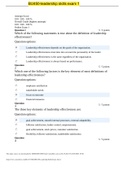
Attempt Score 60 out of 100 points
Time Elapsed 3 minutes
Results All Answers, Submitted Answers, Feedback, Incorrectly
Displayed Answered Questions
• Question 1
10 out of 10 points
Reading rhetorically requires consideration of the following elements:
Selected Purpose, Audience, Stance
Answer:
Answers: Subject, writing style, point of view
Year of publication, popularity, author’s gender
Purpose, Audience, Stance
Length of piece, author’s background, diction
Response To really analyze a text, you need to understand what is the author's
Feedback:
purpose, who the author is writing to, and what position the author is
taking.
• Question 2
10 out of 10 points
Critical reading may involve the following except
Selected Reading quickly for the gist of what is being
Answer:
said
Answers: Pausing to reflect on what you read
Reading quickly for the gist of what is being
said
Discussing what you read with others
Highlighting and annotating the text
Response According to The Norton Field Guide with Readings, “Different texts
Feedback: require different kinds of effort. Some that are simple … can be
skimmed. With academic texts, though, you usually need to read more
slowly and carefully.”
• Question 3
0 out of 10 points
A best practice when critical reading is:
Selected Review the text to determine interest
Answer:
, Answers: Limiting your analysis to your point of view
Crossing out unfamiliar words
Adjusting your reading speed to the level of the writing
Review the text to determine interest
Response According to The Norton Field Guide with Readings, “Different text
Feedback:
require different kinds of effort. With academic texts you usually need
to read more slowly and carefully.”
• Question 4
0 out of 10 points
Academic writing requires
Selected Thesis, argument, and conclusion
Answer:
Answers: Focus, directness, and accuracy
Thesis, argument, and conclusion
Good grammar, elevated diction, proper tone
Topic, description, and narration
Response Academic writiing involves focus, directness, and accuracy.
Feedback:
• Question 5
10 out of 10 points
Which of the following is not a quality that indicates a strong academic mindset?
Selected Disregard opposing views
Answer:
Answers: Engagement
Disregard opposing views
Flexibility
Curiosity
Response According to The Norton Field Guide with Readings, “Treat the ideas of
Feedback:
others with respect. Try to withhold judgement. Look for a common
ground.”
• Question 6
Time Elapsed 3 minutes
Results All Answers, Submitted Answers, Feedback, Incorrectly
Displayed Answered Questions
• Question 1
10 out of 10 points
Reading rhetorically requires consideration of the following elements:
Selected Purpose, Audience, Stance
Answer:
Answers: Subject, writing style, point of view
Year of publication, popularity, author’s gender
Purpose, Audience, Stance
Length of piece, author’s background, diction
Response To really analyze a text, you need to understand what is the author's
Feedback:
purpose, who the author is writing to, and what position the author is
taking.
• Question 2
10 out of 10 points
Critical reading may involve the following except
Selected Reading quickly for the gist of what is being
Answer:
said
Answers: Pausing to reflect on what you read
Reading quickly for the gist of what is being
said
Discussing what you read with others
Highlighting and annotating the text
Response According to The Norton Field Guide with Readings, “Different texts
Feedback: require different kinds of effort. Some that are simple … can be
skimmed. With academic texts, though, you usually need to read more
slowly and carefully.”
• Question 3
0 out of 10 points
A best practice when critical reading is:
Selected Review the text to determine interest
Answer:
, Answers: Limiting your analysis to your point of view
Crossing out unfamiliar words
Adjusting your reading speed to the level of the writing
Review the text to determine interest
Response According to The Norton Field Guide with Readings, “Different text
Feedback:
require different kinds of effort. With academic texts you usually need
to read more slowly and carefully.”
• Question 4
0 out of 10 points
Academic writing requires
Selected Thesis, argument, and conclusion
Answer:
Answers: Focus, directness, and accuracy
Thesis, argument, and conclusion
Good grammar, elevated diction, proper tone
Topic, description, and narration
Response Academic writiing involves focus, directness, and accuracy.
Feedback:
• Question 5
10 out of 10 points
Which of the following is not a quality that indicates a strong academic mindset?
Selected Disregard opposing views
Answer:
Answers: Engagement
Disregard opposing views
Flexibility
Curiosity
Response According to The Norton Field Guide with Readings, “Treat the ideas of
Feedback:
others with respect. Try to withhold judgement. Look for a common
ground.”
• Question 6