1 Exampromax - Stuvia US
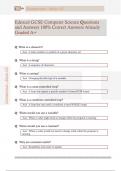
Edexcel GCSE Computer Science, Topic 4:
Networks Questions and Answers 100% Correct
Answers Already Graded A+
Q: LAN - local area network
Ans: A network of computers within the same building, such as a school, home
or business. It is not necessarily connected to the internet.
Q: WAN - wide area network
Ans: When LANs are connected. Can connect organisations based in different
Exampromax - Stuvia US
geographical places. The internet is an example of this.
Q: Network topologies: bus
Ans: Each computer and network device are connected to a single cable or
backbone
Q: Network topologies: star
Ans: Each device on the network has its own cable that connects to a switch or
hub. A hub sends every packet of data to every device
Q: Network topologies: mesh
Ans: All of the devices on the network are interconnected with one another.
Q: Network topologies: ring
Ans: Each device (eg workstation, server, printer) is connected in a ring so each
one is connected to two other devices
Q: MAC (media access control) address
Ans: Each unique piece of hardware on a network has this type of address.
Ensures that data is directed to the correct computer.
, 2 Exampromax - Stuvia US
Q: Data packets
Ans: A piece of information sent over a network. Messages have to be broken
down before they are transferred.
Q: Server
Ans: A computer that holds data to be shared with other computers. A web
server stores and shares websites.
Q: WWW
Ans: All the interlinked HTML pages that can be accessed over the Internet
Q: The internet
Ans: Global communication network that allows computers to connect and
Exampromax - Stuvia US
exchange information
Q: Internet Service Provider (ISP)
Ans: Organisation that provides access to the internet
Q: Router
Ans: Connects different networks together. Read address information and
forward the messages to the correct network. Used to transfer data between a
home network and the internet.
Q: Firewall
Ans: Network security system that checks incoming and outgoing data, deciding
to allow or disallow the data from entering or leaving the network
Q: Hacking
Ans: The act of gaining unauthorised access to a computer system and its data
Q: Malware
Ans: Malicious software - intended to harm or disrupt a computer system
Q: Denial of service (DoS)
Edexcel GCSE Computer Science, Topic 4:
Networks Questions and Answers 100% Correct
Answers Already Graded A+
Q: LAN - local area network
Ans: A network of computers within the same building, such as a school, home
or business. It is not necessarily connected to the internet.
Q: WAN - wide area network
Ans: When LANs are connected. Can connect organisations based in different
Exampromax - Stuvia US
geographical places. The internet is an example of this.
Q: Network topologies: bus
Ans: Each computer and network device are connected to a single cable or
backbone
Q: Network topologies: star
Ans: Each device on the network has its own cable that connects to a switch or
hub. A hub sends every packet of data to every device
Q: Network topologies: mesh
Ans: All of the devices on the network are interconnected with one another.
Q: Network topologies: ring
Ans: Each device (eg workstation, server, printer) is connected in a ring so each
one is connected to two other devices
Q: MAC (media access control) address
Ans: Each unique piece of hardware on a network has this type of address.
Ensures that data is directed to the correct computer.
, 2 Exampromax - Stuvia US
Q: Data packets
Ans: A piece of information sent over a network. Messages have to be broken
down before they are transferred.
Q: Server
Ans: A computer that holds data to be shared with other computers. A web
server stores and shares websites.
Q: WWW
Ans: All the interlinked HTML pages that can be accessed over the Internet
Q: The internet
Ans: Global communication network that allows computers to connect and
Exampromax - Stuvia US
exchange information
Q: Internet Service Provider (ISP)
Ans: Organisation that provides access to the internet
Q: Router
Ans: Connects different networks together. Read address information and
forward the messages to the correct network. Used to transfer data between a
home network and the internet.
Q: Firewall
Ans: Network security system that checks incoming and outgoing data, deciding
to allow or disallow the data from entering or leaving the network
Q: Hacking
Ans: The act of gaining unauthorised access to a computer system and its data
Q: Malware
Ans: Malicious software - intended to harm or disrupt a computer system
Q: Denial of service (DoS)