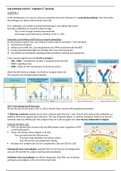
THE IMMUNE SYSTEM – PARHAM 4TH EDITION
CHAPTER 5
T-cell receptors (TCRs) have a similar structure to BCRs but bind mainly to peptide antigens,
derived from pathogenic proteins. This peptide is presented on human cells by a glycoprotein:
the MHC molecule.
TCR recognition of the peptide relies on peptide AND the MHC molecule
Major histocompatibility complex (MHC) = chromosomal region that encodes MHC molecules.
Some genes are polymorphic; different variants of the same gene.
TCR structure
A TCR…
has two polypeptide chains: TCRα and TCRβ.
Their rearrangement resembles that of immunoglobulins.
strongly resembles the Fab fragment of an antibody: with a V- and C-region.
contains complementarity-determining regions = CDRs.
The regions of hypervariability in TCRs are: CDR1, CDR2, CDR3.
Gene rearrangement in T-cell
The T-cell receptor only undergoes gene rearrangement during T-cell development and does
not change after an encounter with a pathogen.
The α-chain resembles the H-chain in B-cells: V-J
The β-chain resembles the L-chain in B-cells: V-D-J
RAG and DNA-modifying enzymes are involved in the recombination process.
Additional N and P nucleotides are inserted between V, (D) and J genes.
This adds to junctional diversity in the CDR3 region.
Severe combined immunodeficiency disease = SCID = is caused by an absence of RAG enzymes; functional T- and
B-cells are absent (hence ‘combined’). Infants that do not get a bone marrow transplant, will die from SCID.
Omenn syndrome = a mutation produces RAG with partial enzymatic activity. Patients suffer from chronic
inflammation – of the skin, a bright red rash. Without a bone marrow transplant, infants will die from this disease.
Gene rearrangement " transcription " splicing " mRNA " α-chain and β-chain to ER " α:β TCR on membrane.
RAG genes key in diversity
V(D)J recombination generates clonal diversity. Key is the two subunits of RAG recombinase.
A theory: RAG genes are transposons that are incorporated in the DNA.
Transposons can make copies of itself and move it to other parts of the chromosome.
It has transposase, an enzyme that cuts ds DNA and recognizes terminal repeat sequences.
The terminal repeat sequences evolved to be the RSSs.
The α- and β-chains need coupling with the CDR3 complex to leave the ER and form the TCR complex.
The CD3 and ζ-chain are need for intracellular signaling.
Deficiency of the CD3δδ and CDR3δε lead to a low number of TCRs and immunodeficiency.
γ:δ TCR is a second TCR class. γ:δ T-cells reside in tissue, resemble NK cells and do not need MHC for recognition.
Gene rearrangement is similar to α:β,
but:
1) the δ- chain is on the α-chain locus
2) δ- and γ-chain have fewer genes
3) the γ- chain can include 2 D segments:
more variability
CHAPTER 5
T-cell receptors (TCRs) have a similar structure to BCRs but bind mainly to peptide antigens,
derived from pathogenic proteins. This peptide is presented on human cells by a glycoprotein:
the MHC molecule.
TCR recognition of the peptide relies on peptide AND the MHC molecule
Major histocompatibility complex (MHC) = chromosomal region that encodes MHC molecules.
Some genes are polymorphic; different variants of the same gene.
TCR structure
A TCR…
has two polypeptide chains: TCRα and TCRβ.
Their rearrangement resembles that of immunoglobulins.
strongly resembles the Fab fragment of an antibody: with a V- and C-region.
contains complementarity-determining regions = CDRs.
The regions of hypervariability in TCRs are: CDR1, CDR2, CDR3.
Gene rearrangement in T-cell
The T-cell receptor only undergoes gene rearrangement during T-cell development and does
not change after an encounter with a pathogen.
The α-chain resembles the H-chain in B-cells: V-J
The β-chain resembles the L-chain in B-cells: V-D-J
RAG and DNA-modifying enzymes are involved in the recombination process.
Additional N and P nucleotides are inserted between V, (D) and J genes.
This adds to junctional diversity in the CDR3 region.
Severe combined immunodeficiency disease = SCID = is caused by an absence of RAG enzymes; functional T- and
B-cells are absent (hence ‘combined’). Infants that do not get a bone marrow transplant, will die from SCID.
Omenn syndrome = a mutation produces RAG with partial enzymatic activity. Patients suffer from chronic
inflammation – of the skin, a bright red rash. Without a bone marrow transplant, infants will die from this disease.
Gene rearrangement " transcription " splicing " mRNA " α-chain and β-chain to ER " α:β TCR on membrane.
RAG genes key in diversity
V(D)J recombination generates clonal diversity. Key is the two subunits of RAG recombinase.
A theory: RAG genes are transposons that are incorporated in the DNA.
Transposons can make copies of itself and move it to other parts of the chromosome.
It has transposase, an enzyme that cuts ds DNA and recognizes terminal repeat sequences.
The terminal repeat sequences evolved to be the RSSs.
The α- and β-chains need coupling with the CDR3 complex to leave the ER and form the TCR complex.
The CD3 and ζ-chain are need for intracellular signaling.
Deficiency of the CD3δδ and CDR3δε lead to a low number of TCRs and immunodeficiency.
γ:δ TCR is a second TCR class. γ:δ T-cells reside in tissue, resemble NK cells and do not need MHC for recognition.
Gene rearrangement is similar to α:β,
but:
1) the δ- chain is on the α-chain locus
2) δ- and γ-chain have fewer genes
3) the γ- chain can include 2 D segments:
more variability