

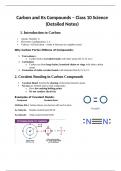
Carbon and Its Compounds – Class 10 Science
(Detailed Notes)
🔹 1. Introduction to Carbon
Atomic Number: 6
Electronic Configuration: 2, 4
Valency: 4 (Tetravalent – needs 4 electrons to complete octet)
Why Carbon Forms Millions of Compounds:
1. Tetravalency:
o Carbon forms 4 covalent bonds with other atoms (H, O, N, etc.)
2. Catenation:
o Carbon can form long chains, branched chains or rings with other carbon
atoms.
3. Formation of stable covalent bonds with elements like H, O, N, Cl.
2. Covalent Bonding in Carbon Compounds
Covalent Bond: Formed by sharing of electrons between atoms.
No ions are formed, hence such compounds:
o Have low melting/boiling points
o Do not conduct electricity
Examples of Covalent Bonds:
Compound Covalent Bond
Methane (CH₄) -Carbon shares one electron with each H atom
O₂ molecule- Double covalent bond (O=O)
N₂ molecule- Triple covalent bond (N≡N)
, 3. Allotropes of Carbon
Carbon exists in different physical forms (same element, different structures).
Allotrope Properties Structure
Hardest known substance, does not conduct Each C bonded to 4 other C atoms in 3D
Diamond
electricity network
Each C bonded to 3 C atoms in hexagonal
Graphite Soft, good conductor of electricity
layers
Fullerenes 60 carbon atoms in ring + hexagonal
Spherical molecules (buckyballs)
(C₆₀) structure
4. Hydrocarbons
Compounds made up of carbon and hydrogen only.
Types of Hydrocarbons:
1. Saturated Hydrocarbons (Alkanes)
o Only single bonds between carbon
atoms.
o General formula: CₙH₂ₙ₊₂
o Example: Methane (CH₄), Ethane
(C₂H₆)
2. Unsaturated Hydrocarbons
o Have double or triple bonds between
carbon atoms.
Type Bond Formula Example
One double bond Ethene
Alkenes CₙH₂ₙ
(C=C) (C₂H₄)
Alkynes One triple bond Ethyne
CₙH₂ₙ₋₂
(C≡C) (C₂H₂)
(Detailed Notes)
🔹 1. Introduction to Carbon
Atomic Number: 6
Electronic Configuration: 2, 4
Valency: 4 (Tetravalent – needs 4 electrons to complete octet)
Why Carbon Forms Millions of Compounds:
1. Tetravalency:
o Carbon forms 4 covalent bonds with other atoms (H, O, N, etc.)
2. Catenation:
o Carbon can form long chains, branched chains or rings with other carbon
atoms.
3. Formation of stable covalent bonds with elements like H, O, N, Cl.
2. Covalent Bonding in Carbon Compounds
Covalent Bond: Formed by sharing of electrons between atoms.
No ions are formed, hence such compounds:
o Have low melting/boiling points
o Do not conduct electricity
Examples of Covalent Bonds:
Compound Covalent Bond
Methane (CH₄) -Carbon shares one electron with each H atom
O₂ molecule- Double covalent bond (O=O)
N₂ molecule- Triple covalent bond (N≡N)
, 3. Allotropes of Carbon
Carbon exists in different physical forms (same element, different structures).
Allotrope Properties Structure
Hardest known substance, does not conduct Each C bonded to 4 other C atoms in 3D
Diamond
electricity network
Each C bonded to 3 C atoms in hexagonal
Graphite Soft, good conductor of electricity
layers
Fullerenes 60 carbon atoms in ring + hexagonal
Spherical molecules (buckyballs)
(C₆₀) structure
4. Hydrocarbons
Compounds made up of carbon and hydrogen only.
Types of Hydrocarbons:
1. Saturated Hydrocarbons (Alkanes)
o Only single bonds between carbon
atoms.
o General formula: CₙH₂ₙ₊₂
o Example: Methane (CH₄), Ethane
(C₂H₆)
2. Unsaturated Hydrocarbons
o Have double or triple bonds between
carbon atoms.
Type Bond Formula Example
One double bond Ethene
Alkenes CₙH₂ₙ
(C=C) (C₂H₄)
Alkynes One triple bond Ethyne
CₙH₂ₙ₋₂
(C≡C) (C₂H₂)


