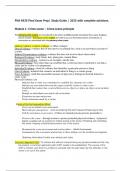
PHA 6935 Final Exam Prep| Study Guide | 2025 with complete solutions.
Module 1- Crime scene – Crime scene principle
The primary crime scenes are considered to be where a crime actually took place like a rape, burglary,
and or murder. Secondary crimes scenes are where you can find other pieces of evidence, in
connection or associated with the primary crime scene
indirect evidence vs direct evidence vs Other evidence:
Direct Evidence: evidence that (if true) proves an alleged fact, such as an eyewitness account of
a crime
Indirect/Circumstances evidence: evidence that does not involve direct observation
Biological Evidence: body fluids, hair, plant parts, natural fibers
Documentary evidence : contract as an example, suicide note
Physical Evidence: Any object that can establish that a crime has been committed or can link a
crime and its victim or its perpetrator.
Individual Evidence: a kind of evidence that identifies a particular person or thing
Class Evidence: material that connects an individual or thing to a certain group
Trace Evidence: small but measurable amounts of physical or biological material found at a
crime scene
Physical Evidence: can
• Indicate that a crime was committed or establish key elements of a crime –
• Indicate an association between the suspect and the victim or crime scene –
• Establish that contact has occurred between two objects or place an object at an incident
scene ;
• Identify an individual associated with an incident
• Exonerate an innocent person
• Verify statements made by a victim
Duties of the first responding officer?
• Carry out an initial scene assessment
• Deal with any emergencies – such as rendering first aid if required (Preserving of Life)
• Call for assistance as necessary (if there are injured persons present, paramedics)
• Preserve the scene – through actions to protect potential physical evidence. A physical
barrier (cordon) set up a barrier to restrict access to the scene: Protecting and controlling
the scene. keeping unauthorized persons out of the scene
• Document the scene assessment and actions taken – Initial Assessment
• Communicate the assessment and actions to those taking over the incident investigation.
• Obtaining information-Control over witness and victim
Common Approach Path: To achieve this without compromising any physical evidence that may
be present, a common approach path (CAP) needs to be established. The course of the
CAP is chosen such that it is unlikely to coincide with the path taken by the offender or the
victim in or out of the scene
,Module 2: crime scene examiner's role:
• During initial assessment
o Confirm that a crime is likely to have occurred
o Safety measures is required before proceeding ( Health and safety) . PPE
o Initial Record the scene before full assessment:
▪ Identify key areas of the scene
▪ Identify key evidence types and main areas
▪ General layout of the scene ( Entrance , exit and CAP)
▪ Environmental condition ( Outdoor Heat or cold weather)
▪ Assessment of resources needed
▪ Rough sketches
▪ Record and observe: odors, signs of struggle, condition of scene and
unusual out of place, ect..
• Recording and recovering of evidence :
o Photographing the scene
o Sketching the scene
o Note Taking
o Collecting evidence
o Packaging evidence and storing evidence
o Effective crime scene recording: good crime scene photograpy, crime scene sketches
and detailed note taking at the crime scene
o
• searching for and collecting physical evidence: searching methods: Spiral search, Grid search
Quadrant or zone search and Strip or line search.
Optical detection methods
• Absorption mode – Dry blood is known to strongly absorb light at around 415 nm
(corresponding to the violet region of the visible spectrum).
• Diffused reflection mode – this can be beneficial when searching for marks on flat, shiny
surfaces, such as on glass, mirrors, polished floorboards, ceramic tiles, etc.
• Luminescence mode – which involves working in the dark with a monochromatic light
source and suitable filtered goggles. This mode can be applied to the detection of a range
of evidence types such as semen and saliva stains, textile fibres, gunshot residues and, in
some cases, latent fingermarks (where the fingermarks are contaminated with a
luminescent material). Lumienscence mode can assist with detection of what: biological stain
such as semen and saliva, textile fibres and gunshot residue
Collection of Evidence:
• Priorities need to be established regarding the order in which evidence will be collected
• Various collection techniques are available to the scene examiner, including removal of the
whole item (e.g., bedspread, furniture, weapon, etc.), hand-picking, tape-lifting, vacuuming,
swabbing, scraping, and sweeping, swabbing, casting, Pippeting ( blood or biological
samples)
, • Each item of evidence collected by the scene examiner must be detailed in the examiner’s
case notes. In addition to a photographic record of each item, the information that needs
to be documented includes:
• A description of the item;Where the item was located (also indicated on a scene
sketch);The date and time of collection;How it was collected and packaged; and A unique
item reference number.
Evidence Storage and Transport
Evidence removed from the crime scene must be transported in a secure and
appropriate manner. scene examiner on return from the crime scene may include the
following:
• Collating the exhibits and recording their existence in a master exhibit register or
computerized database;
• Ensuring that, while not under examination, the evidence is stored in a secure area that is
only accessible to approved individuals;
• Undertaking additional examinations that cannot be readily undertaken at the scene (this
may include the application of specialist optical or photographic techniques, processing
for latent fingermarks, and examination of impression evidence such as toolmarks and
footwear impressions);
• Consulting with laboratory staff to assist in determining possible evidential value, the
analyses that need to be undertaken, and the order in which these analyses should occur,
with major cases generally requiring a meeting between the investigators, the crime scene
examiners, and the laboratory staff who will undertake subsequent analyses; and
• Transferring the possession of relevant items of evidence to the laboratory staff charged
with undertaking further analyses, with such changes in possession being recorded (e.g., in
the crime scene examiner’s case file and in the master exhibit register or computerized
database) to ensure that chain-of-custody is maintained.
Packaging & Handling Requirements
• Evidence at the crime scene that has been located, recorded and collected must
then be packaged and labelled appropriately. recommended. Some general
guidelines are as follows:
• Items of clothing: These should be packaged separately in ‘breathable’ containers
such as paper bags
• Green plant material (e.g., marijuana): As for clothing, green plant material must be
packaged in breathable containers such as paper bags. Such evidence will rot if
packaged in airtight containers.
, • Wet body fluids (e.g., blood): Allow to dry or, if packaged wet, the container must
be breathable. Liquid blood can be packaged in a sample vial that contains a
preservative such as EDTA.
• Swabs for DNA analysis: Allow to dry and package in envelopes or paper bags (not
plastic).
• Trace evidence such as hairs, fibres, paint chips, or glass fragments: The
recommended packaging is a folded sheet of clean paper (druggist’s fold) that is
then placed in an envelope or plastic bag.
• Digital items (e.g., hard drives, memory cards, SIM cards) Should be sealed in
antistatic bags.
• Knives and hypodermic syringes: Should be packaged in tubes that are specifically
designed for this purpose (and then the tube sealed in a suitable evidence bag).
• Firearms: Firearms firstly need to be rendered safe by a qualified individual. They
should never be packaged and shipped in a loaded state. Weapons should be well
packed in a strong cardboard box to prevent shifting in transit. If projectiles are
recovered then these should be individually wrapped in paper and sealed in rigid
containers.
• Items collected for possible flammable liquid residues (e.g., fire debris) : Must be
sealed in an airtight container to prevent loss of volatile components. Common
containers include unused metal paint tins, glass jars, and special-purpose ‘arson’
bags (e.g., nylon, or heavy-duty composite bags).
• Liquids (e.g., liquid hydrocarbons such as petrol/gasoline) or powders (e.g., suspected
drug material): Use a clean glass vial or jar with an airtight seal.
• Sample packaging: clothing in breathable paper bag, DNA swabs should be dried and packaged
in envelope or paper bag and liquid/powder should be collected in vials or jars
• Swabbing techniques to collect material from a dried stain that appears to be blood, Trace
DNA that might be present on a surface and explosive residue
• Evidence must be stored under appropriate environmental conditions. Which of the following
is inappropriate: Storage of fire debris samples in a cold room, storage of paint at room
temperature and storage of dried semen stain in a freezer
Module 1- Crime scene – Crime scene principle
The primary crime scenes are considered to be where a crime actually took place like a rape, burglary,
and or murder. Secondary crimes scenes are where you can find other pieces of evidence, in
connection or associated with the primary crime scene
indirect evidence vs direct evidence vs Other evidence:
Direct Evidence: evidence that (if true) proves an alleged fact, such as an eyewitness account of
a crime
Indirect/Circumstances evidence: evidence that does not involve direct observation
Biological Evidence: body fluids, hair, plant parts, natural fibers
Documentary evidence : contract as an example, suicide note
Physical Evidence: Any object that can establish that a crime has been committed or can link a
crime and its victim or its perpetrator.
Individual Evidence: a kind of evidence that identifies a particular person or thing
Class Evidence: material that connects an individual or thing to a certain group
Trace Evidence: small but measurable amounts of physical or biological material found at a
crime scene
Physical Evidence: can
• Indicate that a crime was committed or establish key elements of a crime –
• Indicate an association between the suspect and the victim or crime scene –
• Establish that contact has occurred between two objects or place an object at an incident
scene ;
• Identify an individual associated with an incident
• Exonerate an innocent person
• Verify statements made by a victim
Duties of the first responding officer?
• Carry out an initial scene assessment
• Deal with any emergencies – such as rendering first aid if required (Preserving of Life)
• Call for assistance as necessary (if there are injured persons present, paramedics)
• Preserve the scene – through actions to protect potential physical evidence. A physical
barrier (cordon) set up a barrier to restrict access to the scene: Protecting and controlling
the scene. keeping unauthorized persons out of the scene
• Document the scene assessment and actions taken – Initial Assessment
• Communicate the assessment and actions to those taking over the incident investigation.
• Obtaining information-Control over witness and victim
Common Approach Path: To achieve this without compromising any physical evidence that may
be present, a common approach path (CAP) needs to be established. The course of the
CAP is chosen such that it is unlikely to coincide with the path taken by the offender or the
victim in or out of the scene
,Module 2: crime scene examiner's role:
• During initial assessment
o Confirm that a crime is likely to have occurred
o Safety measures is required before proceeding ( Health and safety) . PPE
o Initial Record the scene before full assessment:
▪ Identify key areas of the scene
▪ Identify key evidence types and main areas
▪ General layout of the scene ( Entrance , exit and CAP)
▪ Environmental condition ( Outdoor Heat or cold weather)
▪ Assessment of resources needed
▪ Rough sketches
▪ Record and observe: odors, signs of struggle, condition of scene and
unusual out of place, ect..
• Recording and recovering of evidence :
o Photographing the scene
o Sketching the scene
o Note Taking
o Collecting evidence
o Packaging evidence and storing evidence
o Effective crime scene recording: good crime scene photograpy, crime scene sketches
and detailed note taking at the crime scene
o
• searching for and collecting physical evidence: searching methods: Spiral search, Grid search
Quadrant or zone search and Strip or line search.
Optical detection methods
• Absorption mode – Dry blood is known to strongly absorb light at around 415 nm
(corresponding to the violet region of the visible spectrum).
• Diffused reflection mode – this can be beneficial when searching for marks on flat, shiny
surfaces, such as on glass, mirrors, polished floorboards, ceramic tiles, etc.
• Luminescence mode – which involves working in the dark with a monochromatic light
source and suitable filtered goggles. This mode can be applied to the detection of a range
of evidence types such as semen and saliva stains, textile fibres, gunshot residues and, in
some cases, latent fingermarks (where the fingermarks are contaminated with a
luminescent material). Lumienscence mode can assist with detection of what: biological stain
such as semen and saliva, textile fibres and gunshot residue
Collection of Evidence:
• Priorities need to be established regarding the order in which evidence will be collected
• Various collection techniques are available to the scene examiner, including removal of the
whole item (e.g., bedspread, furniture, weapon, etc.), hand-picking, tape-lifting, vacuuming,
swabbing, scraping, and sweeping, swabbing, casting, Pippeting ( blood or biological
samples)
, • Each item of evidence collected by the scene examiner must be detailed in the examiner’s
case notes. In addition to a photographic record of each item, the information that needs
to be documented includes:
• A description of the item;Where the item was located (also indicated on a scene
sketch);The date and time of collection;How it was collected and packaged; and A unique
item reference number.
Evidence Storage and Transport
Evidence removed from the crime scene must be transported in a secure and
appropriate manner. scene examiner on return from the crime scene may include the
following:
• Collating the exhibits and recording their existence in a master exhibit register or
computerized database;
• Ensuring that, while not under examination, the evidence is stored in a secure area that is
only accessible to approved individuals;
• Undertaking additional examinations that cannot be readily undertaken at the scene (this
may include the application of specialist optical or photographic techniques, processing
for latent fingermarks, and examination of impression evidence such as toolmarks and
footwear impressions);
• Consulting with laboratory staff to assist in determining possible evidential value, the
analyses that need to be undertaken, and the order in which these analyses should occur,
with major cases generally requiring a meeting between the investigators, the crime scene
examiners, and the laboratory staff who will undertake subsequent analyses; and
• Transferring the possession of relevant items of evidence to the laboratory staff charged
with undertaking further analyses, with such changes in possession being recorded (e.g., in
the crime scene examiner’s case file and in the master exhibit register or computerized
database) to ensure that chain-of-custody is maintained.
Packaging & Handling Requirements
• Evidence at the crime scene that has been located, recorded and collected must
then be packaged and labelled appropriately. recommended. Some general
guidelines are as follows:
• Items of clothing: These should be packaged separately in ‘breathable’ containers
such as paper bags
• Green plant material (e.g., marijuana): As for clothing, green plant material must be
packaged in breathable containers such as paper bags. Such evidence will rot if
packaged in airtight containers.
, • Wet body fluids (e.g., blood): Allow to dry or, if packaged wet, the container must
be breathable. Liquid blood can be packaged in a sample vial that contains a
preservative such as EDTA.
• Swabs for DNA analysis: Allow to dry and package in envelopes or paper bags (not
plastic).
• Trace evidence such as hairs, fibres, paint chips, or glass fragments: The
recommended packaging is a folded sheet of clean paper (druggist’s fold) that is
then placed in an envelope or plastic bag.
• Digital items (e.g., hard drives, memory cards, SIM cards) Should be sealed in
antistatic bags.
• Knives and hypodermic syringes: Should be packaged in tubes that are specifically
designed for this purpose (and then the tube sealed in a suitable evidence bag).
• Firearms: Firearms firstly need to be rendered safe by a qualified individual. They
should never be packaged and shipped in a loaded state. Weapons should be well
packed in a strong cardboard box to prevent shifting in transit. If projectiles are
recovered then these should be individually wrapped in paper and sealed in rigid
containers.
• Items collected for possible flammable liquid residues (e.g., fire debris) : Must be
sealed in an airtight container to prevent loss of volatile components. Common
containers include unused metal paint tins, glass jars, and special-purpose ‘arson’
bags (e.g., nylon, or heavy-duty composite bags).
• Liquids (e.g., liquid hydrocarbons such as petrol/gasoline) or powders (e.g., suspected
drug material): Use a clean glass vial or jar with an airtight seal.
• Sample packaging: clothing in breathable paper bag, DNA swabs should be dried and packaged
in envelope or paper bag and liquid/powder should be collected in vials or jars
• Swabbing techniques to collect material from a dried stain that appears to be blood, Trace
DNA that might be present on a surface and explosive residue
• Evidence must be stored under appropriate environmental conditions. Which of the following
is inappropriate: Storage of fire debris samples in a cold room, storage of paint at room
temperature and storage of dried semen stain in a freezer