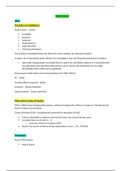
Police Powers-
Intro-
The police as investigators-
Ranks (Junior – Senior):
Constable
Sergeant
Inspector
Chief Inspector
Superintendent
Chief Superintendent
The Criminal Investigation Dept also follow the same rankings eg: ‘Detective Sergent’
A major role of operational police officers is to investigate crime and bring the perpetrators to justice.
Have wide ranging powers to enable them to search for and obtain evidence, it is important that
you appreciate how and when these powers can be used as the implications for any legal
proceedings which follow can be significant.
Most powers within Police and Criminal Evidence Act 1984 (‘PACE’).
PC – arrest
Custody officer (sergeant) - detain
Inspector – Review detention
Superintendent – Extend detention
-
PACE and the Codes of Practice-
PACE codified many existing police powers, enhanced safeguards/ welfare of suspects + introduced new
law for evidence & procedure
Codes of Practice (CoP) = fundamental framework for operation of PACE
CoP are admissible in evidence and must be taken into account by the courts
Currently there are 8 CoPs: A – H
o Each has a Note for Guidance (NfG)
Breach may lead to evidence being inadmissible in court – s76 , s78 PACE
--
The Powers-
Some of the powers:
Stop & Search
, Arrest
Detention without charge
Taking intimate samples
Taking non-intimate samples
In exercising these powers a police officer will have to be able to demonstrate that he:
a) has the legal authority to do it; and
b) has carried it out lawfully.
Use PACE as a pneumonic:
P: Identify the power
A: What is the legal authority granting the power?
C: What criteria need to be met and are they met on the facts?
E: How should the power be exercised and has it been exercised correctly on the facts?
Reasonable grounds:
Many powers will require an officer to have reasonable grounds.
I.e.: he can say WHY he believes it is necessary to do what he is about to do
o An objective test & analysis of the facts of the case
--
Stop and Search-
The most important power is located in PACE, but other stop and search powers are found in other
legislation
The power to search for controlled drugs is set out in s.23 Misuse of Drugs Act 1971
Annex A to COP A sets out a list of all statutory powers to stop and search.
Power to stop and search for stolen/ prohibited articles-
Authority:
S1 PACE – provides a wide power to search any persons/ vehicle for stolen/ prohibited articles
(inc. Fireworks)
stolen/ prohibited articles: s1(7), (8) PACE:
o Any articles acquired as a result of offences of theft or burglary.
o Offensive weapons or articles made or adapted for use in connection with offences
under the Theft Act 1968 or the Criminal Damage Act 1971.
Criteria:
Intro-
The police as investigators-
Ranks (Junior – Senior):
Constable
Sergeant
Inspector
Chief Inspector
Superintendent
Chief Superintendent
The Criminal Investigation Dept also follow the same rankings eg: ‘Detective Sergent’
A major role of operational police officers is to investigate crime and bring the perpetrators to justice.
Have wide ranging powers to enable them to search for and obtain evidence, it is important that
you appreciate how and when these powers can be used as the implications for any legal
proceedings which follow can be significant.
Most powers within Police and Criminal Evidence Act 1984 (‘PACE’).
PC – arrest
Custody officer (sergeant) - detain
Inspector – Review detention
Superintendent – Extend detention
-
PACE and the Codes of Practice-
PACE codified many existing police powers, enhanced safeguards/ welfare of suspects + introduced new
law for evidence & procedure
Codes of Practice (CoP) = fundamental framework for operation of PACE
CoP are admissible in evidence and must be taken into account by the courts
Currently there are 8 CoPs: A – H
o Each has a Note for Guidance (NfG)
Breach may lead to evidence being inadmissible in court – s76 , s78 PACE
--
The Powers-
Some of the powers:
Stop & Search
, Arrest
Detention without charge
Taking intimate samples
Taking non-intimate samples
In exercising these powers a police officer will have to be able to demonstrate that he:
a) has the legal authority to do it; and
b) has carried it out lawfully.
Use PACE as a pneumonic:
P: Identify the power
A: What is the legal authority granting the power?
C: What criteria need to be met and are they met on the facts?
E: How should the power be exercised and has it been exercised correctly on the facts?
Reasonable grounds:
Many powers will require an officer to have reasonable grounds.
I.e.: he can say WHY he believes it is necessary to do what he is about to do
o An objective test & analysis of the facts of the case
--
Stop and Search-
The most important power is located in PACE, but other stop and search powers are found in other
legislation
The power to search for controlled drugs is set out in s.23 Misuse of Drugs Act 1971
Annex A to COP A sets out a list of all statutory powers to stop and search.
Power to stop and search for stolen/ prohibited articles-
Authority:
S1 PACE – provides a wide power to search any persons/ vehicle for stolen/ prohibited articles
(inc. Fireworks)
stolen/ prohibited articles: s1(7), (8) PACE:
o Any articles acquired as a result of offences of theft or burglary.
o Offensive weapons or articles made or adapted for use in connection with offences
under the Theft Act 1968 or the Criminal Damage Act 1971.
Criteria: