Lecture 3
2 - Applications of thermodynamics to compressible flow in pipes and
ducts
2.1 - The speed of sound
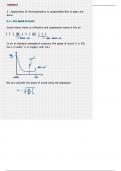
Sound waves travel as refraction and compression waves in the air
-Dense iLess Perse AIR
In air at standard atmospheric pressure, the speed of sound ‘a’ is 330
ms-1, in water ‘a’ is roughly 1481 ms-1
-Jesus I
350 Ms
WATER das
We can calculate the speed of sound using the expression
=
,For ideal gases, one of the isentropic flow relations we have is
:
cor
·
i
. e..
p =
Cp
*
Here ‘C’ is a constant for a particular process
Consequently
:
Hence for an ideal gas
: = Nort
Here we’ve used P = fRT and consequently, the speed of
sound in an ideal gas is purely a function of temperature.
, 2.2 Mach Number
We define the Mach number to be the ratio of either the speed of
flow or the speed of an object in a flow, to the speed of sound
Ma = Uta
The Mach number tells you how fast your flow is moving relative to
the speed of sound.
• We say that a flow is subsonic if Ma < 1, which means U < a
• We say that the flow is supersonic if Ma > 1, which means U > a
• We say that a flow is sonic if Ma = 1, which means U = a
2.3 Mass reservation for compressible flow in a pipe or a duct
Find
The mass in the control volume -
o
pAd
The rate of change of mass in the control volume equals the mass
flux into the control volume minus the mass flux out of the control
volume
gr
~
The mass flux M =
JuA = M is kgs
↑ MS
As we are dealing with compressible flow, density f is a variable
and not a constant
2 - Applications of thermodynamics to compressible flow in pipes and
ducts
2.1 - The speed of sound
Sound waves travel as refraction and compression waves in the air
-Dense iLess Perse AIR
In air at standard atmospheric pressure, the speed of sound ‘a’ is 330
ms-1, in water ‘a’ is roughly 1481 ms-1
-Jesus I
350 Ms
WATER das
We can calculate the speed of sound using the expression
=
,For ideal gases, one of the isentropic flow relations we have is
:
cor
·
i
. e..
p =
Cp
*
Here ‘C’ is a constant for a particular process
Consequently
:
Hence for an ideal gas
: = Nort
Here we’ve used P = fRT and consequently, the speed of
sound in an ideal gas is purely a function of temperature.
, 2.2 Mach Number
We define the Mach number to be the ratio of either the speed of
flow or the speed of an object in a flow, to the speed of sound
Ma = Uta
The Mach number tells you how fast your flow is moving relative to
the speed of sound.
• We say that a flow is subsonic if Ma < 1, which means U < a
• We say that the flow is supersonic if Ma > 1, which means U > a
• We say that a flow is sonic if Ma = 1, which means U = a
2.3 Mass reservation for compressible flow in a pipe or a duct
Find
The mass in the control volume -
o
pAd
The rate of change of mass in the control volume equals the mass
flux into the control volume minus the mass flux out of the control
volume
gr
~
The mass flux M =
JuA = M is kgs
↑ MS
As we are dealing with compressible flow, density f is a variable
and not a constant