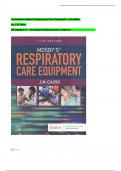
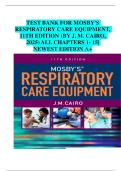
Test Bank - Mosby's Respiratory Care Equipment, 11th
Edition (By J. M. Cairo) All 1- 15 Chapters || Newest Edition
latest update
TEST BANK
,Description
The Most Clinically Relevant Respiratory Care Equipment Textbook On The Market, Mosby’s
Respiratory Care Equipment, 10th Edition Employs A "How-To" Approach That Moves Beyond
Technical Descriptions Of Machinery. Learn To Identify Equipment, Understand How It Works,
And Apply Your Knowledge To Clinical Practice With This Comprehensive Overview Of The
Equipment And Techniques Used By Respiratory Therapists To Treat Cardiopulmonary
Dysfunction. The 10th Edition Includes Updated Information On The Latest Devices And
Equipment, Which Are Divided Into Clearly Defined Sections Including: Ventilators, Transport,
Home-Care, Neonatal And Pediatric Ventilators, And Alternative Ventilators. In Addition, There’s
A Focus On Specific Ventilator Characteristics Such As Mode, Monitors And Displays, Alarms
And Indicators, Graphics, Special Features, And Troubleshooting For Lesser-Used Ventilators.
Table Of Contents
I. Introduction
1. Basic Physics For The Respiratory Therapist
2. Principles Of Infection Control
3. Introduction To Ventilators
II. Medical Gases
4. Manufacture, Storage, And Transport Of Medical Gases
5. Administering Medical Gases: Regulators, Flowmeters, And Controlling Devices
6. Humidity And Aerosol Therapy
,III. Assessment
7. Assessment Of Pulmonary Function
8. Assessment Of Cardiovascular Function
9. Blood Gas Monitoring
IV. Devices
10. Lung Expansion Devices
11. Mechanical Ventilators: General-Use Devices
12. Infant/Pediatric Ventilators
13. Home-Care, Transport Devices, Alternative Devices
V. Critical Care And Other Therapies
14. Airway Management Devices And ACLS
15. Sleep Diagnostics
, Chapter 01: Basic Physics For The Respiratory Therapist
MULTIPLE CHOICES
1. Power Is A Measure Of Which Of The Following?
a. Mechanical Energy
b. Gravitational Potential Energy
c. The Rate At Which Work Is Being Performed
d. The Rate At Which Atoms And Molecules Move
ANS: C
Power Is A Measure Of The Rate At Which Work Is Being Performed. The Formula P =
W/J, Where W = Watts And 1 Watt Is Equal To 1 J/S, Expresses This. Joules Are The
International Standard For Expressing Energy And Work.
PTS: 1 REF: Page 8
2. When Effort Produces A Change In The Position Of Matter:
a. Work Is Performed.
b. It Is Known As A Joule.
c. Mechanical Power Is Created.
d. The Law Of The Conservation Of Energy Is Being Used.
ANS: A
Work Is Performed Only When Effort Or Outside Forces Produce A Change In The
Position Of Matter.
PTS: 1 REF: Page 8
3. The Unit Used To Express The Force Of 1 Newton (N) Acting On A 1-Kilogram (Kg)
Object To Move It 1 Meter (M) Is Which Of The Following?
a. Watt C. Kilowatt
Edition (By J. M. Cairo) All 1- 15 Chapters || Newest Edition
latest update
TEST BANK
,Description
The Most Clinically Relevant Respiratory Care Equipment Textbook On The Market, Mosby’s
Respiratory Care Equipment, 10th Edition Employs A "How-To" Approach That Moves Beyond
Technical Descriptions Of Machinery. Learn To Identify Equipment, Understand How It Works,
And Apply Your Knowledge To Clinical Practice With This Comprehensive Overview Of The
Equipment And Techniques Used By Respiratory Therapists To Treat Cardiopulmonary
Dysfunction. The 10th Edition Includes Updated Information On The Latest Devices And
Equipment, Which Are Divided Into Clearly Defined Sections Including: Ventilators, Transport,
Home-Care, Neonatal And Pediatric Ventilators, And Alternative Ventilators. In Addition, There’s
A Focus On Specific Ventilator Characteristics Such As Mode, Monitors And Displays, Alarms
And Indicators, Graphics, Special Features, And Troubleshooting For Lesser-Used Ventilators.
Table Of Contents
I. Introduction
1. Basic Physics For The Respiratory Therapist
2. Principles Of Infection Control
3. Introduction To Ventilators
II. Medical Gases
4. Manufacture, Storage, And Transport Of Medical Gases
5. Administering Medical Gases: Regulators, Flowmeters, And Controlling Devices
6. Humidity And Aerosol Therapy
,III. Assessment
7. Assessment Of Pulmonary Function
8. Assessment Of Cardiovascular Function
9. Blood Gas Monitoring
IV. Devices
10. Lung Expansion Devices
11. Mechanical Ventilators: General-Use Devices
12. Infant/Pediatric Ventilators
13. Home-Care, Transport Devices, Alternative Devices
V. Critical Care And Other Therapies
14. Airway Management Devices And ACLS
15. Sleep Diagnostics
, Chapter 01: Basic Physics For The Respiratory Therapist
MULTIPLE CHOICES
1. Power Is A Measure Of Which Of The Following?
a. Mechanical Energy
b. Gravitational Potential Energy
c. The Rate At Which Work Is Being Performed
d. The Rate At Which Atoms And Molecules Move
ANS: C
Power Is A Measure Of The Rate At Which Work Is Being Performed. The Formula P =
W/J, Where W = Watts And 1 Watt Is Equal To 1 J/S, Expresses This. Joules Are The
International Standard For Expressing Energy And Work.
PTS: 1 REF: Page 8
2. When Effort Produces A Change In The Position Of Matter:
a. Work Is Performed.
b. It Is Known As A Joule.
c. Mechanical Power Is Created.
d. The Law Of The Conservation Of Energy Is Being Used.
ANS: A
Work Is Performed Only When Effort Or Outside Forces Produce A Change In The
Position Of Matter.
PTS: 1 REF: Page 8
3. The Unit Used To Express The Force Of 1 Newton (N) Acting On A 1-Kilogram (Kg)
Object To Move It 1 Meter (M) Is Which Of The Following?
a. Watt C. Kilowatt