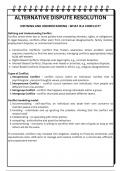
ALTERNATIVE DISPUTE RESOLUTION
DEFINING AND UNDERSTANDING - WHAT IS A CONFLICT?
Defining and Understanding Conflict
Conflict arises when two or more parties have competing interests, rights, or obligations.
In legal disputes, conflicts often stem from contractual disagreements, family matters,
employment disputes, or commercial transactions.
Constructive Conflicts: Conflict that fosters awareness where problem exists,
requires creativity to find the best outcomes, managing conflicts appropriately helps
build self-esteem.
Rights-Based Conflicts: Disputes over legal rights, e.g., contract breaches.
Interest-Based Conflicts: Disputes over needs or priorities, e.g., workplace disputes.
Value-Based Conflicts: Disputes over beliefs or ethics, e.g., religious disagreements.
Types of Conflict:
1. Intrapersonal Conflict - conflict occurs within an individual. Conflict that is
psychological - persons thoughts values, principles and emotions.
2. Interpersonal Conflict - conflict occurs between two individuals. How people are
different from one another.
3. Intragroup Conflict - conflict that happens among individuals within a group.
4. Intergroup Conflict - conflict that takes place between different teams.
Conflict handeling model:
1. Accommodating - self-sacrifice, an individual sets aside their own concerns to
maintain peace in the situation.
2. Avoiding - individuals end up ignoring the problem, thinking that the conflict will
resolve itself.
3. Collaborating - co-operating with other parties.
4. competing - authoritative and assertive behaviour.
5. compromising - one party is willing to sacrifice their own sets of goals as long as the
others will do the same.
If unresolved, conflicts may escalate into litigation, leading to financial, emotional, and
reputational costs. ADR aims to manage and resolve conflicts in a structured, efficient,
and cooperative manner.
, DISTINCTION BETWEEN ADVERSARIAL PROCEEDINGS AND FACILITATIVE/
CONSENSUS-BUILDING PROCESSES
Adversarial Proceedings (Litigation and Arbitration)
Involves formal legal processes where parties argue their cases before a judge or
arbitrator.
Decision is made by a third party (court/arbitrator) and is legally binding.
Procedures are rigid, often lengthy, and expensive.
Outcomes can be unpredictable, and relationships between parties may suffer.
Facilitative/Consensus-Building Processes (Mediation, Conciliation, and Negotiation)
Aim to foster communication, collaboration, and mutually agreeable solutions.
The outcome is voluntary and depends on the parties' willingness to settle.
Procedures are flexible, confidential, and cost-effective.
Focuses on preserving relationships and reducing hostility.
DEFINING AND UNDERSTANDING - WHAT IS A CONFLICT?
Defining and Understanding Conflict
Conflict arises when two or more parties have competing interests, rights, or obligations.
In legal disputes, conflicts often stem from contractual disagreements, family matters,
employment disputes, or commercial transactions.
Constructive Conflicts: Conflict that fosters awareness where problem exists,
requires creativity to find the best outcomes, managing conflicts appropriately helps
build self-esteem.
Rights-Based Conflicts: Disputes over legal rights, e.g., contract breaches.
Interest-Based Conflicts: Disputes over needs or priorities, e.g., workplace disputes.
Value-Based Conflicts: Disputes over beliefs or ethics, e.g., religious disagreements.
Types of Conflict:
1. Intrapersonal Conflict - conflict occurs within an individual. Conflict that is
psychological - persons thoughts values, principles and emotions.
2. Interpersonal Conflict - conflict occurs between two individuals. How people are
different from one another.
3. Intragroup Conflict - conflict that happens among individuals within a group.
4. Intergroup Conflict - conflict that takes place between different teams.
Conflict handeling model:
1. Accommodating - self-sacrifice, an individual sets aside their own concerns to
maintain peace in the situation.
2. Avoiding - individuals end up ignoring the problem, thinking that the conflict will
resolve itself.
3. Collaborating - co-operating with other parties.
4. competing - authoritative and assertive behaviour.
5. compromising - one party is willing to sacrifice their own sets of goals as long as the
others will do the same.
If unresolved, conflicts may escalate into litigation, leading to financial, emotional, and
reputational costs. ADR aims to manage and resolve conflicts in a structured, efficient,
and cooperative manner.
, DISTINCTION BETWEEN ADVERSARIAL PROCEEDINGS AND FACILITATIVE/
CONSENSUS-BUILDING PROCESSES
Adversarial Proceedings (Litigation and Arbitration)
Involves formal legal processes where parties argue their cases before a judge or
arbitrator.
Decision is made by a third party (court/arbitrator) and is legally binding.
Procedures are rigid, often lengthy, and expensive.
Outcomes can be unpredictable, and relationships between parties may suffer.
Facilitative/Consensus-Building Processes (Mediation, Conciliation, and Negotiation)
Aim to foster communication, collaboration, and mutually agreeable solutions.
The outcome is voluntary and depends on the parties' willingness to settle.
Procedures are flexible, confidential, and cost-effective.
Focuses on preserving relationships and reducing hostility.