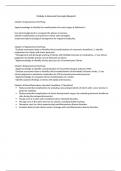
Module 4 Advanced Concepts Blueprint
Chapter 36 Ignatavicius Med-Surg
Apply knowledge to identify the manifestations for early stages of Alzheimer's.
Use clinical judgement to recognize the phases of seizures.
Identify manifestations and priority in clients with meningitis.
Understand pharmacological management for migraine headaches.
Chapter 37 Ignatavicius Med-Surg
*Evaluate assessment data to identify clinical manifestations of autonomic dysreflexia. 2. Identify
implications for clients with lower back pain.
*Management and discharge teaching of clients with Multiple Sclerosis on medications. 4. Use clinical
judgement to identify priority care of ACD post op clients.
*Apply knowledge to identify priority post-op care of Laminectomy Clients.
Chapter 38 Ignatavicius Med-Surg
*Apply knowledge to identify contraindication of Tissue Plasminogen Activator (TPA).
*Evaluate assessment data to identify clinical manifestations of thrombotic ischemic stroke. 3. Use
clinical judgment to administer medication for ICP (Increased intracranial pressure).
*Apply knowledge to recognize clinical manifestations of a stroke.
*Identify expected findings of clients with epidural hematoma.
Chapter 48 Noninflammatory Intestinal Conditions (7 Questions)
Reduce potential complications by analyzing cues postoperatively of clients with a new ostomy to
generate solutions.
Reduce potential complications of clients having bowel surgery by evaluating electronic healthcare
data during the perioperative period.
Mange care of a client with noninflammatory intestinal disorders.
Manage care of the client who has an ostomy, including health teaching.
Recognize cues for clients experiencing noninflammatory disease disorders.
Evaluate dietary foods clients need to manage with noninflammatory disease disorders.
, Chapter 49 Inflammatory Intestinal Conditions (6 Questions)
Recognize cues for clients experiencing inflammatory disease disorders.
Peritonitis (Acute) Cues:
Causes: Rigid board like abdomen (classic), Abdomen pain (localized, poorly
Any person that has a Gtube/Jtube can localized, or referred to shoulder or chest), Distended abdomen, N/V
get it and you need to be able to anorexia, Decreased bowel sounds, Can’t pass flatus or feces, Rebound
recognize s/s and treat quickly to prevent tenderness, High Fever > 100, tachycardia, Dehydration from high fever
sepsis and poor skin turgor, Decreased U/O, Hiccups
E-coli
Perforated colon Evaluation: able to tolerate fluids before removing the NG tube, no N/V,
Stomach Ulcer verbalized relief or control of pain, experiences restoration of fluid
Diverticulitis balance.
Nursing Care: Elevate knees to take pressure off
their stomach to decrease pain, limited stimuli,
monitor resp. function, monitor V/S to make sure
not going septic, Neuros, strict asepsis, semi
fowlers pos. to increase resp status with knees
flexed for pain, NG tube and NPO.
Labs: May need sample of fluid with peritonitis,
Xray and ultrasound to see any perforation
Meds: Hypertonic IV r/t third spacing, May need
TPN
Surgery: May need Exploratory laparotomy to go in
and clean out cavity and abx cleansing, possible
drain insertion
Chapter 36 Ignatavicius Med-Surg
Apply knowledge to identify the manifestations for early stages of Alzheimer's.
Use clinical judgement to recognize the phases of seizures.
Identify manifestations and priority in clients with meningitis.
Understand pharmacological management for migraine headaches.
Chapter 37 Ignatavicius Med-Surg
*Evaluate assessment data to identify clinical manifestations of autonomic dysreflexia. 2. Identify
implications for clients with lower back pain.
*Management and discharge teaching of clients with Multiple Sclerosis on medications. 4. Use clinical
judgement to identify priority care of ACD post op clients.
*Apply knowledge to identify priority post-op care of Laminectomy Clients.
Chapter 38 Ignatavicius Med-Surg
*Apply knowledge to identify contraindication of Tissue Plasminogen Activator (TPA).
*Evaluate assessment data to identify clinical manifestations of thrombotic ischemic stroke. 3. Use
clinical judgment to administer medication for ICP (Increased intracranial pressure).
*Apply knowledge to recognize clinical manifestations of a stroke.
*Identify expected findings of clients with epidural hematoma.
Chapter 48 Noninflammatory Intestinal Conditions (7 Questions)
Reduce potential complications by analyzing cues postoperatively of clients with a new ostomy to
generate solutions.
Reduce potential complications of clients having bowel surgery by evaluating electronic healthcare
data during the perioperative period.
Mange care of a client with noninflammatory intestinal disorders.
Manage care of the client who has an ostomy, including health teaching.
Recognize cues for clients experiencing noninflammatory disease disorders.
Evaluate dietary foods clients need to manage with noninflammatory disease disorders.
, Chapter 49 Inflammatory Intestinal Conditions (6 Questions)
Recognize cues for clients experiencing inflammatory disease disorders.
Peritonitis (Acute) Cues:
Causes: Rigid board like abdomen (classic), Abdomen pain (localized, poorly
Any person that has a Gtube/Jtube can localized, or referred to shoulder or chest), Distended abdomen, N/V
get it and you need to be able to anorexia, Decreased bowel sounds, Can’t pass flatus or feces, Rebound
recognize s/s and treat quickly to prevent tenderness, High Fever > 100, tachycardia, Dehydration from high fever
sepsis and poor skin turgor, Decreased U/O, Hiccups
E-coli
Perforated colon Evaluation: able to tolerate fluids before removing the NG tube, no N/V,
Stomach Ulcer verbalized relief or control of pain, experiences restoration of fluid
Diverticulitis balance.
Nursing Care: Elevate knees to take pressure off
their stomach to decrease pain, limited stimuli,
monitor resp. function, monitor V/S to make sure
not going septic, Neuros, strict asepsis, semi
fowlers pos. to increase resp status with knees
flexed for pain, NG tube and NPO.
Labs: May need sample of fluid with peritonitis,
Xray and ultrasound to see any perforation
Meds: Hypertonic IV r/t third spacing, May need
TPN
Surgery: May need Exploratory laparotomy to go in
and clean out cavity and abx cleansing, possible
drain insertion