Jesse Rusyniak
Task # 1 Math Tools
Mathematics Methods and Instruction for Students with Mild/Moderate Exceptionalities
WGU – D237
Student ID # 009449757
Part One: Tools
A. Hands-on Tools
Tool 1: Legos
• Place value can be taught using Legos.
• For all sorts of learners, Legos are an excellent approach to develop a mental
knowledge of place value.
• Legos, like dice, can be a distraction in the classroom if the teacher isn't careful.
Tool 2: Ruler
• Students can learn how to measure area and perimeter using rulers.
• Rulers allow pupils to experiment with measuring concepts in a visual way.
• Because of their size, rulers are limited in what they can measure. They may also
necessitate a more in-depth thought process.
Tool 3: Dice
• Addition and subtraction can be done with dice.
• Dice are a great method to keep children interested in a lesson since they make it
enjoyable.
• Dice tumbling off the desk may cause students to lose focus.
Tool 4: Two Colored Counters
• llustrate mathematical principles such as addition, subtraction, multiplication, and
division
• Two colored counters have the advantage of assisting with a wide range of visual
mathematical concepts, including sorting, counting, probability, place value, and
much more.
• A disadvantage is that the counters are not easy to use with larger numbers.
B. Virtual Tools
Tool 1: Number Pieces (https://www.mathlearningcenter.org/apps/number-pieces)
• Students can use number pieces to aid them with a variety of basic math operations.
• Students can learn about the importance of place value by using number pieces.
• Because this app is not aesthetically appealing, pupils may lose interest.
Tool 2: Virtual Clocks (https://www.roomrecess.com/Tools/InteractiveClock/play.html)
• Assist kids in learning how to read an analog clock.
• An advantage can be that teachers can use these tools to stop or take away individual
clock hands to increase or decrease the difficulty of the task.
, • One downside is that if a student does not know their numbers, they may struggle.
Tool 3: Pattern Shapes (https://www.mathlearningcenter.org/apps/pattern-shapes)
• Addition and subtraction are made easier with pattern forms.
• Fractions are easier to understand when pupils use pattern shapes.
• The software can be difficult to navigate.
Tool 4: Number Rack (https://www.mathlearningcenter.org/apps/number-rack)
• Number racks are used to add and subtract.
• Number racks assist in the natural development of a student's number sense in
elementary school.
• The possibilities are restricted, and they can only assist with simple addition and
subtraction tasks.
Part Two: Lesson Plan
C.
General Information
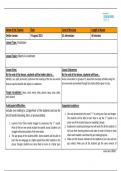
Lesson Title: Estimating, Measuring, and Comparing
Subject(s): Math
Grade/Level/Setting: 2nd Grade Classroom
Prerequisite Skills/Prior Knowledge:
Students will have prior number knowledge, such as counting, addition, and subtraction, as well as knowledge of
measuring on a smaller scale. Students must also understand how to use a ruler.
Standards and Objectives
State/National Academic Standard(s):
CCSS.Math.Content.2.MD.A.3
Estimate lengths using units of inches, feet, centimeters, and meters.
CCSS.Math.Content.2.MD.A.1
Measure the length of an object by selecting and using appropriate tools such as rulers, yardsticks, meter sticks, and
measuring tapes.
CCSS.Math.Content.2.MD.A.4
Measure to determine how much longer one object is than another, expressing the length difference in terms of a
standard length unit.
Learning Objective(s):
Students will be able to estimate the length of an object with 90 percent accuracy using the appropriate terminology
of inches, feet, centimeters, and meters. Students will be able to measure and determine the difference between two
objects with 90 percent accuracy using standard unit length.
Materials Technology
Paper, pencil, graphic organizer, and ruler The teacher will demonstrate what needs to be done to
the entire class using a virtual ruler projected on the
smartboard.
Language Demands
Specific ways that academic language (vocabulary, functions, discourse, syntax) is used by students to participate
in learning tasks through reading, writing, listening, and/or speaking to demonstrate their understanding.
Task # 1 Math Tools
Mathematics Methods and Instruction for Students with Mild/Moderate Exceptionalities
WGU – D237
Student ID # 009449757
Part One: Tools
A. Hands-on Tools
Tool 1: Legos
• Place value can be taught using Legos.
• For all sorts of learners, Legos are an excellent approach to develop a mental
knowledge of place value.
• Legos, like dice, can be a distraction in the classroom if the teacher isn't careful.
Tool 2: Ruler
• Students can learn how to measure area and perimeter using rulers.
• Rulers allow pupils to experiment with measuring concepts in a visual way.
• Because of their size, rulers are limited in what they can measure. They may also
necessitate a more in-depth thought process.
Tool 3: Dice
• Addition and subtraction can be done with dice.
• Dice are a great method to keep children interested in a lesson since they make it
enjoyable.
• Dice tumbling off the desk may cause students to lose focus.
Tool 4: Two Colored Counters
• llustrate mathematical principles such as addition, subtraction, multiplication, and
division
• Two colored counters have the advantage of assisting with a wide range of visual
mathematical concepts, including sorting, counting, probability, place value, and
much more.
• A disadvantage is that the counters are not easy to use with larger numbers.
B. Virtual Tools
Tool 1: Number Pieces (https://www.mathlearningcenter.org/apps/number-pieces)
• Students can use number pieces to aid them with a variety of basic math operations.
• Students can learn about the importance of place value by using number pieces.
• Because this app is not aesthetically appealing, pupils may lose interest.
Tool 2: Virtual Clocks (https://www.roomrecess.com/Tools/InteractiveClock/play.html)
• Assist kids in learning how to read an analog clock.
• An advantage can be that teachers can use these tools to stop or take away individual
clock hands to increase or decrease the difficulty of the task.
, • One downside is that if a student does not know their numbers, they may struggle.
Tool 3: Pattern Shapes (https://www.mathlearningcenter.org/apps/pattern-shapes)
• Addition and subtraction are made easier with pattern forms.
• Fractions are easier to understand when pupils use pattern shapes.
• The software can be difficult to navigate.
Tool 4: Number Rack (https://www.mathlearningcenter.org/apps/number-rack)
• Number racks are used to add and subtract.
• Number racks assist in the natural development of a student's number sense in
elementary school.
• The possibilities are restricted, and they can only assist with simple addition and
subtraction tasks.
Part Two: Lesson Plan
C.
General Information
Lesson Title: Estimating, Measuring, and Comparing
Subject(s): Math
Grade/Level/Setting: 2nd Grade Classroom
Prerequisite Skills/Prior Knowledge:
Students will have prior number knowledge, such as counting, addition, and subtraction, as well as knowledge of
measuring on a smaller scale. Students must also understand how to use a ruler.
Standards and Objectives
State/National Academic Standard(s):
CCSS.Math.Content.2.MD.A.3
Estimate lengths using units of inches, feet, centimeters, and meters.
CCSS.Math.Content.2.MD.A.1
Measure the length of an object by selecting and using appropriate tools such as rulers, yardsticks, meter sticks, and
measuring tapes.
CCSS.Math.Content.2.MD.A.4
Measure to determine how much longer one object is than another, expressing the length difference in terms of a
standard length unit.
Learning Objective(s):
Students will be able to estimate the length of an object with 90 percent accuracy using the appropriate terminology
of inches, feet, centimeters, and meters. Students will be able to measure and determine the difference between two
objects with 90 percent accuracy using standard unit length.
Materials Technology
Paper, pencil, graphic organizer, and ruler The teacher will demonstrate what needs to be done to
the entire class using a virtual ruler projected on the
smartboard.
Language Demands
Specific ways that academic language (vocabulary, functions, discourse, syntax) is used by students to participate
in learning tasks through reading, writing, listening, and/or speaking to demonstrate their understanding.