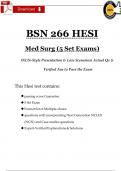
BSN 266 HESI
Med Surg (5 Set Exams)
(NGN-Style Presentation & Case Scenarios) Actual Qs &
Verified Ans to Pass the Exam
This Hesi test contains:
passing score Guarantee
5 Set Exam
Format Set of Multiple-choice
questions with incorporating Next Generation NCLEX
(NGN) and Case studies questions
Expert-Verified Explanations & Solutions
, Table of Contents
BSN 266 Hesi Med surg Exam #1 ......................................2
BSN 266 Hesi Med surg Exam #2 ....................................61
BSN 266 Hesi Med surg Exam #3 ..................................126
BSN 266 Hesi Med surg Exam #4 ..................................197
BSN 266 Hesi Med surg Exam #5 ................................. 259
BSN 266 HESI MED SURG EXAM #1
### 1.
A client who underwent cardiac stent placement 4 days ago arrives to
the emergency department reporting sudden onset chest pressure and
shortness of breath.
Which action should the nurse take next?
Answer Choices:
a. Administer prescribed nitroglycerin sublingually.
b. Obtain a 12-lead electrocardiogram (ECG) and begin continuous
cardiac monitoring.
c. Give oxygen at 2 liters per minute via nasal cannula.
d. Prepare the client for immediate cardiac catheterization.
ANSWER:
,b. Obtain a 12-lead electrocardiogram (ECG) and begin continuous cardiac
monitoring.
Expert Rationale:
A client with sudden chest pressure and shortness of breath after recent
stenting is at high risk for acute stent thrombosis or myocardial infarction
(MI). Immediate acquisition of a 12-lead ECG is critical to assess for
ischemic changes and to prioritize timely reperfusion therapy if needed.
Continuous cardiac monitoring is essential to detect arrhythmias.
Although oxygen and nitroglycerin may be administered per protocol,
assessment data guides further interventions. Immediate preparation for
catheterization is
premature before diagnostic confirmation.
---
### 2.
While completing a health assessment for a client with migraine
headaches, the nurse identifies bilateral weakness in the client’s hand
grips. The client reports joint pain and difficulty twisting a door knob
due to weakness.
Which action should the nurse take next?
Answer Choices:
a. Teach the client relaxation techniques to manage migraine pain.
b. Document the findings and continue with the neurological assessment.
c. Gather additional assessment data about the pain and weakness.
, d. Refer the client immediately to a neurologist.
Med Surg (5 Set Exams)
(NGN-Style Presentation & Case Scenarios) Actual Qs &
Verified Ans to Pass the Exam
This Hesi test contains:
passing score Guarantee
5 Set Exam
Format Set of Multiple-choice
questions with incorporating Next Generation NCLEX
(NGN) and Case studies questions
Expert-Verified Explanations & Solutions
, Table of Contents
BSN 266 Hesi Med surg Exam #1 ......................................2
BSN 266 Hesi Med surg Exam #2 ....................................61
BSN 266 Hesi Med surg Exam #3 ..................................126
BSN 266 Hesi Med surg Exam #4 ..................................197
BSN 266 Hesi Med surg Exam #5 ................................. 259
BSN 266 HESI MED SURG EXAM #1
### 1.
A client who underwent cardiac stent placement 4 days ago arrives to
the emergency department reporting sudden onset chest pressure and
shortness of breath.
Which action should the nurse take next?
Answer Choices:
a. Administer prescribed nitroglycerin sublingually.
b. Obtain a 12-lead electrocardiogram (ECG) and begin continuous
cardiac monitoring.
c. Give oxygen at 2 liters per minute via nasal cannula.
d. Prepare the client for immediate cardiac catheterization.
ANSWER:
,b. Obtain a 12-lead electrocardiogram (ECG) and begin continuous cardiac
monitoring.
Expert Rationale:
A client with sudden chest pressure and shortness of breath after recent
stenting is at high risk for acute stent thrombosis or myocardial infarction
(MI). Immediate acquisition of a 12-lead ECG is critical to assess for
ischemic changes and to prioritize timely reperfusion therapy if needed.
Continuous cardiac monitoring is essential to detect arrhythmias.
Although oxygen and nitroglycerin may be administered per protocol,
assessment data guides further interventions. Immediate preparation for
catheterization is
premature before diagnostic confirmation.
---
### 2.
While completing a health assessment for a client with migraine
headaches, the nurse identifies bilateral weakness in the client’s hand
grips. The client reports joint pain and difficulty twisting a door knob
due to weakness.
Which action should the nurse take next?
Answer Choices:
a. Teach the client relaxation techniques to manage migraine pain.
b. Document the findings and continue with the neurological assessment.
c. Gather additional assessment data about the pain and weakness.
, d. Refer the client immediately to a neurologist.