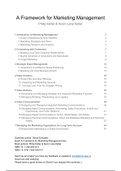
A Framework for Marketing Management
Philip Kotler & Kevin Lane Keller
1 Introduction to Marketing Management 2
1 Scope of Marketing for New Realities 2
2 Marketing Strategies and Plans 3
3 Marketing Research and Analysis 5
2 Connecting with Customers 7
4 Building Long-Term Customer Relationships 7
5 Buying Dynamics of Consumers and Businesses 8
6 Target Marketing 9
3 Strategic Brand Management 12
7 Competitive and Effective Brand Positioning 12
8 Branding and Core Business Growth 13
4 Value Creation 15
9 Product Mix and New Offerings 15
10: Analyzing and Marketing Services 16
11: Concepts and Tools for Strategic Pricing 16
5 Value Delivery 18
12 Developing and Managing Strategic and Integrated Marketing Channels 18
13 Managing Retailing, Wholesaling, and Logistics 19
6 Value Communication 20
14 Designing and Managing Integrated Marketing Communications 20
15 Managing Mass Communications: Advertising, Sales Promotions, Events and
Experiences, and Public Relations 21
16 Managing Digital Communications: Online, Social Media, and Mobile 21
17 Managing Personal Communications: Direct and Database Marketing and Personal
Selling 22
7 Managing the Marketing Organization for Long-Term Success 24
18 Responsible Marketing in a Global Environment 24
Summary author: David Schouten
Book: A Framework for Marketing Management (6e)
Book authors: Philip Kotler & Kevin Lane Keller
ISBN 10: 1-292-09314-5
ISBN 13: 978-1-292-09314-7
Send me an email if you have any feedback or questions:
Good luck with studying!
Please leave a good review on Stuvia if you enjoyed this summary :)
,1 Introduction to Marketing Management
1 Scope of Marketing for New Realities
The American Marketing Association defines marketing as “the activity, set of institutions,
and processes for creating, communicating, delivering, and exchanging offerings that have
value for customers, clients, partners, and society at large”. The aim of marketing is “to know
and understand the customer so well that the product or service fits him and sells itself”.
Marketers market 10 main types of entities: goods, services, events, experiences, persons,
places, properties, organizations, information, and ideas.
The term market is used to describe customer groups. There’s need markets, product
markets, demographic markets, geographic markets, or voter markets, labor markets, and
donor markets. Four key customer markets are consumer, business, global, and nonprofit.
Some core marketing concepts are
● Needs, Wants and Demands
Needs are basic human requirements, which become wants when directed to
specific objects that might satisfy the need. Demands are wants for specific
wants, backed by ability to pay. We can distinguish five types of needs:
stated, real, unstated, delight, and secret needs.
● Target Markets, Positioning, and Segmentation
A market offering should be developed for each target market and be
positioned in target buyer’s minds as delivering benefits.
● Offerings and Brands
Customer needs are addressed by developing a value proposition. A brand
is an offering from a known source.
● Marketing Channels
There are three types of channels: Communication channels, Distribution
channel, and Service channels
● Paid, Owned and Earned Media
There are three categories of media: Paid (TV, magazine and display ads),
Owned (FB page, website), and Earned (word of mouth, buzz)
● Impressions and Engagement
Impressions occur when consumers view a communication. Engagement is
the extent of a customer’s attention and active involvement with a
communication (likes, retweets)
● Value and Satisfaction
The customer value triad c onsists of quality, service and price. The buyer
chooses the offerings they perceive to have the best value.
● Supply Chain
A longer channel stretching from raw materials to components to finished
products carried to final buyers.
2
, ● Competition
Competition includes all the actual and potential rival offerings and
substitutions a buyer might consider.
● Marketing Environment
Consists of the task environment (actors engaged in producing, distributing
and promoting the offering) and broad environment.
The book focuses on three transformative forces: Technology, Globalization, and Social
Responsibility.
A company’s marketing efforts are guided by a philosophy/orientation towards the
marketplace. Common philosophies are Production concept (consumers prefer products
which are widely available and inexpensive); Product concept (consumers prefer products
with best quality, performance or features); Selling concept (products which usually don’t sell
themselves, e.g. insurance. Aggressive selling tactics); Marketing concept (find the right
product for your customers; and Holistic Marketing concept.
The Holistic Marketing Concept acknowledges that everything matters in
marketing. It’s based on four broad components;
● Relationship Marketing
Aims to build mutually satisfying long-term relationships with key constituents
in order to earn and retain their business. The ultimate outcome is a
marketing network, consisting of the company and its supporting stakeholders
● Integrated Marketing
Two key themes are that (1) many different marketing activities can create,
communicate and deliver value; and (2) marketers should design and
implement each marketing activity with all other activities in mind.
● Internal Marketing
The task of hiring, training and motivating able employees.
● Performance Marketing
Performance marketing requires understanding of financial and nonfinancial
returns to business and society from marketing activities and programs.
The four Ps of marketing (product, price, place, and promotion) have been updated to be
more representative of modern marketing realities: people, processes, programs and
performance.
2 Marketing Strategies and Plans
Traditionally, marketing was only taking place during the selling process. More recently
however, the realization has come that the value creation and delivery sequence consist of
three phases: choosing the value, providing the value, and communicating the value.
Marketing is part of every phase.
A firm’s success depends on its ability to coordinate core business processes, like the
market-sensing process, the new-offering realization process, and the customer acquisition
process.
3
Philip Kotler & Kevin Lane Keller
1 Introduction to Marketing Management 2
1 Scope of Marketing for New Realities 2
2 Marketing Strategies and Plans 3
3 Marketing Research and Analysis 5
2 Connecting with Customers 7
4 Building Long-Term Customer Relationships 7
5 Buying Dynamics of Consumers and Businesses 8
6 Target Marketing 9
3 Strategic Brand Management 12
7 Competitive and Effective Brand Positioning 12
8 Branding and Core Business Growth 13
4 Value Creation 15
9 Product Mix and New Offerings 15
10: Analyzing and Marketing Services 16
11: Concepts and Tools for Strategic Pricing 16
5 Value Delivery 18
12 Developing and Managing Strategic and Integrated Marketing Channels 18
13 Managing Retailing, Wholesaling, and Logistics 19
6 Value Communication 20
14 Designing and Managing Integrated Marketing Communications 20
15 Managing Mass Communications: Advertising, Sales Promotions, Events and
Experiences, and Public Relations 21
16 Managing Digital Communications: Online, Social Media, and Mobile 21
17 Managing Personal Communications: Direct and Database Marketing and Personal
Selling 22
7 Managing the Marketing Organization for Long-Term Success 24
18 Responsible Marketing in a Global Environment 24
Summary author: David Schouten
Book: A Framework for Marketing Management (6e)
Book authors: Philip Kotler & Kevin Lane Keller
ISBN 10: 1-292-09314-5
ISBN 13: 978-1-292-09314-7
Send me an email if you have any feedback or questions:
Good luck with studying!
Please leave a good review on Stuvia if you enjoyed this summary :)
,1 Introduction to Marketing Management
1 Scope of Marketing for New Realities
The American Marketing Association defines marketing as “the activity, set of institutions,
and processes for creating, communicating, delivering, and exchanging offerings that have
value for customers, clients, partners, and society at large”. The aim of marketing is “to know
and understand the customer so well that the product or service fits him and sells itself”.
Marketers market 10 main types of entities: goods, services, events, experiences, persons,
places, properties, organizations, information, and ideas.
The term market is used to describe customer groups. There’s need markets, product
markets, demographic markets, geographic markets, or voter markets, labor markets, and
donor markets. Four key customer markets are consumer, business, global, and nonprofit.
Some core marketing concepts are
● Needs, Wants and Demands
Needs are basic human requirements, which become wants when directed to
specific objects that might satisfy the need. Demands are wants for specific
wants, backed by ability to pay. We can distinguish five types of needs:
stated, real, unstated, delight, and secret needs.
● Target Markets, Positioning, and Segmentation
A market offering should be developed for each target market and be
positioned in target buyer’s minds as delivering benefits.
● Offerings and Brands
Customer needs are addressed by developing a value proposition. A brand
is an offering from a known source.
● Marketing Channels
There are three types of channels: Communication channels, Distribution
channel, and Service channels
● Paid, Owned and Earned Media
There are three categories of media: Paid (TV, magazine and display ads),
Owned (FB page, website), and Earned (word of mouth, buzz)
● Impressions and Engagement
Impressions occur when consumers view a communication. Engagement is
the extent of a customer’s attention and active involvement with a
communication (likes, retweets)
● Value and Satisfaction
The customer value triad c onsists of quality, service and price. The buyer
chooses the offerings they perceive to have the best value.
● Supply Chain
A longer channel stretching from raw materials to components to finished
products carried to final buyers.
2
, ● Competition
Competition includes all the actual and potential rival offerings and
substitutions a buyer might consider.
● Marketing Environment
Consists of the task environment (actors engaged in producing, distributing
and promoting the offering) and broad environment.
The book focuses on three transformative forces: Technology, Globalization, and Social
Responsibility.
A company’s marketing efforts are guided by a philosophy/orientation towards the
marketplace. Common philosophies are Production concept (consumers prefer products
which are widely available and inexpensive); Product concept (consumers prefer products
with best quality, performance or features); Selling concept (products which usually don’t sell
themselves, e.g. insurance. Aggressive selling tactics); Marketing concept (find the right
product for your customers; and Holistic Marketing concept.
The Holistic Marketing Concept acknowledges that everything matters in
marketing. It’s based on four broad components;
● Relationship Marketing
Aims to build mutually satisfying long-term relationships with key constituents
in order to earn and retain their business. The ultimate outcome is a
marketing network, consisting of the company and its supporting stakeholders
● Integrated Marketing
Two key themes are that (1) many different marketing activities can create,
communicate and deliver value; and (2) marketers should design and
implement each marketing activity with all other activities in mind.
● Internal Marketing
The task of hiring, training and motivating able employees.
● Performance Marketing
Performance marketing requires understanding of financial and nonfinancial
returns to business and society from marketing activities and programs.
The four Ps of marketing (product, price, place, and promotion) have been updated to be
more representative of modern marketing realities: people, processes, programs and
performance.
2 Marketing Strategies and Plans
Traditionally, marketing was only taking place during the selling process. More recently
however, the realization has come that the value creation and delivery sequence consist of
three phases: choosing the value, providing the value, and communicating the value.
Marketing is part of every phase.
A firm’s success depends on its ability to coordinate core business processes, like the
market-sensing process, the new-offering realization process, and the customer acquisition
process.
3