

LKJHGFD
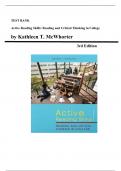
TEST BANK
Active Reading Skills: Reading and Critical Thinking in College
by Kathleen T. McWhorter
3rd Edition
ST
U
D
YL
AB
, LKJHGFD
NAME: DATE: SECTION:
NUMBER CORRECT X 10 POINTS = SCORE: %
CHAPTER 1
READING College textbooks: An active approach
Directions: Write the letter of the choice that best completes each statement in the space provided.
1. A successful way to approach a reading assignment is to
a. set goals for yourself.
ST
b. decide what you need to learn before you begin.
c. tell yourself that the assignment is manageable.
d. do all of the above.
2. All of the following techniques can help you increase your attention span except
a. reading with a purpose.
U
b. keeping a distractions list.
c. working on only one assignment per evening.
d. combining physical and mental activities.
D
3. One characteristic of active readers is that they typically
a. read everything at the same speed.
b. analyze the purpose of an assignment.
YL
c. accept whatever is in print as true.
d. study lecture notes and textbook readings separately.
4. The first step in previewing a reading assignment is to
a. look for unfamiliar terminology.
b. read the chapter summary.
AB
c. read the title and subtitle.
d. note any graphs, charts, or tables.
5. Guide questions are questions you expect to be able to answer
a. before you read the material.
b. while or after you read the material.
c. after you research the material in other sources.
d. without reading the material.
6. The SQ3R system improves your reading efficiency by
a. increasing your comprehension.
b. improving your recall.
c. saving you time later when you prepare for an exam.
d. all of the above.
LKJHGFD
, LKJHGFD
7. In the SQ3R system, the “S” stands for
a. summarize.
b. self-test.
c. survey.
d. study.
8. Making connections between new information and what you already know is called
a. intent to remember.
b. association.
c. categorization.
d. visualization.
ST
Directions: For each of the following chapter or article titles, choose the most helpful guide question
and write the letter of the choice in the space provided.
9. “Civil Rights and the March on Washington”
a. When was the March on Washington?
b. Why was the March on Washington significant in the civil rights movement?
U
c. Did Dr. Martin Luther King, Jr., lead the March on Washington?
d. Did the March on Washington affect the struggle for civil rights?
10. “Dietary Dilemmas: Finding A Diet You Can Live With”
D
a. What diets are appropriate for diabetics?
b. Is it common for people to face a dietary dilemma?
c. How do you find a diet that is right for you?
YL
d. Is the author qualified to write about diets?
AB
LKJHGFD
, LKJHGFD
NAME: DATE: SECTION:
NUMBER CORRECT X 10 POINTS = SCORE: %
CHAPTER 2
STRENGTHENING YOUR VOCABULARY
Directions: Write the letter of the choice that best completes each statement in the space provided.
1. Inference is the process of figuring out the meaning of an unknown word by using
ST
a. logic and reasoning.
b. examples.
c. contrast clues.
d. punctuation.
2. Of the following phrases, the one that indicates that a writer is using a definition context
U
clue is
a. such as.
b. to illustrate.
D
c. on the other hand.
d. refers to.
3. A synonym is a word or phrase that
YL
a. sounds the same as another word.
b. has the same meaning as another word.
c. has the opposite meaning of another word.
d. is spelled the same as another word but has a different meaning.
AB
4. The part of a word that contains its basic meaning is the
a. prefix.
b. suffix.
c. root.
d. context.
5. The word antibiotic consists of a
a. root only.
b. prefix and a root.
c. prefix, a root, and a suffix.
d. root and a suffix.
LKJHGFD
TEST BANK
Active Reading Skills: Reading and Critical Thinking in College
by Kathleen T. McWhorter
3rd Edition
ST
U
D
YL
AB
, LKJHGFD
NAME: DATE: SECTION:
NUMBER CORRECT X 10 POINTS = SCORE: %
CHAPTER 1
READING College textbooks: An active approach
Directions: Write the letter of the choice that best completes each statement in the space provided.
1. A successful way to approach a reading assignment is to
a. set goals for yourself.
ST
b. decide what you need to learn before you begin.
c. tell yourself that the assignment is manageable.
d. do all of the above.
2. All of the following techniques can help you increase your attention span except
a. reading with a purpose.
U
b. keeping a distractions list.
c. working on only one assignment per evening.
d. combining physical and mental activities.
D
3. One characteristic of active readers is that they typically
a. read everything at the same speed.
b. analyze the purpose of an assignment.
YL
c. accept whatever is in print as true.
d. study lecture notes and textbook readings separately.
4. The first step in previewing a reading assignment is to
a. look for unfamiliar terminology.
b. read the chapter summary.
AB
c. read the title and subtitle.
d. note any graphs, charts, or tables.
5. Guide questions are questions you expect to be able to answer
a. before you read the material.
b. while or after you read the material.
c. after you research the material in other sources.
d. without reading the material.
6. The SQ3R system improves your reading efficiency by
a. increasing your comprehension.
b. improving your recall.
c. saving you time later when you prepare for an exam.
d. all of the above.
LKJHGFD
, LKJHGFD
7. In the SQ3R system, the “S” stands for
a. summarize.
b. self-test.
c. survey.
d. study.
8. Making connections between new information and what you already know is called
a. intent to remember.
b. association.
c. categorization.
d. visualization.
ST
Directions: For each of the following chapter or article titles, choose the most helpful guide question
and write the letter of the choice in the space provided.
9. “Civil Rights and the March on Washington”
a. When was the March on Washington?
b. Why was the March on Washington significant in the civil rights movement?
U
c. Did Dr. Martin Luther King, Jr., lead the March on Washington?
d. Did the March on Washington affect the struggle for civil rights?
10. “Dietary Dilemmas: Finding A Diet You Can Live With”
D
a. What diets are appropriate for diabetics?
b. Is it common for people to face a dietary dilemma?
c. How do you find a diet that is right for you?
YL
d. Is the author qualified to write about diets?
AB
LKJHGFD
, LKJHGFD
NAME: DATE: SECTION:
NUMBER CORRECT X 10 POINTS = SCORE: %
CHAPTER 2
STRENGTHENING YOUR VOCABULARY
Directions: Write the letter of the choice that best completes each statement in the space provided.
1. Inference is the process of figuring out the meaning of an unknown word by using
ST
a. logic and reasoning.
b. examples.
c. contrast clues.
d. punctuation.
2. Of the following phrases, the one that indicates that a writer is using a definition context
U
clue is
a. such as.
b. to illustrate.
D
c. on the other hand.
d. refers to.
3. A synonym is a word or phrase that
YL
a. sounds the same as another word.
b. has the same meaning as another word.
c. has the opposite meaning of another word.
d. is spelled the same as another word but has a different meaning.
AB
4. The part of a word that contains its basic meaning is the
a. prefix.
b. suffix.
c. root.
d. context.
5. The word antibiotic consists of a
a. root only.
b. prefix and a root.
c. prefix, a root, and a suffix.
d. root and a suffix.
LKJHGFD


