SPAUD 505 Final questions well answered graded
A+ updated
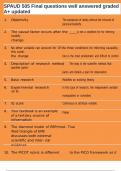
1. Objectivity The expression of reality without the intrusion of
personal beliefs
2. The causal factor occurs after the is not a condition for for inferring
causality
change
3. No other variable can account for Of the three conditions for inferring causality,
this condi-
the change tion is the most problematic and diflcult to control
4. Description of research method The step in the scientific method that
specifies partici-
pants and details a plan for observation
5. Basic research Modifies an existing theory
6. Experimental research In this type of research, the independent variable
can be
manipulated or controlled
7. IQ score Continuous & attribute variable
8. Your textbook is an example False
of a tertiary source of
information
9. The diamond model of EBP/mod- True
ified triangle of EPB
discusses both external
scientific and inter- nal
evidence
10. The PICOT rubric is different to the PICO framework as it
1/
34
,SPAUD 505 Final questions well answered graded
A+ updated
consid- ers "T", which stands False
for theme
11. Inductive Analysis Qualitative researchers usually begin with specific
exam- ples or facts, formulate questions and may
end up with generalized principles or theories
2/
34
,SPAUD 505 Final questions well answered graded
A+ updated
12. Ordinal data Ranked severity groups (mild, moderate, severe)
13. Nominal data Phoneme production (correct vs. incorrect)
14. Ratio data Stuttering frequency
15. Interval data A standard score on a behavioral test ( e.g. PPVT,
TOLD, CELF)
16. Ratio data Speech intelligibility score
17. A positively skewed distribution is
True one in which most scores
cluster around the low value
but a small number of scores
spread out into the very high
scores
18. Histograms are graphical True
rep- resentations of
continuous vari- ables
19. The statement, False
"neurotypical adults will
have faster word recall than
patients post-stroke with
aphasia" is an example of a
null hypothesis
20. Unstructured interviews Interviews that are driven by the person being
inter-
viewed and that are more suitable for exploring
3/
34
, SPAUD 505 Final questions well answered graded
A+ updated
sensitive, emotional, and personal topics
21. The degree to which False
relationship between IV &
DV is observed
4/
34
A+ updated
1. Objectivity The expression of reality without the intrusion of
personal beliefs
2. The causal factor occurs after the is not a condition for for inferring
causality
change
3. No other variable can account for Of the three conditions for inferring causality,
this condi-
the change tion is the most problematic and diflcult to control
4. Description of research method The step in the scientific method that
specifies partici-
pants and details a plan for observation
5. Basic research Modifies an existing theory
6. Experimental research In this type of research, the independent variable
can be
manipulated or controlled
7. IQ score Continuous & attribute variable
8. Your textbook is an example False
of a tertiary source of
information
9. The diamond model of EBP/mod- True
ified triangle of EPB
discusses both external
scientific and inter- nal
evidence
10. The PICOT rubric is different to the PICO framework as it
1/
34
,SPAUD 505 Final questions well answered graded
A+ updated
consid- ers "T", which stands False
for theme
11. Inductive Analysis Qualitative researchers usually begin with specific
exam- ples or facts, formulate questions and may
end up with generalized principles or theories
2/
34
,SPAUD 505 Final questions well answered graded
A+ updated
12. Ordinal data Ranked severity groups (mild, moderate, severe)
13. Nominal data Phoneme production (correct vs. incorrect)
14. Ratio data Stuttering frequency
15. Interval data A standard score on a behavioral test ( e.g. PPVT,
TOLD, CELF)
16. Ratio data Speech intelligibility score
17. A positively skewed distribution is
True one in which most scores
cluster around the low value
but a small number of scores
spread out into the very high
scores
18. Histograms are graphical True
rep- resentations of
continuous vari- ables
19. The statement, False
"neurotypical adults will
have faster word recall than
patients post-stroke with
aphasia" is an example of a
null hypothesis
20. Unstructured interviews Interviews that are driven by the person being
inter-
viewed and that are more suitable for exploring
3/
34
, SPAUD 505 Final questions well answered graded
A+ updated
sensitive, emotional, and personal topics
21. The degree to which False
relationship between IV &
DV is observed
4/
34