
Chapter 08: Bacterial Genetics and Biotechnology
MULTIPLE CHOICE
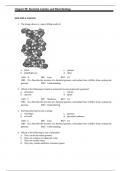
1. The image shown is a space-filling model of
a. DNA. c. protein.
b. peptidoglycan. d. lipid.
ANS: A DIF: Easy REF: 8.1
OBJ: 8.1a Describe the structure of a bacterial genome, and explain how it differs from a eukaryotic
genome. MSC: Understanding
2. Which of the following is found in eukaryotic but not prokaryotic genomes?
a. promoters c. introns
b. operons d. genes
ANS: C DIF: Moderate REF: 8.1
OBJ: 8.1a Describe the structure of a bacterial genome, and explain how it differs from a eukaryotic
genome. MSC: Remembering
3. Each bacterial species has a unique
a. cell shape. c. genome.
b. cell wall. d. glycolytic pathway.
ANS: C DIF: Easy REF: 8.1
OBJ: 8.1a Describe the structure of a bacterial genome, and explain how it differs from a eukaryotic
genome. MSC: Understanding
4. Which of the following is true of plasmids?
a. They can be the entire genome.
b. They are common in eukaryotic cells.
c. They are usually linear.
d. They may contain antibiotic resistance genes.
, ANS: D DIF: Easy REF: 8.1
OBJ: 8.1b Explain what a plasmid is, and describe the role of plasmids in the spread of antibiotic
resistance genes. MSC: Remembering
5. Plasmids usually contain genes that are
a. important for cell survival in all environments.
b. important for cell survival in particular environments.
c. not important for cell survival in any environments.
d. composed of single-stranded DNA.
ANS: B DIF: Moderate REF: 8.1
OBJ: 8.1b Explain what a plasmid is, and describe the role of plasmids in the spread of antibiotic
resistance genes. MSC: Understanding
6. In this image of a nucleoside, which arrow is pointing to the 2¢ carbon of deoxyribose?
a. 1 c. 3
b. 2 d. 4
ANS: C DIF: Moderate REF: 8.2
OBJ: 8.2a Explain how bidirectional semiconservative DNA replication copies the circular
chromosome of a bacterium during cell division. MSC: Understanding
7. In this image of a nucleoside, which arrow is pointing to the 5¢ carbon of deoxyribose?
a. 1 c. 3
b. 2 d. 4
ANS: A DIF: Moderate REF: 8.2
OBJ: 8.2a Explain how bidirectional semiconservative DNA replication copies the circular
chromosome of a bacterium during cell division. MSC: Understanding
8. In the active site of DNA polymerase, which monomer will form correct base pairs with a C in the
template strand?
a. dATP c. dGTP
, b. dCTP d. dTTP
ANS: C DIF: Easy REF: 8.2
OBJ: 8.2a Explain how bidirectional semiconservative DNA replication copies the circular
chromosome of a bacterium during cell division. MSC: Understanding
9. An E. coli cell whose DNA contains N14 is placed in media with dNTPs containing a heavy isotope of
nitrogen, N15, which incorporates into newly synthesized DNA. After one cell division, what will the
DNA in the daughter cells look like?
a. One cell will have both strands of the helix N14; the other cell will have both strands of the
helix N15.
b. One cell will have mostly N14 with a little bit of N15; the other cell will have mostly N15
with a little N14.
c. Each cell will have one strand of N14 and one strand of N15.
d. It is impossible to predict what the DNA in the daughter cells will look like.
ANS: C DIF: Difficult REF: 8.2
OBJ: 8.2a Explain how bidirectional semiconservative DNA replication copies the circular
chromosome of a bacterium during cell division. MSC: Evaluating
10. If you wanted to radioactively tag newly synthesized DNA, which numbered phosphate would need to
be radioactive?
a. 1 c. 3
b. 2 d. Either 1, 2, or 3 would work.
ANS: C DIF: Moderate REF: 8.2
OBJ: 8.2b Explain the steps of replication by DNA polymerase, including initiation, elongation, and
termination. MSC: Understanding
11. DNA replication begins at a chromosomal region called the
a. activator. c. origin.
b. initiator. d. promoter.
ANS: C DIF: Moderate REF: 8.2
OBJ: 8.2b Explain the steps of replication by DNA polymerase, including initiation, elongation, and
termination. MSC: Remembering
12. Which of the choices below has the correct 5¢ and 3¢ DNA end designations?
MULTIPLE CHOICE
1. The image shown is a space-filling model of
a. DNA. c. protein.
b. peptidoglycan. d. lipid.
ANS: A DIF: Easy REF: 8.1
OBJ: 8.1a Describe the structure of a bacterial genome, and explain how it differs from a eukaryotic
genome. MSC: Understanding
2. Which of the following is found in eukaryotic but not prokaryotic genomes?
a. promoters c. introns
b. operons d. genes
ANS: C DIF: Moderate REF: 8.1
OBJ: 8.1a Describe the structure of a bacterial genome, and explain how it differs from a eukaryotic
genome. MSC: Remembering
3. Each bacterial species has a unique
a. cell shape. c. genome.
b. cell wall. d. glycolytic pathway.
ANS: C DIF: Easy REF: 8.1
OBJ: 8.1a Describe the structure of a bacterial genome, and explain how it differs from a eukaryotic
genome. MSC: Understanding
4. Which of the following is true of plasmids?
a. They can be the entire genome.
b. They are common in eukaryotic cells.
c. They are usually linear.
d. They may contain antibiotic resistance genes.
, ANS: D DIF: Easy REF: 8.1
OBJ: 8.1b Explain what a plasmid is, and describe the role of plasmids in the spread of antibiotic
resistance genes. MSC: Remembering
5. Plasmids usually contain genes that are
a. important for cell survival in all environments.
b. important for cell survival in particular environments.
c. not important for cell survival in any environments.
d. composed of single-stranded DNA.
ANS: B DIF: Moderate REF: 8.1
OBJ: 8.1b Explain what a plasmid is, and describe the role of plasmids in the spread of antibiotic
resistance genes. MSC: Understanding
6. In this image of a nucleoside, which arrow is pointing to the 2¢ carbon of deoxyribose?
a. 1 c. 3
b. 2 d. 4
ANS: C DIF: Moderate REF: 8.2
OBJ: 8.2a Explain how bidirectional semiconservative DNA replication copies the circular
chromosome of a bacterium during cell division. MSC: Understanding
7. In this image of a nucleoside, which arrow is pointing to the 5¢ carbon of deoxyribose?
a. 1 c. 3
b. 2 d. 4
ANS: A DIF: Moderate REF: 8.2
OBJ: 8.2a Explain how bidirectional semiconservative DNA replication copies the circular
chromosome of a bacterium during cell division. MSC: Understanding
8. In the active site of DNA polymerase, which monomer will form correct base pairs with a C in the
template strand?
a. dATP c. dGTP
, b. dCTP d. dTTP
ANS: C DIF: Easy REF: 8.2
OBJ: 8.2a Explain how bidirectional semiconservative DNA replication copies the circular
chromosome of a bacterium during cell division. MSC: Understanding
9. An E. coli cell whose DNA contains N14 is placed in media with dNTPs containing a heavy isotope of
nitrogen, N15, which incorporates into newly synthesized DNA. After one cell division, what will the
DNA in the daughter cells look like?
a. One cell will have both strands of the helix N14; the other cell will have both strands of the
helix N15.
b. One cell will have mostly N14 with a little bit of N15; the other cell will have mostly N15
with a little N14.
c. Each cell will have one strand of N14 and one strand of N15.
d. It is impossible to predict what the DNA in the daughter cells will look like.
ANS: C DIF: Difficult REF: 8.2
OBJ: 8.2a Explain how bidirectional semiconservative DNA replication copies the circular
chromosome of a bacterium during cell division. MSC: Evaluating
10. If you wanted to radioactively tag newly synthesized DNA, which numbered phosphate would need to
be radioactive?
a. 1 c. 3
b. 2 d. Either 1, 2, or 3 would work.
ANS: C DIF: Moderate REF: 8.2
OBJ: 8.2b Explain the steps of replication by DNA polymerase, including initiation, elongation, and
termination. MSC: Understanding
11. DNA replication begins at a chromosomal region called the
a. activator. c. origin.
b. initiator. d. promoter.
ANS: C DIF: Moderate REF: 8.2
OBJ: 8.2b Explain the steps of replication by DNA polymerase, including initiation, elongation, and
termination. MSC: Remembering
12. Which of the choices below has the correct 5¢ and 3¢ DNA end designations?


