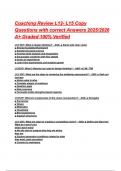
Coaching Review L12- L15 Copy
Questions with correct Answers 2025/2026
A+ Graded 100% Verified
L12/ CH7: What is design thinking? - ANS- ■ Starts with clear vision
■ Strong foundation/framework
■ Solution-focused process
■ Involves both analysis and imagination
■ Encourages creativity with finer details
■ Goals as experiments
■ Learn from experiments and insights gained
L12/CH7: What 3 theories are used in design thinking? - ANS- AI, MI, TTM
L12/ CH7: What are the steps to reviewing the wellbeing assessment? - ANS- ◘ Seek out
success
◘ Notice what is alive
◘ Consider stages of readiness
◘ Question gaps
◘ Note concerns
◘ Formulate initial strengths-based inquiries
L12/CH7: What are components of the vision conversation? - ANS- ■ Strengths
■ Successes
■ Values
■ Motivation
■ Visualizing
■ Best experiences
■ Support structures
L12/ CH7: What are steps to creating a compelling vision? - ANS- ■ Define and discover:
What do I want? (not
what I don't want)
■ Not the time to analyze why they are where
they are
■ Explore generative conditions related to what
they want, past successes
■ Connect to motivators
,L12/ CH7: What are the steps of AI? - ANS- ■ Define
■ Discover
■ Dream
■ Design
■ Destiny
L12/ CH7: How do you create a vision statement? - ANS- ■ Reflect the client's words
around their picture
of well-being
■ Ask them to put the vision in their own words
so it is meaningful and compelling to them
■ Could be sentence, paragraph, picture
■ Written as if it is already happening, "I am..."
L12/ CH7: What values do assessment provide to coaches in health fitness and
wellness? - ANS- • An overall picture of the client's present state of being
including physical health, lifestyle habits, strengths, life
satisfaction, and readiness to make changes.
• A snapshot to better understand and appreciate the
client's life context. The coaching questions and approach
for a client who has significant health issues such as
obesity, hypertension, back injury, or cancer is different
than the approach for a highly motivated, fit client.
• If a client has suffered a major loss, or was recently
diagnosed with a major illness, understanding this
situation early is important because of the impact on the
client's interest and ability to tackle change.
• Early indication of the client's strengths and healthy habits
as well as health risks and areas of challenge.
L12/ CH7: What areas does the well being assessment cover? - ANS- 1. Energy - Such as
levels of energy throughout a typical day,
including energy boosters and energy drains
Confidential Page 6 of 49 5/1/2009
2. Life satisfaction - Such as sense of purpose, joy, gratitude, work
satisfaction, and personal relationship satisfaction
3. Mental and Emotional Fitness - Such as coping skills, resilience,
sleep patterns, stress levels, emotional status, social
activity/support, and personal loss
4. Weight Management - Such as Body Mass Index, height, weight
and waist measurement
5. Physical activity / exercise - Such as frequency and types of
physical activity
, 6. Nutrition - Such as intake frequency of healthy snacks, whole
grains, fruits and vegetables, water, soft drinks, alcoholic
beverages, and trans fats
7. Health - Such as blood pressure, cholesterol, heart rate,
relationship with a physician, women's/men's health issues,
frequency of illness, medications, tobacco use, and
personal/family health history.
L12/ CH7: How can the assessment help with "red flags"? - ANS- Assessments can help
identify "red flags" or support a
coaching discussion on the topic of physical health issues (e.g. medical
care gaps, injury, or contraindications to exercise) or mental health
issues (depression or other mental health concerns) where a referral
may be important or even critical. Any coach who is helping a client set
goals in the area of exercise, regardless of credentials, should be aware
of guidelines for safety around beginning an exercise program, and
when exercise testing is recommended before starting to exercise (see
ACSM guidelines later in this chapter).
Be aware of any "red flags" such as health risks, injuries,
or other health concerns that might require a physician release before
engaging in regular exercise. If exercise will be a part of the coaching
program, a physician release form can be provided to the client to give
to his/her physician (see Appendix C for a sample physician release
form). Guidelines pertaining to the need for medical clearance and
exercise participation are available from the American College of Sports
Medicine (ACSM). Those guidelines and the ACSM risk classification
are adapted and summarized below.
L12/ CH7: The assessment can provide initial information about a clients: - ANS- 1.
Priorities - An assessment can be designed to calculate, or allow
clients to indicate, their areas of highest priority. For example, on
a scale of 0-10 (highest), the client may indicate that focusing the
coaching program on improving life satisfaction is a 10 (highest
priority) while improving nutritional habits is a 5 (of average
priority).
2. Confidence - Similarly, the assessment may include a method
for clients to indicate the strength of their belief in their ability to
make a behavior change. This information enables the coach to
more appropriately design opportunities for the development of
self-efficacy by working with the appropriate personal,
environmental, and behavioral factors (see Chapter 6).
3. Readiness for change - It is beneficial for an assessment to
create an awareness of the client's stage of change within the
various areas (see Chapter 3). When it comes to moving a client
Questions with correct Answers 2025/2026
A+ Graded 100% Verified
L12/ CH7: What is design thinking? - ANS- ■ Starts with clear vision
■ Strong foundation/framework
■ Solution-focused process
■ Involves both analysis and imagination
■ Encourages creativity with finer details
■ Goals as experiments
■ Learn from experiments and insights gained
L12/CH7: What 3 theories are used in design thinking? - ANS- AI, MI, TTM
L12/ CH7: What are the steps to reviewing the wellbeing assessment? - ANS- ◘ Seek out
success
◘ Notice what is alive
◘ Consider stages of readiness
◘ Question gaps
◘ Note concerns
◘ Formulate initial strengths-based inquiries
L12/CH7: What are components of the vision conversation? - ANS- ■ Strengths
■ Successes
■ Values
■ Motivation
■ Visualizing
■ Best experiences
■ Support structures
L12/ CH7: What are steps to creating a compelling vision? - ANS- ■ Define and discover:
What do I want? (not
what I don't want)
■ Not the time to analyze why they are where
they are
■ Explore generative conditions related to what
they want, past successes
■ Connect to motivators
,L12/ CH7: What are the steps of AI? - ANS- ■ Define
■ Discover
■ Dream
■ Design
■ Destiny
L12/ CH7: How do you create a vision statement? - ANS- ■ Reflect the client's words
around their picture
of well-being
■ Ask them to put the vision in their own words
so it is meaningful and compelling to them
■ Could be sentence, paragraph, picture
■ Written as if it is already happening, "I am..."
L12/ CH7: What values do assessment provide to coaches in health fitness and
wellness? - ANS- • An overall picture of the client's present state of being
including physical health, lifestyle habits, strengths, life
satisfaction, and readiness to make changes.
• A snapshot to better understand and appreciate the
client's life context. The coaching questions and approach
for a client who has significant health issues such as
obesity, hypertension, back injury, or cancer is different
than the approach for a highly motivated, fit client.
• If a client has suffered a major loss, or was recently
diagnosed with a major illness, understanding this
situation early is important because of the impact on the
client's interest and ability to tackle change.
• Early indication of the client's strengths and healthy habits
as well as health risks and areas of challenge.
L12/ CH7: What areas does the well being assessment cover? - ANS- 1. Energy - Such as
levels of energy throughout a typical day,
including energy boosters and energy drains
Confidential Page 6 of 49 5/1/2009
2. Life satisfaction - Such as sense of purpose, joy, gratitude, work
satisfaction, and personal relationship satisfaction
3. Mental and Emotional Fitness - Such as coping skills, resilience,
sleep patterns, stress levels, emotional status, social
activity/support, and personal loss
4. Weight Management - Such as Body Mass Index, height, weight
and waist measurement
5. Physical activity / exercise - Such as frequency and types of
physical activity
, 6. Nutrition - Such as intake frequency of healthy snacks, whole
grains, fruits and vegetables, water, soft drinks, alcoholic
beverages, and trans fats
7. Health - Such as blood pressure, cholesterol, heart rate,
relationship with a physician, women's/men's health issues,
frequency of illness, medications, tobacco use, and
personal/family health history.
L12/ CH7: How can the assessment help with "red flags"? - ANS- Assessments can help
identify "red flags" or support a
coaching discussion on the topic of physical health issues (e.g. medical
care gaps, injury, or contraindications to exercise) or mental health
issues (depression or other mental health concerns) where a referral
may be important or even critical. Any coach who is helping a client set
goals in the area of exercise, regardless of credentials, should be aware
of guidelines for safety around beginning an exercise program, and
when exercise testing is recommended before starting to exercise (see
ACSM guidelines later in this chapter).
Be aware of any "red flags" such as health risks, injuries,
or other health concerns that might require a physician release before
engaging in regular exercise. If exercise will be a part of the coaching
program, a physician release form can be provided to the client to give
to his/her physician (see Appendix C for a sample physician release
form). Guidelines pertaining to the need for medical clearance and
exercise participation are available from the American College of Sports
Medicine (ACSM). Those guidelines and the ACSM risk classification
are adapted and summarized below.
L12/ CH7: The assessment can provide initial information about a clients: - ANS- 1.
Priorities - An assessment can be designed to calculate, or allow
clients to indicate, their areas of highest priority. For example, on
a scale of 0-10 (highest), the client may indicate that focusing the
coaching program on improving life satisfaction is a 10 (highest
priority) while improving nutritional habits is a 5 (of average
priority).
2. Confidence - Similarly, the assessment may include a method
for clients to indicate the strength of their belief in their ability to
make a behavior change. This information enables the coach to
more appropriately design opportunities for the development of
self-efficacy by working with the appropriate personal,
environmental, and behavioral factors (see Chapter 6).
3. Readiness for change - It is beneficial for an assessment to
create an awareness of the client's stage of change within the
various areas (see Chapter 3). When it comes to moving a client