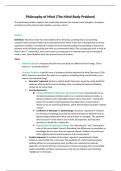
Philosophy of Mind (The Mind-Body Problem)
The mind-body problem explores the relationship between the mental realm (thoughts, sensations,
emotions) and the physical realm (bodies, neurons, atoms)
Dualism
Definition: The theory that the mind is distinct from the body, asserting that a human being
comprises both a physical body and an immaterial mind, which is the seat of thought and conscious
experience. Dualism is considered a solution to the mind-body problem by specifying a clean break
between mind and body, positing the mind as an immaterial entity. This concept goes back at least to
Plato in the 4th century BCE, who saw humans as composed of a material body and an immaterial
mind or soul. Some Buddhist texts also present forms of dualism.
Types:
- Substance Dualism: Proposes that the mind and body are different kind of things. This is
known as “soul-body dualism”
- Cartesian Dualism: A specific form of substance dualism advanced by René Descartes (1596-
1650). Descartes described the mind as res cogitans (a thinking thing) and the body as res
extensa (an extended thing)
Descartes’ argument: Based on radical doubt, Descartes argued he could doubt the
existence of his body but not his thinking, thus concluding his body and thinking
cannot be the same thing
Counterarguments:
Princess Elisabeth of Bohemia’s Interaction Problem: Questioned how an
immaterial substance (mind) could act on a material substance (body), as
physical contact seems impossible between them. Descartes’’ mechanistic
picture of causation requiring physical bumping never recovered from
Newton’s law of universal gravitation, which demonstrated causation without
contact.
Conflation of Ontology vs. Epistemology: Descartes' argument is criticized
for drawing an ontological conclusion (mind and body are distinct) from an
epistemological distinction (what can be known or doubted). The argument
fails because X=Y only when X and Y share all properties, but Descartes'
premises on doubt don't satisfy this.
Morning Star/Evening Star Analogy: The "Morning Star" and "Evening Star"
refer to the same object (Venus), illustrating that differences in perception or
knowledge do not mean they are separate objects. Similarly, the mind and
body might be interconnected aspects of the same system.
Zombie Argument: A variation of Descartes' argument, popularized by David
Chalmers, which distils the crucial step: the possibility of a fully functioning body
existing without an accompanying mind. Zombies are molecule-for-molecule
duplicates of humans that lack consciousness. Proponents argue that conceivability
implies possibility, and thus consciousness must be non-physical and something
"additional" to the body.
, Counterarguments: Questions arise regarding the assumption that imagination
reliably guides possibility, pointing to examples like infinite prime numbers or
Penrose stairs that can be imagined but are impossible. Critics argue that even if
Mary had a knowledge gap, it doesn't mean conscious experience is not physical.
- Property Dualism: Postulates that there is only one kind of thing (physical), but two kinds of
properties: mental and physical. Mental properties (e.g., sadness, curiosity, consciousness)
cannot be reduced to physical properties. It is sometimes considered more compatible with
science than substance dualism because nonphysical properties are easier to accommodate
than nonphysical things.
Knowledge Argument (Mary's Room): Introduced by Frank Jackson, this thought
experiment posits Mary, a neuroscientist who knows all physical information about
colour vision but has never seen colour. The intuition is that she learns something
new ("what it is like to see red," or phenomenal consciousness) upon experiencing
colour for the first time. Since she knew all physical facts, what she learned must be
nonphysical, suggesting that not all knowledge is physical and therefore phenomenal
consciousness doesn't reduce to brain facts.
Counterarguments: Some argue that Mary might not be surprised if she truly knew
all physical facts. Others contend that a knowledge gap doesn't mean conscious
experience isn't physical, or that it's impossible to learn all physical facts in a black
and white environment.
Physicalism
In its broadest terms, it maintains that everything, including minds, is physical, and arose from the
rearrangement and interactions of physical particles and forces that emerged after the universe's
birth. It asserts that the mind sits comfortably in the physical world and requires no divine
intervention to explain its origin.
- Philosophical Behaviourism: Defines mental states as sets of behavioural dispositions. Gilbert
Ryle famously called Cartesian dualism a "category mistake," arguing the mind is not
something additional to the body's workings but rather present in intelligent behaviour itself.
Arguments in favour: Avoids the interaction problem and the problem of other
minds (since mental states are observable behaviours).
Counterarguments:
Super-Spartans: Thought experiment by Hilary Putnam positing individuals
who feel pain but suppress all typical pain behaviours, challenging the idea
that mental states are reducible to behaviour.
Inner Aspect: There is an inner aspect to the mind not always reflected in
behaviour (e.g., a well-trained actress).
Conceptual vs. Causal Connection: Ryle argues mind and intelligent
behaviour are conceptually connected, not causally, but critics argue
conceptual connection doesn't exclude causal connection.
Mental Holism: Behaviours are influenced by multiple mental states, making
it hard to define a single mental state (e.g., thirst leading to drinking also
involves belief it's water, desire to stay alive).
The mind-body problem explores the relationship between the mental realm (thoughts, sensations,
emotions) and the physical realm (bodies, neurons, atoms)
Dualism
Definition: The theory that the mind is distinct from the body, asserting that a human being
comprises both a physical body and an immaterial mind, which is the seat of thought and conscious
experience. Dualism is considered a solution to the mind-body problem by specifying a clean break
between mind and body, positing the mind as an immaterial entity. This concept goes back at least to
Plato in the 4th century BCE, who saw humans as composed of a material body and an immaterial
mind or soul. Some Buddhist texts also present forms of dualism.
Types:
- Substance Dualism: Proposes that the mind and body are different kind of things. This is
known as “soul-body dualism”
- Cartesian Dualism: A specific form of substance dualism advanced by René Descartes (1596-
1650). Descartes described the mind as res cogitans (a thinking thing) and the body as res
extensa (an extended thing)
Descartes’ argument: Based on radical doubt, Descartes argued he could doubt the
existence of his body but not his thinking, thus concluding his body and thinking
cannot be the same thing
Counterarguments:
Princess Elisabeth of Bohemia’s Interaction Problem: Questioned how an
immaterial substance (mind) could act on a material substance (body), as
physical contact seems impossible between them. Descartes’’ mechanistic
picture of causation requiring physical bumping never recovered from
Newton’s law of universal gravitation, which demonstrated causation without
contact.
Conflation of Ontology vs. Epistemology: Descartes' argument is criticized
for drawing an ontological conclusion (mind and body are distinct) from an
epistemological distinction (what can be known or doubted). The argument
fails because X=Y only when X and Y share all properties, but Descartes'
premises on doubt don't satisfy this.
Morning Star/Evening Star Analogy: The "Morning Star" and "Evening Star"
refer to the same object (Venus), illustrating that differences in perception or
knowledge do not mean they are separate objects. Similarly, the mind and
body might be interconnected aspects of the same system.
Zombie Argument: A variation of Descartes' argument, popularized by David
Chalmers, which distils the crucial step: the possibility of a fully functioning body
existing without an accompanying mind. Zombies are molecule-for-molecule
duplicates of humans that lack consciousness. Proponents argue that conceivability
implies possibility, and thus consciousness must be non-physical and something
"additional" to the body.
, Counterarguments: Questions arise regarding the assumption that imagination
reliably guides possibility, pointing to examples like infinite prime numbers or
Penrose stairs that can be imagined but are impossible. Critics argue that even if
Mary had a knowledge gap, it doesn't mean conscious experience is not physical.
- Property Dualism: Postulates that there is only one kind of thing (physical), but two kinds of
properties: mental and physical. Mental properties (e.g., sadness, curiosity, consciousness)
cannot be reduced to physical properties. It is sometimes considered more compatible with
science than substance dualism because nonphysical properties are easier to accommodate
than nonphysical things.
Knowledge Argument (Mary's Room): Introduced by Frank Jackson, this thought
experiment posits Mary, a neuroscientist who knows all physical information about
colour vision but has never seen colour. The intuition is that she learns something
new ("what it is like to see red," or phenomenal consciousness) upon experiencing
colour for the first time. Since she knew all physical facts, what she learned must be
nonphysical, suggesting that not all knowledge is physical and therefore phenomenal
consciousness doesn't reduce to brain facts.
Counterarguments: Some argue that Mary might not be surprised if she truly knew
all physical facts. Others contend that a knowledge gap doesn't mean conscious
experience isn't physical, or that it's impossible to learn all physical facts in a black
and white environment.
Physicalism
In its broadest terms, it maintains that everything, including minds, is physical, and arose from the
rearrangement and interactions of physical particles and forces that emerged after the universe's
birth. It asserts that the mind sits comfortably in the physical world and requires no divine
intervention to explain its origin.
- Philosophical Behaviourism: Defines mental states as sets of behavioural dispositions. Gilbert
Ryle famously called Cartesian dualism a "category mistake," arguing the mind is not
something additional to the body's workings but rather present in intelligent behaviour itself.
Arguments in favour: Avoids the interaction problem and the problem of other
minds (since mental states are observable behaviours).
Counterarguments:
Super-Spartans: Thought experiment by Hilary Putnam positing individuals
who feel pain but suppress all typical pain behaviours, challenging the idea
that mental states are reducible to behaviour.
Inner Aspect: There is an inner aspect to the mind not always reflected in
behaviour (e.g., a well-trained actress).
Conceptual vs. Causal Connection: Ryle argues mind and intelligent
behaviour are conceptually connected, not causally, but critics argue
conceptual connection doesn't exclude causal connection.
Mental Holism: Behaviours are influenced by multiple mental states, making
it hard to define a single mental state (e.g., thirst leading to drinking also
involves belief it's water, desire to stay alive).