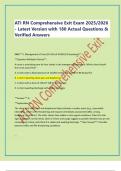
ATI RN Comprehensive Exit Exam 2025/2026
- Latest Version with 180 Actual Questions &
Verified Answers
#### **1. Management of Care (20-25% of ATI/NCLEX Questions)**
**Question (Multiple-Choice)**:
A nurse is prioritizing care for four clients in the emergency department. Which client should
the nurse assess first?
A. A client with a blood pressure of 110/60 mmHg and a pulse of 88 beats/min
B. A client reporting chest pain and diaphoresis
C. A client with a fever of 100.4°F (38°C) and a cough
D. A client awaiting discharge with stable vital signs
**Answer**: B
**Explanation**:
The client with chest pain and diaphoresis likely indicates a cardiac event (e.g., myocardial
infarction), which is life-threatening and requires immediate assessment (ABCs: airway,
breathing, circulation). The other clients have stable or less urgent conditions: Client A’s vital
signs are within normal limits, Client C’s fever and cough suggest a possible infection but are not
immediately critical, and Client D is stable and awaiting discharge. **Key Concept**: Prioritize
based on ABCs and life-threatening conditions.
---
,#### **2. Safety and Infection Control (10-15% of Questions)**
**Question (Select-All-That-Apply, NGN Style)**:
A nurse is caring for a client with MRSA in a private room. Which actions should the nurse take
to prevent the spread of infection? (Select all that apply.)
A. Wear gloves when entering the room
B. Perform hand hygiene before and after client contact
C. Use a stethoscope designated for the client
D. Wear a gown only if contact with bodily fluids is expected
E. Place a surgical mask on the client during transport
**Answers**: A, B, C, E
**Explanation**:
- **A (Correct)**: Gloves are required for contact precautions to prevent direct contact with
MRSA.
- **B (Correct)**: Hand hygiene is essential before and after client contact to reduce
transmission.
- **C (Correct)**: A dedicated stethoscope prevents cross-contamination between clients.
- **D (Incorrect)**: For MRSA, a gown is required for all client contact under contact
precautions, not just when bodily fluids are expected.
- **E (Correct)**: A surgical mask on the client during transport prevents droplet spread if
coughing occurs.
**Key Concept**: Contact precautions for MRSA include gloves, gown, and dedicated
equipment; hand hygiene is universal.
---
#### **3. Pharmacology and Parenteral Therapies (15-20% of Questions)**
**Question (Multiple-Choice)**:
,A nurse is administering digoxin 0.25 mg to a client with heart failure. Which finding should the
nurse report to the healthcare provider before administering the dose?
A. Heart rate of 58 beats/min
B. Blood pressure of 130/80 mmHg
C. Potassium level of 3.8 mEq/L
D. Respiratory rate of 16 breaths/min
**Answer**: A
**Explanation**:
Digoxin slows the heart rate and is contraindicated if the heart rate is below 60 beats/min due
to the risk of worsening bradycardia. The nurse should withhold the dose and notify the
provider. The other findings are within normal limits: BP of 130/80 is stable, potassium of 3.8
mEq/L is normal (3.5-5.0), and respiratory rate of 16 is normal. **Key Concept**: Check apical
pulse for a full minute before administering digoxin; withhold if <60 beats/min.
---
#### **4. Physiological Adaptation – Electrolyte Imbalances (10-15% of Questions)**
**Question (NGN Case Study – Partial)**:
A 45-year-old client is admitted with dehydration and reports muscle weakness and confusion.
Labs show: Sodium 148 mEq/L, Potassium 2.8 mEq/L, Chloride 100 mEq/L. The nurse anticipates
which intervention?
A. Administer 0.9% sodium chloride IV
B. Administer potassium chloride IV per protocol
C. Restrict oral fluid intake
D. Administer furosemide 20 mg IV
**Answer**: B
, **Explanation**:
The client’s potassium level of 2.8 mEq/L indicates hypokalemia (normal: 3.5-5.0 mEq/L), which
can cause muscle weakness and confusion. IV potassium chloride is the appropriate
intervention to correct this. Option A (0.9% sodium chloride) addresses dehydration but not
hypokalemia specifically. Option C (fluid restriction) is inappropriate for dehydration. Option D
(furosemide) would worsen hypokalemia by increasing potassium excretion. **Key Concept**:
Hypokalemia requires potassium replacement; monitor for cardiac arrhythmias.
---
#### **5. Maternal-Newborn Care (10-15% of Questions)**
**Question (Multiple-Choice)**:
A nurse is assessing a postpartum client 24 hours after delivery. Which finding requires
immediate intervention?
A. Lochia rubra with small clots
B. Fundus firm, 1 cm above the umbilicus
C. Saturation of a perineal pad in 15 minutes
D. Breast tenderness on palpation
**Answer**: C
**Explanation**:
Saturation of a perineal pad in 15 minutes indicates excessive postpartum bleeding, a sign of
potential hemorrhage requiring immediate intervention. Lochia rubra with small clots (A) is
normal in the first 24-48 hours. A fundus 1 cm above the umbilicus (B) is expected at 24 hours
postpartum. Breast tenderness (D) is common due to milk production. **Key Concept**:
Postpartum hemorrhage is a priority; normal lochia soaks a pad over 1-2 hours.
---
- Latest Version with 180 Actual Questions &
Verified Answers
#### **1. Management of Care (20-25% of ATI/NCLEX Questions)**
**Question (Multiple-Choice)**:
A nurse is prioritizing care for four clients in the emergency department. Which client should
the nurse assess first?
A. A client with a blood pressure of 110/60 mmHg and a pulse of 88 beats/min
B. A client reporting chest pain and diaphoresis
C. A client with a fever of 100.4°F (38°C) and a cough
D. A client awaiting discharge with stable vital signs
**Answer**: B
**Explanation**:
The client with chest pain and diaphoresis likely indicates a cardiac event (e.g., myocardial
infarction), which is life-threatening and requires immediate assessment (ABCs: airway,
breathing, circulation). The other clients have stable or less urgent conditions: Client A’s vital
signs are within normal limits, Client C’s fever and cough suggest a possible infection but are not
immediately critical, and Client D is stable and awaiting discharge. **Key Concept**: Prioritize
based on ABCs and life-threatening conditions.
---
,#### **2. Safety and Infection Control (10-15% of Questions)**
**Question (Select-All-That-Apply, NGN Style)**:
A nurse is caring for a client with MRSA in a private room. Which actions should the nurse take
to prevent the spread of infection? (Select all that apply.)
A. Wear gloves when entering the room
B. Perform hand hygiene before and after client contact
C. Use a stethoscope designated for the client
D. Wear a gown only if contact with bodily fluids is expected
E. Place a surgical mask on the client during transport
**Answers**: A, B, C, E
**Explanation**:
- **A (Correct)**: Gloves are required for contact precautions to prevent direct contact with
MRSA.
- **B (Correct)**: Hand hygiene is essential before and after client contact to reduce
transmission.
- **C (Correct)**: A dedicated stethoscope prevents cross-contamination between clients.
- **D (Incorrect)**: For MRSA, a gown is required for all client contact under contact
precautions, not just when bodily fluids are expected.
- **E (Correct)**: A surgical mask on the client during transport prevents droplet spread if
coughing occurs.
**Key Concept**: Contact precautions for MRSA include gloves, gown, and dedicated
equipment; hand hygiene is universal.
---
#### **3. Pharmacology and Parenteral Therapies (15-20% of Questions)**
**Question (Multiple-Choice)**:
,A nurse is administering digoxin 0.25 mg to a client with heart failure. Which finding should the
nurse report to the healthcare provider before administering the dose?
A. Heart rate of 58 beats/min
B. Blood pressure of 130/80 mmHg
C. Potassium level of 3.8 mEq/L
D. Respiratory rate of 16 breaths/min
**Answer**: A
**Explanation**:
Digoxin slows the heart rate and is contraindicated if the heart rate is below 60 beats/min due
to the risk of worsening bradycardia. The nurse should withhold the dose and notify the
provider. The other findings are within normal limits: BP of 130/80 is stable, potassium of 3.8
mEq/L is normal (3.5-5.0), and respiratory rate of 16 is normal. **Key Concept**: Check apical
pulse for a full minute before administering digoxin; withhold if <60 beats/min.
---
#### **4. Physiological Adaptation – Electrolyte Imbalances (10-15% of Questions)**
**Question (NGN Case Study – Partial)**:
A 45-year-old client is admitted with dehydration and reports muscle weakness and confusion.
Labs show: Sodium 148 mEq/L, Potassium 2.8 mEq/L, Chloride 100 mEq/L. The nurse anticipates
which intervention?
A. Administer 0.9% sodium chloride IV
B. Administer potassium chloride IV per protocol
C. Restrict oral fluid intake
D. Administer furosemide 20 mg IV
**Answer**: B
, **Explanation**:
The client’s potassium level of 2.8 mEq/L indicates hypokalemia (normal: 3.5-5.0 mEq/L), which
can cause muscle weakness and confusion. IV potassium chloride is the appropriate
intervention to correct this. Option A (0.9% sodium chloride) addresses dehydration but not
hypokalemia specifically. Option C (fluid restriction) is inappropriate for dehydration. Option D
(furosemide) would worsen hypokalemia by increasing potassium excretion. **Key Concept**:
Hypokalemia requires potassium replacement; monitor for cardiac arrhythmias.
---
#### **5. Maternal-Newborn Care (10-15% of Questions)**
**Question (Multiple-Choice)**:
A nurse is assessing a postpartum client 24 hours after delivery. Which finding requires
immediate intervention?
A. Lochia rubra with small clots
B. Fundus firm, 1 cm above the umbilicus
C. Saturation of a perineal pad in 15 minutes
D. Breast tenderness on palpation
**Answer**: C
**Explanation**:
Saturation of a perineal pad in 15 minutes indicates excessive postpartum bleeding, a sign of
potential hemorrhage requiring immediate intervention. Lochia rubra with small clots (A) is
normal in the first 24-48 hours. A fundus 1 cm above the umbilicus (B) is expected at 24 hours
postpartum. Breast tenderness (D) is common due to milk production. **Key Concept**:
Postpartum hemorrhage is a priority; normal lochia soaks a pad over 1-2 hours.
---