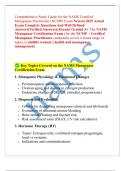
Comprehensive Study Guide for the NAMS Certified
Menopause Practitioner (NCMP) Exam Newest 2025 Actual
Exam Complete Questions And Well Defined
Answers(Verified Answers)|Already Graded A+ The NAMS
Menopause Certification Exam (for the NCMP – Certified
Menopause Practitioner credential) covers a broad range of
topics in midlife women’s health and menopause
management.
Key Topics Covered on the NAMS Menopause
Certification Exam
1. Menopause Physiology & Hormonal Changes
• Perimenopause and menopause transition
• Ovarian aging and decline in estrogen production
• Endocrine changes (FSH, LH, estradiol, progesterone)
2. Diagnosis and Evaluation
• Criteria for diagnosing menopause (clinical and lab-based)
• Evaluation of abnormal uterine bleeding
• Bone density testing and fracture risk
• Risk assessment tools (FRAX, CV risk calculators)
3. Hormone Therapy (HT)
• Types: Estrogen-only, combined estrogen-progestogen,
local vs systemic
• Indications and contraindications
, • Benefits vs risks (breast cancer, stroke, VTE, CAD)
• HT formulations, dosages, routes (oral, transdermal,
vaginal)
4. Non-Hormonal Therapies
• SSRIs/SNRIs for vasomotor symptoms
• Gabapentin, clonidine, lifestyle modifications
• Botanicals and alternative therapies (e.g., black cohosh,
soy)
5. Vasomotor Symptoms & Genitourinary Syndrome of
Menopause (GSM)
• Hot flashes, night sweats
• Vaginal dryness, dyspareunia
• Urinary urgency and incontinence
• Management strategies (HT, lubricants, vaginal estrogen,
DHEA)
6. Sexual Health and Dysfunction
• Libido changes
• Dyspareunia, arousal disorders
• Counseling and treatment approaches
7. Osteoporosis and Bone Health
• Risk factors and screening guidelines
• Pharmacologic treatment (bisphosphonates, denosumab,
SERMs)
• Lifestyle and dietary recommendations (calcium, vitamin
D, weight-bearing exercise)
,8. Cardiovascular Health
• CV risk in midlife women
• Lipid profile changes with menopause
• Impact of HT on cardiovascular outcomes
9. Breast Health
• Cancer risk assessment (family history, BRCA, lifestyle)
• Breast screening guidelines (mammograms, clinical exams)
• HT and breast cancer relationship
10. Mental Health & Cognitive Function
• Mood disorders (depression, anxiety, irritability)
• Sleep disorders
• Cognitive changes, dementia, and Alzheimer’s risk
11. Chronic Disease Prevention
• Diabetes, hypertension, metabolic syndrome
• Obesity and lifestyle interventions
• Immunizations and cancer screening recommendations
12. Special Populations
• Women with early menopause or premature ovarian
insufficiency (POI)
• Cancer survivors (breast, gynecologic)
• LGBTQ+ and transgender considerations in menopause
care
, Climacteric phase - correct answer..The period of endrocrinologic,
somatic, and transitory psychologic changes that occur around
the time of menopause.
Early menopause - correct answer..LMP before age 45
white and hispanic populations - correct answer..Who is at highest
risk of osteoporosis?
1 in 4 women (25%) require long term care
1 in 2 woemn (50%) have long term loss of mobility - correct
answer..What amount of women require long term care after hip
fracture?
What amount of women have long term loss of mobility after hip
fracture?
lower - correct answer..Asians have ____BMD than white people?
higher - correct answer..Black women have ____BMD than white
people?
38% for osteoporotic fracture and 68% for hip fracture - correct
answer..Over 3 servings of alcohol daily and risk for fracture?
white, asiain, black, hispanic - correct answer..What 4 ethnic
specific versions of FRAX are there?
dairy free diet-300mg calcium daily.
Needs 800-1200mg - correct answer..Dairy free diet amount of
calicum. How much do they need to supplement?
approved in mexico
decreased risk of vertebral and nonvertebral fracture
Menopause Practitioner (NCMP) Exam Newest 2025 Actual
Exam Complete Questions And Well Defined
Answers(Verified Answers)|Already Graded A+ The NAMS
Menopause Certification Exam (for the NCMP – Certified
Menopause Practitioner credential) covers a broad range of
topics in midlife women’s health and menopause
management.
Key Topics Covered on the NAMS Menopause
Certification Exam
1. Menopause Physiology & Hormonal Changes
• Perimenopause and menopause transition
• Ovarian aging and decline in estrogen production
• Endocrine changes (FSH, LH, estradiol, progesterone)
2. Diagnosis and Evaluation
• Criteria for diagnosing menopause (clinical and lab-based)
• Evaluation of abnormal uterine bleeding
• Bone density testing and fracture risk
• Risk assessment tools (FRAX, CV risk calculators)
3. Hormone Therapy (HT)
• Types: Estrogen-only, combined estrogen-progestogen,
local vs systemic
• Indications and contraindications
, • Benefits vs risks (breast cancer, stroke, VTE, CAD)
• HT formulations, dosages, routes (oral, transdermal,
vaginal)
4. Non-Hormonal Therapies
• SSRIs/SNRIs for vasomotor symptoms
• Gabapentin, clonidine, lifestyle modifications
• Botanicals and alternative therapies (e.g., black cohosh,
soy)
5. Vasomotor Symptoms & Genitourinary Syndrome of
Menopause (GSM)
• Hot flashes, night sweats
• Vaginal dryness, dyspareunia
• Urinary urgency and incontinence
• Management strategies (HT, lubricants, vaginal estrogen,
DHEA)
6. Sexual Health and Dysfunction
• Libido changes
• Dyspareunia, arousal disorders
• Counseling and treatment approaches
7. Osteoporosis and Bone Health
• Risk factors and screening guidelines
• Pharmacologic treatment (bisphosphonates, denosumab,
SERMs)
• Lifestyle and dietary recommendations (calcium, vitamin
D, weight-bearing exercise)
,8. Cardiovascular Health
• CV risk in midlife women
• Lipid profile changes with menopause
• Impact of HT on cardiovascular outcomes
9. Breast Health
• Cancer risk assessment (family history, BRCA, lifestyle)
• Breast screening guidelines (mammograms, clinical exams)
• HT and breast cancer relationship
10. Mental Health & Cognitive Function
• Mood disorders (depression, anxiety, irritability)
• Sleep disorders
• Cognitive changes, dementia, and Alzheimer’s risk
11. Chronic Disease Prevention
• Diabetes, hypertension, metabolic syndrome
• Obesity and lifestyle interventions
• Immunizations and cancer screening recommendations
12. Special Populations
• Women with early menopause or premature ovarian
insufficiency (POI)
• Cancer survivors (breast, gynecologic)
• LGBTQ+ and transgender considerations in menopause
care
, Climacteric phase - correct answer..The period of endrocrinologic,
somatic, and transitory psychologic changes that occur around
the time of menopause.
Early menopause - correct answer..LMP before age 45
white and hispanic populations - correct answer..Who is at highest
risk of osteoporosis?
1 in 4 women (25%) require long term care
1 in 2 woemn (50%) have long term loss of mobility - correct
answer..What amount of women require long term care after hip
fracture?
What amount of women have long term loss of mobility after hip
fracture?
lower - correct answer..Asians have ____BMD than white people?
higher - correct answer..Black women have ____BMD than white
people?
38% for osteoporotic fracture and 68% for hip fracture - correct
answer..Over 3 servings of alcohol daily and risk for fracture?
white, asiain, black, hispanic - correct answer..What 4 ethnic
specific versions of FRAX are there?
dairy free diet-300mg calcium daily.
Needs 800-1200mg - correct answer..Dairy free diet amount of
calicum. How much do they need to supplement?
approved in mexico
decreased risk of vertebral and nonvertebral fracture