Table of contents
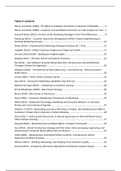
Narver and Slater (1990) - The Effect of a Market Orientation on Business Profitability ..........2
Narver and Slater (1998) – Customer-Led and Market-Oriented: Let’s Not Confuse the Two ...7
Achrol & Kotler (2012): Frontiers of the Marketing Paradigm in the Third Millennium ............9
Homburg (2014) – Customer Experience Management (CEM): Toward Implementing an
Evolving Marketing Concept .................................................................................................12
Dolan (2014) – Framework for Marketing Strategy Formation (P1 – P13) .............................15
Laughlin (2014) – Holistic Customer Insight as an Engine of Growth .....................................17
Van den Driest (2016) – Building an Insights Engine .............................................................19
Magids (2015) – The New Science of Customer Emotions .....................................................22
Pai (2013) – User adoption of Social Networking Sites: Eliciting Uses and Gratifications
Through a Means-End Approach ..........................................................................................26
Almquist (2016) – The Elements of Value Measuring – and Delivering – What Consumers
Really Want ..........................................................................................................................30
Lemon (2001) – What Drives Customer Equity ......................................................................32
Day (2011) – Closing the Marketing Capabilities Gap (niet af) ..............................................34
Edelman & Singer (2015) – Competing on Customer Journeys ..............................................38
Kim & Mauborgne (2005) – Blue Ocean Strategy ..................................................................40
Burke (2010) – Blue Ocean vs Five Forces..............................................................................43
Nord (1980) – A behavior Modification Perspective on Marketing ........................................44
Wells (2014) – Behavioral Psychology, Marketing and Consumer Behavior: A Literature
Review and Future Research Agenda ....................................................................................47
Gelbrich, K (2017) – Rewarding Customers Who Keep a Product: How Reinforcement Affects
Customers’ Product Return Decision in Online Retailing ........................................................48
Chen (2011) – Online Social Interactions: A natural Experiment on Word of Mouth Versus
Observational Learning.........................................................................................................51
Dwivedi (2010) – Brand Extension Feedback Effects: A Holistic Framework...........................53
Hsu (2016) – Brand Architecture Strategy and Firm Value: How Leveraging, Separating, and
Distancing the Corporate Brand Affects Risk and Returns .....................................................55
Hsieh (2005) – Maintaining a Committed Online Customer: A Study Across Search-
Experience-Credence Products ..............................................................................................59
Watson (2015) – Building, Measuring, and Profiting From Customer Loyalty ........................62
Silveira (2017) – Comparing Alternative Approaches to Estimate Customer Equity ...............64
, Topic 1A. Core of Marketing Thinking
Narver and Slater (1990) - The Effect of a Market Orientation on
Business Profitability
Reading questions:
• What is the core of this definition and how is it related to marketing and the marketing
concept?
Set of beliefs that put the customers’ interest first. Market Orientation (MO) is the
implementation of the marketing concept. The ability to generate, disseminate and use
superior information about the customers.
Marketing concept: Being Market-Oriented is essential to success.
The organization culture that creates the necessary behaviors (1. Additional benefits or 2.
Reduction in acquisition and usage cost) for the creation of superior value for buyers (SCA) à
which lead to superior performance for the business.
• Why is it important to measure this concept?
Market Orientation leads to better market performance because it creates superior value for
customers à SCA
Measurement of MO (new measure development, reliability, construct validity). Success
measure is profitability.
• Can you explain why some companies benefit more from (investments in) Market
Orientation than others?
Depends on how internally oriented they are, commodity businesses are often price-driven
instead of value-driven (because of its telemarketing approach). Commodity business
profitability is U-shaped (don’t invest at all so the costs will be diminished or invest much in
market orientation to ensure profitability. Median is not suggested). For non-commodity, the
more MO, the more profitability.
Research Gap = Yet to date there has been no valid measure of a market orientation and no
systematic analysis of its effect on the business performance.
Goal of this research = The development of a valid measure of market orientation and analyse
its effect on a business profitability.
They define and try to measure the concept of market orientation in their research
What is a valid measure of market orientation in order to increase the business performance
/ profitability?
SCA (sustainable competitive advantage) = expected value of product A exceeds the expected
value of product B.
Value of a product (for the buyer) = Difference between the expected benefits and the
acquisition and usage costs. A seller creates value in two ways: Increase benefits in relation to
the costs and decrease costs in relation to the benefits.
2
,The conceptual model
Market orientation = The organization culture that creates the necessary behaviors (1.
Additional benefits or 2. Reduction in acquisition and usage cost) for the creation of superior
value for buyers (SCA) à which leads to superior performance for the business.
Three behavioral components of market orientation:
1. Customer orientation: all activities to acquire information about the buyers. i.e.
Understand the buyers value chain over time (subject to internal and market
dynamics) to be able to create superior value continuously. “Who are my potential
buyers now and in the future?”
2. Competitor orientation: All activities to acquire information about the competitors.
i.e. understand the short-term strengths and weaknesses and long-term capabilities
and strategies of the key current / potential competitors.
3. Interfunctional coordination: The business’s efforts derived from the information
about the buyers and competitors (involving more than just the marketing department
– the entire business) to create superior value for the buyer. Sharing of information
and resources derived from the first two in order to integrate and collaborate different
departments within the business.
In short à These 3 behavioral components of market orientation comprehend the activities
of market information acquisition (verkrijgen van) and information dissemination
(verspreiden van) and respond on this (voldoen aan de behoeften van de klanten) in order to
create customer value.
Two decision criteria of market orientation:
1. Long term focus à in relation to profits and in implementing each of the three
behavioral components. A business must constantly discover and implement
additional value for its customers to prevent that its competitors have created a
superior buyer-value. This needs a range of long-term tactics and investments.
2. Profitability (economic wealth) à The ultimate goal for businesses in a market
orientation. Profit is a component of market orientation (without profit, a business is
not able to perform the thee behavioral components of market orientation) and
profitability is a consequence of market orientation.
For non-profit organizations, the objective of profitability is survival (to cover long-run
expenses).
The effect of Market Orientation on Business Performance
Hypotheses: There is a positive relationship between market orientation and business
profitability.
It is easier for distribution and specialty business to implement the three components of
market orientation than it is for commodity businesses. The value for commodity goods is
often price-driven. Two reasons why implementing a market orientation may be not
successful for commodity businesses:
3
, 1. These businesses are internally oriented and they see their selves to be in “the
business of selling eggs” rather than in “the business of identifying and satisfying
buyers”. They are often more traditional with a stubborn management.
2. Tend to use a sales-center/telemarketing approach more, where its harder to convey
the benefits of the product to the buyer and thus the price becomes the value of the
products (price-driven value).
Commodity Businesses (e.g. goederenbeurs): Not differentiated by many customers (grain,
milk, eggs – doesn’t matter where it comes from).
Distribution Businesses: Wholesaler
Specialty Businesses: very specific need. Products with a unique features and characteristics.
The most effective way for a seller to increase buyer value is to visit a buyer’s business and
the buyers’ customers frequently (Coca Cola à Rayon Managers). Two reasons why it is more
difficult in commodity business to increase buyer value through a telemarketing approach
than through a field salesforce approach (buitendienst):
1. Over telephone it is more difficult to identify the buyer’s needs and wants (value
increasing opportunities) since the seller only learns from the buyer’s needs when the
buyer tells him (= reactive instead of proactive). This leads to a more buyer price-driven
mode. In a field salesforce approach however, the seller can identify the buyer's needs
in a more proactive manner because he may see more than what the buyer tells him.
2. Selling products by telephone may increase price sensitivity of buyers. It Is harder to
convey (uitdrukken) the benefits and costs and hence the total value for the buyer by
telephone. Result à Buyers tend to give more attention to compare sellers’ prices
instead of the sellers’ total value to the buyer.
Because the commodity businesses make more use of a sales-center / telemarketing approach
than their competitors (distribution and specialty businesses), they are more price-driven.
Price-driven businesses are less likely to create superior value (SCA) than businesses that
create value for buyers other than price. For this reason, Narver & Slater expect the
commodity businesses to have a lower mean score both market orientation and on each of
the three component s of market orientation than the specialty and distribution businesses
and have a lower profitability than the competitors.
Since commodity businesses are more often traditional internal oriented, they perceive
increasing market orientation costlier and thus unattractive (at least in the short run) à
Decision making is time consuming because of the complex management structure, often
large businesses which are less flexible and heave higher conversion costs.
Implication Narver & Slater:
For commodity businesses the relationship between market orientation and profitability will
be U-shaped à Businesses with highest market orientation generate the highest profitability,
business with lowest market orientation generate second highest profitability (because these
companies are the most internally oriented and thus may be very consistent and efficient in
4
Narver and Slater (1990) - The Effect of a Market Orientation on Business Profitability ..........2
Narver and Slater (1998) – Customer-Led and Market-Oriented: Let’s Not Confuse the Two ...7
Achrol & Kotler (2012): Frontiers of the Marketing Paradigm in the Third Millennium ............9
Homburg (2014) – Customer Experience Management (CEM): Toward Implementing an
Evolving Marketing Concept .................................................................................................12
Dolan (2014) – Framework for Marketing Strategy Formation (P1 – P13) .............................15
Laughlin (2014) – Holistic Customer Insight as an Engine of Growth .....................................17
Van den Driest (2016) – Building an Insights Engine .............................................................19
Magids (2015) – The New Science of Customer Emotions .....................................................22
Pai (2013) – User adoption of Social Networking Sites: Eliciting Uses and Gratifications
Through a Means-End Approach ..........................................................................................26
Almquist (2016) – The Elements of Value Measuring – and Delivering – What Consumers
Really Want ..........................................................................................................................30
Lemon (2001) – What Drives Customer Equity ......................................................................32
Day (2011) – Closing the Marketing Capabilities Gap (niet af) ..............................................34
Edelman & Singer (2015) – Competing on Customer Journeys ..............................................38
Kim & Mauborgne (2005) – Blue Ocean Strategy ..................................................................40
Burke (2010) – Blue Ocean vs Five Forces..............................................................................43
Nord (1980) – A behavior Modification Perspective on Marketing ........................................44
Wells (2014) – Behavioral Psychology, Marketing and Consumer Behavior: A Literature
Review and Future Research Agenda ....................................................................................47
Gelbrich, K (2017) – Rewarding Customers Who Keep a Product: How Reinforcement Affects
Customers’ Product Return Decision in Online Retailing ........................................................48
Chen (2011) – Online Social Interactions: A natural Experiment on Word of Mouth Versus
Observational Learning.........................................................................................................51
Dwivedi (2010) – Brand Extension Feedback Effects: A Holistic Framework...........................53
Hsu (2016) – Brand Architecture Strategy and Firm Value: How Leveraging, Separating, and
Distancing the Corporate Brand Affects Risk and Returns .....................................................55
Hsieh (2005) – Maintaining a Committed Online Customer: A Study Across Search-
Experience-Credence Products ..............................................................................................59
Watson (2015) – Building, Measuring, and Profiting From Customer Loyalty ........................62
Silveira (2017) – Comparing Alternative Approaches to Estimate Customer Equity ...............64
, Topic 1A. Core of Marketing Thinking
Narver and Slater (1990) - The Effect of a Market Orientation on
Business Profitability
Reading questions:
• What is the core of this definition and how is it related to marketing and the marketing
concept?
Set of beliefs that put the customers’ interest first. Market Orientation (MO) is the
implementation of the marketing concept. The ability to generate, disseminate and use
superior information about the customers.
Marketing concept: Being Market-Oriented is essential to success.
The organization culture that creates the necessary behaviors (1. Additional benefits or 2.
Reduction in acquisition and usage cost) for the creation of superior value for buyers (SCA) à
which lead to superior performance for the business.
• Why is it important to measure this concept?
Market Orientation leads to better market performance because it creates superior value for
customers à SCA
Measurement of MO (new measure development, reliability, construct validity). Success
measure is profitability.
• Can you explain why some companies benefit more from (investments in) Market
Orientation than others?
Depends on how internally oriented they are, commodity businesses are often price-driven
instead of value-driven (because of its telemarketing approach). Commodity business
profitability is U-shaped (don’t invest at all so the costs will be diminished or invest much in
market orientation to ensure profitability. Median is not suggested). For non-commodity, the
more MO, the more profitability.
Research Gap = Yet to date there has been no valid measure of a market orientation and no
systematic analysis of its effect on the business performance.
Goal of this research = The development of a valid measure of market orientation and analyse
its effect on a business profitability.
They define and try to measure the concept of market orientation in their research
What is a valid measure of market orientation in order to increase the business performance
/ profitability?
SCA (sustainable competitive advantage) = expected value of product A exceeds the expected
value of product B.
Value of a product (for the buyer) = Difference between the expected benefits and the
acquisition and usage costs. A seller creates value in two ways: Increase benefits in relation to
the costs and decrease costs in relation to the benefits.
2
,The conceptual model
Market orientation = The organization culture that creates the necessary behaviors (1.
Additional benefits or 2. Reduction in acquisition and usage cost) for the creation of superior
value for buyers (SCA) à which leads to superior performance for the business.
Three behavioral components of market orientation:
1. Customer orientation: all activities to acquire information about the buyers. i.e.
Understand the buyers value chain over time (subject to internal and market
dynamics) to be able to create superior value continuously. “Who are my potential
buyers now and in the future?”
2. Competitor orientation: All activities to acquire information about the competitors.
i.e. understand the short-term strengths and weaknesses and long-term capabilities
and strategies of the key current / potential competitors.
3. Interfunctional coordination: The business’s efforts derived from the information
about the buyers and competitors (involving more than just the marketing department
– the entire business) to create superior value for the buyer. Sharing of information
and resources derived from the first two in order to integrate and collaborate different
departments within the business.
In short à These 3 behavioral components of market orientation comprehend the activities
of market information acquisition (verkrijgen van) and information dissemination
(verspreiden van) and respond on this (voldoen aan de behoeften van de klanten) in order to
create customer value.
Two decision criteria of market orientation:
1. Long term focus à in relation to profits and in implementing each of the three
behavioral components. A business must constantly discover and implement
additional value for its customers to prevent that its competitors have created a
superior buyer-value. This needs a range of long-term tactics and investments.
2. Profitability (economic wealth) à The ultimate goal for businesses in a market
orientation. Profit is a component of market orientation (without profit, a business is
not able to perform the thee behavioral components of market orientation) and
profitability is a consequence of market orientation.
For non-profit organizations, the objective of profitability is survival (to cover long-run
expenses).
The effect of Market Orientation on Business Performance
Hypotheses: There is a positive relationship between market orientation and business
profitability.
It is easier for distribution and specialty business to implement the three components of
market orientation than it is for commodity businesses. The value for commodity goods is
often price-driven. Two reasons why implementing a market orientation may be not
successful for commodity businesses:
3
, 1. These businesses are internally oriented and they see their selves to be in “the
business of selling eggs” rather than in “the business of identifying and satisfying
buyers”. They are often more traditional with a stubborn management.
2. Tend to use a sales-center/telemarketing approach more, where its harder to convey
the benefits of the product to the buyer and thus the price becomes the value of the
products (price-driven value).
Commodity Businesses (e.g. goederenbeurs): Not differentiated by many customers (grain,
milk, eggs – doesn’t matter where it comes from).
Distribution Businesses: Wholesaler
Specialty Businesses: very specific need. Products with a unique features and characteristics.
The most effective way for a seller to increase buyer value is to visit a buyer’s business and
the buyers’ customers frequently (Coca Cola à Rayon Managers). Two reasons why it is more
difficult in commodity business to increase buyer value through a telemarketing approach
than through a field salesforce approach (buitendienst):
1. Over telephone it is more difficult to identify the buyer’s needs and wants (value
increasing opportunities) since the seller only learns from the buyer’s needs when the
buyer tells him (= reactive instead of proactive). This leads to a more buyer price-driven
mode. In a field salesforce approach however, the seller can identify the buyer's needs
in a more proactive manner because he may see more than what the buyer tells him.
2. Selling products by telephone may increase price sensitivity of buyers. It Is harder to
convey (uitdrukken) the benefits and costs and hence the total value for the buyer by
telephone. Result à Buyers tend to give more attention to compare sellers’ prices
instead of the sellers’ total value to the buyer.
Because the commodity businesses make more use of a sales-center / telemarketing approach
than their competitors (distribution and specialty businesses), they are more price-driven.
Price-driven businesses are less likely to create superior value (SCA) than businesses that
create value for buyers other than price. For this reason, Narver & Slater expect the
commodity businesses to have a lower mean score both market orientation and on each of
the three component s of market orientation than the specialty and distribution businesses
and have a lower profitability than the competitors.
Since commodity businesses are more often traditional internal oriented, they perceive
increasing market orientation costlier and thus unattractive (at least in the short run) à
Decision making is time consuming because of the complex management structure, often
large businesses which are less flexible and heave higher conversion costs.
Implication Narver & Slater:
For commodity businesses the relationship between market orientation and profitability will
be U-shaped à Businesses with highest market orientation generate the highest profitability,
business with lowest market orientation generate second highest profitability (because these
companies are the most internally oriented and thus may be very consistent and efficient in
4