Page |1
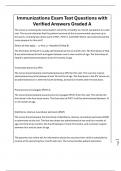
Immunizations Questions and Correct
Answers/ Latest Update / Already Graded
The nurse is reviewing the immunization record for a healthy six-
month-old patient at a well visit. The record indicates that the patient
received all the recommended vaccines up to this point, including two
doses each of RV1, PCV13, and DTaP. Which vaccine(s) should the
nurse prepare for this visit?
Select all that apply.
Ans: Hepatitis B (Hep B)
The third dose of Hep B is usually administered at the six month
visit. The first doses of Hep B are administered at birth and
again between one to two months of age. The third dose of Hep
B is administered between 6 and 18 months of age.
Inactivated poliovirus (IPV)
The nurse should prepare inactivated poliovirus (IPV) for this
visit. This vaccine may be administered any time between 6 and
18 months of age. The final dose in the IPV series can be
administered on or after the fourth birthday, at least six months
after the last dose.
Pneumococcal conjugate (PCV13)
The nurse should prepare pneumococcal conjugate (PCV13) for
this visit. This will be the third dose in the four-dose series. The
All rights reserved © 2025/ 2026 |
, Page |2
final dose of PVC13 will be administered between 12 to 18
months of age.
Diphtheria, tetanus, & acellular pertussis (DTaP)
The nurse should prepare the third dose of diphtheria, tetanus,
& acellular pertussis (DTaP) to administer at the visit. The first
two doses are administered at two and four months of age, the
third at six months, the fourth between 15 and 18 months, and a
booster is given between four and six years of age.
The parents of an infant ask for information about the vaccines their
child is scheduled to receive at the upcoming four-month well visit. The
nurse provides patient education handouts about which vaccine(s)
typically administered at four months of age?
Ans: Rotavirus (RV1)
Rotavirus is administered at the four month visit. If Rotarix
(RV1) is used, this would be the second and final dose. If
RotaTeq (RV5) is used for either the first or second dose, then a
three-dose series is required at ages two, four, and six months.
Inactivated poliovirus (IPV)
The IPV vaccine is administered at the four month visit. This is
the second shot in the series. The next will be due between 6
and 18 months of age.
All rights reserved © 2025/ 2026 |
, Page |3
Pneumococcal conjugate (PCV13)
Pneumococcal conjugate (PCV13) is administered at the four
month visit. This four-dose series is administered at ages two,
four, and six months and again between 12 and 15 months of
age.
Haemophilus influenzae type b (Hib)
Haemophilus influenzae type b (Hib) is due at the four month
visit. Depending on the specific vaccine used, this may be the
final dose in a two-dose primary series or another dose may be
required to complete the primary series. A booster dose is
administered between 12 to 15 months of ag e to complete the
full Hib series.
An infant is at the clinic for a Nine-month well visit. The nurse reviews
the chart and notes the infant did not receive the third DTaP vaccine at
the six month visit. Which action by the nurse is most appropriate?
Ans: Give third dose
The nurse should give the third dose at the nine month well visit
since this will allow the infant to catch up.
A healthy child is brought to the clinic for a 15-month well visit. The
nurse notes that the toddler received haemophilus influenzae type b
(Hib) #4; measles, mumps, rubella (MMR)#1; and pneumococcal
All rights reserved © 2025/ 2026 |
Immunizations Questions and Correct
Answers/ Latest Update / Already Graded
The nurse is reviewing the immunization record for a healthy six-
month-old patient at a well visit. The record indicates that the patient
received all the recommended vaccines up to this point, including two
doses each of RV1, PCV13, and DTaP. Which vaccine(s) should the
nurse prepare for this visit?
Select all that apply.
Ans: Hepatitis B (Hep B)
The third dose of Hep B is usually administered at the six month
visit. The first doses of Hep B are administered at birth and
again between one to two months of age. The third dose of Hep
B is administered between 6 and 18 months of age.
Inactivated poliovirus (IPV)
The nurse should prepare inactivated poliovirus (IPV) for this
visit. This vaccine may be administered any time between 6 and
18 months of age. The final dose in the IPV series can be
administered on or after the fourth birthday, at least six months
after the last dose.
Pneumococcal conjugate (PCV13)
The nurse should prepare pneumococcal conjugate (PCV13) for
this visit. This will be the third dose in the four-dose series. The
All rights reserved © 2025/ 2026 |
, Page |2
final dose of PVC13 will be administered between 12 to 18
months of age.
Diphtheria, tetanus, & acellular pertussis (DTaP)
The nurse should prepare the third dose of diphtheria, tetanus,
& acellular pertussis (DTaP) to administer at the visit. The first
two doses are administered at two and four months of age, the
third at six months, the fourth between 15 and 18 months, and a
booster is given between four and six years of age.
The parents of an infant ask for information about the vaccines their
child is scheduled to receive at the upcoming four-month well visit. The
nurse provides patient education handouts about which vaccine(s)
typically administered at four months of age?
Ans: Rotavirus (RV1)
Rotavirus is administered at the four month visit. If Rotarix
(RV1) is used, this would be the second and final dose. If
RotaTeq (RV5) is used for either the first or second dose, then a
three-dose series is required at ages two, four, and six months.
Inactivated poliovirus (IPV)
The IPV vaccine is administered at the four month visit. This is
the second shot in the series. The next will be due between 6
and 18 months of age.
All rights reserved © 2025/ 2026 |
, Page |3
Pneumococcal conjugate (PCV13)
Pneumococcal conjugate (PCV13) is administered at the four
month visit. This four-dose series is administered at ages two,
four, and six months and again between 12 and 15 months of
age.
Haemophilus influenzae type b (Hib)
Haemophilus influenzae type b (Hib) is due at the four month
visit. Depending on the specific vaccine used, this may be the
final dose in a two-dose primary series or another dose may be
required to complete the primary series. A booster dose is
administered between 12 to 15 months of ag e to complete the
full Hib series.
An infant is at the clinic for a Nine-month well visit. The nurse reviews
the chart and notes the infant did not receive the third DTaP vaccine at
the six month visit. Which action by the nurse is most appropriate?
Ans: Give third dose
The nurse should give the third dose at the nine month well visit
since this will allow the infant to catch up.
A healthy child is brought to the clinic for a 15-month well visit. The
nurse notes that the toddler received haemophilus influenzae type b
(Hib) #4; measles, mumps, rubella (MMR)#1; and pneumococcal
All rights reserved © 2025/ 2026 |