1.17 - Particle nature of light
Photoelectric effect
● In ALL cases, the net charge on an electroscope while a charged rod is near = 0
∵ charge is conserved
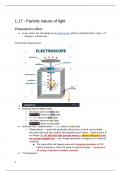
Gold leaf experiment
●
● Gold leaf doesn’t deflect when:
○ Red laser shone on steel plate
○ White light shone on steel plate
○ UV light shone on steel plate
○ Red laser shone on zinc plate
○ White light shone on zinc plate
● Gold leaf ONLY deflects when UV light shone on zinc plate
○ Observation — gold leaf gradually attracts to central rod (initially
the gold leaf and the central rod repelled each other ∵ both have a -
ve charge, the UV light has high enough energy to absorb electrons from
the central rod/gold leaf ∴ net charge gradually changes to 0 [neutral\
system])
■ The same effect will happen even with changing intensities of UV
light (ie distance from UV lamp to electroscope) ∵ no./amount
of energy of photons remains constant
● ***Conclusions:
1
, ○ Different materials have different energy requirements to (start to)
absorb/release electrons
○ 1 photon can only interact with 1 electron
Electron-volt
● ***Elementary charge (e): electric charge carried by a single proton (+e)/electron (-
e), eg ———
○ Au nucleus: +79e
○ H+ (hydrogen/protium ion), D+ (deuterium ion), T+ (tritium ion): +e
○ 𝜶 (alpha particle): +2e
○ 𝛃- (beta minus particle): -e
○ 𝛃+ (beta plus particle/positron): +e
2
○ u (up quark): + e
3
1
○ d (down quark): - e
3
● ***Electronvolt: work done on/energy gained by an electron when it moves through
a potential difference of 1 V
○ ∵ E(energy)=Q(charge)× V (voltage) ,
∴ 1 eV = (1.6 x 10-19) x 1 = 1.6 x 10⁻¹⁹ J
Einstein’s photoelectric equation
●
2
Photoelectric effect
● In ALL cases, the net charge on an electroscope while a charged rod is near = 0
∵ charge is conserved
Gold leaf experiment
●
● Gold leaf doesn’t deflect when:
○ Red laser shone on steel plate
○ White light shone on steel plate
○ UV light shone on steel plate
○ Red laser shone on zinc plate
○ White light shone on zinc plate
● Gold leaf ONLY deflects when UV light shone on zinc plate
○ Observation — gold leaf gradually attracts to central rod (initially
the gold leaf and the central rod repelled each other ∵ both have a -
ve charge, the UV light has high enough energy to absorb electrons from
the central rod/gold leaf ∴ net charge gradually changes to 0 [neutral\
system])
■ The same effect will happen even with changing intensities of UV
light (ie distance from UV lamp to electroscope) ∵ no./amount
of energy of photons remains constant
● ***Conclusions:
1
, ○ Different materials have different energy requirements to (start to)
absorb/release electrons
○ 1 photon can only interact with 1 electron
Electron-volt
● ***Elementary charge (e): electric charge carried by a single proton (+e)/electron (-
e), eg ———
○ Au nucleus: +79e
○ H+ (hydrogen/protium ion), D+ (deuterium ion), T+ (tritium ion): +e
○ 𝜶 (alpha particle): +2e
○ 𝛃- (beta minus particle): -e
○ 𝛃+ (beta plus particle/positron): +e
2
○ u (up quark): + e
3
1
○ d (down quark): - e
3
● ***Electronvolt: work done on/energy gained by an electron when it moves through
a potential difference of 1 V
○ ∵ E(energy)=Q(charge)× V (voltage) ,
∴ 1 eV = (1.6 x 10-19) x 1 = 1.6 x 10⁻¹⁹ J
Einstein’s photoelectric equation
●
2