Les Pronoms Adverbiaux: En
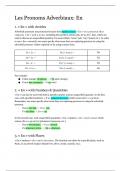
1. « En » with Articles
Adverbial pronouns are pronouns because they replace nouns. « En » is a pr on oun that
r eplaces « de » and a noun, including the partitive articles (du, de la, de l’, des), which are
used to discuss an unspecified quantity of a noun (think, “some” salt, “any” bread, etc.). In order
to use « En » correctly, one must specify what noun they are replacing previous to using the
adverbial pronoun–either explicitly or by using context clues.
De + Le → Du (+ noun) → En
De + La → De la (+ noun)→ En
De + L’ → De l’ (+ noun) → En
De + Les → Des (+ noun) → En
Par exemple:
● J’aime manger du gâteau. → J’en aime manger.
● Il veut des croissants? → Il en veut?
2. « En » with Numbers & Quantities
« En » can also be used with both a specific number and an unspecified quantity. In the first
case, with specified numbers, « E n» replaces the noun which comes after a n um ber .
Remember; one must specify what noun they are replacing previous to using the adverbial
pronoun.
- I have one dog. → I have one.
- J’ai un chien. → J’en ai un.
In the second case, with unspecified quantities, « En » replaces « de » an d a n oun which
comes after a quantity (plusieurs, beaucoup, etc.).
- I have several pens. → I have several.
- J’ai plusieurs stylos. → J’en ai plusieurs.
3. « En » with Places
« En » replaces « de » and a location . The location can either be a specific place, such as
Paris, or an adverb of place (think here, there, inside, outside, etc.).
1. « En » with Articles
Adverbial pronouns are pronouns because they replace nouns. « En » is a pr on oun that
r eplaces « de » and a noun, including the partitive articles (du, de la, de l’, des), which are
used to discuss an unspecified quantity of a noun (think, “some” salt, “any” bread, etc.). In order
to use « En » correctly, one must specify what noun they are replacing previous to using the
adverbial pronoun–either explicitly or by using context clues.
De + Le → Du (+ noun) → En
De + La → De la (+ noun)→ En
De + L’ → De l’ (+ noun) → En
De + Les → Des (+ noun) → En
Par exemple:
● J’aime manger du gâteau. → J’en aime manger.
● Il veut des croissants? → Il en veut?
2. « En » with Numbers & Quantities
« En » can also be used with both a specific number and an unspecified quantity. In the first
case, with specified numbers, « E n» replaces the noun which comes after a n um ber .
Remember; one must specify what noun they are replacing previous to using the adverbial
pronoun.
- I have one dog. → I have one.
- J’ai un chien. → J’en ai un.
In the second case, with unspecified quantities, « En » replaces « de » an d a n oun which
comes after a quantity (plusieurs, beaucoup, etc.).
- I have several pens. → I have several.
- J’ai plusieurs stylos. → J’en ai plusieurs.
3. « En » with Places
« En » replaces « de » and a location . The location can either be a specific place, such as
Paris, or an adverb of place (think here, there, inside, outside, etc.).