

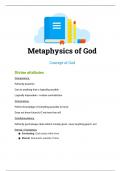
Metaphysics of God
Concept of God
Divine attributes
Omnipotence
Perfectly powerful
Can do anything that is logically possible
Logically impossible = contain contradiction
Omniscience
Perfect knowledge of everything possible to know
Does not know future b/C we have free will
Omnibenevolence
Perfectly good always does what’s morally good - never anything good / evil
Eternal / Everlasting
● Everlasting: God exists within time
● Eternal: God exists outside of time
, 2
whereas humans experience time in succession, i.e. one moment at a time, an eternal
being experiences all moments simultaneously
Eg. “past” and “future” = “present” to God
● T-simultaneity: applies to temporal (within time) beings, like humans who can
perceive 2 things happening simultaneously in the present moment only.
● E-simultaneity: This applies to atemporal (outside of time) beings, like God. God
can perceive multiple things happening simultaneously at all times
Problems / inconsistencies
Problem of the stone
If God is omnipotent (all powerful), can God create a stone so heavy He can’t lift it?
● If He can’t then he’s not powerful enough to create this stone
● But if He can then he’s not powerful enough to lift the stone
Either way, there is something God cannot do – which means He’s not omnipotent.
‘a stone an omnipotent being can’t lift’ is not a possible thing – it’s a contradiction
( can’t do what’s logically impossible.)
Euthyphro dilemma
whether morality is created by, or independent of, God.
● Is torturing babies wrong because God says it’s wrong?: morality is independent
of God = their power would be limited by morality
● Or, does God say ‘don’t torture babies’ because it is wrong?: God created morality
= what reason to choose some actions are good over they’re wrong. Good and
wrong are arbitrary if no reason = hard to make sense of claim “God is good”
(challenge to God’s benevolence)
, 3
Hw: God chooses rules of morality based on his other attributes. God loves humanity
and doesn’t like to see us suffer and so for this reason God chose to make ‘torturing
babies is bad’ true instead. This would mean goodness and badness are not arbitrary
whims but are instead grounded in some justification (God’s love).
Omniscience vs free will
● God is omniscient but we don’t have free will
● We have free will but God is not omniscient
God’s omniscience should be understood as the claim that God knows everything it is
possible to know. The whole point of free will is that it makes it impossible to know the
future = still omniscient
as an eternal being God exists outside of time and so is observing (and thus knows) our
freely chosen actions of the future.
God’s existence
Ontological argument
Priori reasoning
Concept of God
Divine attributes
Omnipotence
Perfectly powerful
Can do anything that is logically possible
Logically impossible = contain contradiction
Omniscience
Perfect knowledge of everything possible to know
Does not know future b/C we have free will
Omnibenevolence
Perfectly good always does what’s morally good - never anything good / evil
Eternal / Everlasting
● Everlasting: God exists within time
● Eternal: God exists outside of time
, 2
whereas humans experience time in succession, i.e. one moment at a time, an eternal
being experiences all moments simultaneously
Eg. “past” and “future” = “present” to God
● T-simultaneity: applies to temporal (within time) beings, like humans who can
perceive 2 things happening simultaneously in the present moment only.
● E-simultaneity: This applies to atemporal (outside of time) beings, like God. God
can perceive multiple things happening simultaneously at all times
Problems / inconsistencies
Problem of the stone
If God is omnipotent (all powerful), can God create a stone so heavy He can’t lift it?
● If He can’t then he’s not powerful enough to create this stone
● But if He can then he’s not powerful enough to lift the stone
Either way, there is something God cannot do – which means He’s not omnipotent.
‘a stone an omnipotent being can’t lift’ is not a possible thing – it’s a contradiction
( can’t do what’s logically impossible.)
Euthyphro dilemma
whether morality is created by, or independent of, God.
● Is torturing babies wrong because God says it’s wrong?: morality is independent
of God = their power would be limited by morality
● Or, does God say ‘don’t torture babies’ because it is wrong?: God created morality
= what reason to choose some actions are good over they’re wrong. Good and
wrong are arbitrary if no reason = hard to make sense of claim “God is good”
(challenge to God’s benevolence)
, 3
Hw: God chooses rules of morality based on his other attributes. God loves humanity
and doesn’t like to see us suffer and so for this reason God chose to make ‘torturing
babies is bad’ true instead. This would mean goodness and badness are not arbitrary
whims but are instead grounded in some justification (God’s love).
Omniscience vs free will
● God is omniscient but we don’t have free will
● We have free will but God is not omniscient
God’s omniscience should be understood as the claim that God knows everything it is
possible to know. The whole point of free will is that it makes it impossible to know the
future = still omniscient
as an eternal being God exists outside of time and so is observing (and thus knows) our
freely chosen actions of the future.
God’s existence
Ontological argument
Priori reasoning


