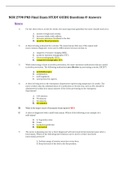
NUR4153
Clinical Reasoning & Clinical
Judgment
Final Exam Review
(Questions & Solutions)
2025
1
,1. MCQ
A 68-year-old patient with congestive heart failure reports sudden weight
gain of 4 lbs in 24 hours, increasing dyspnea, and peripheral edema.
Which hypothesis should the nurse prioritize?
A. Dietary noncompliance
B. Acute renal failure
C. Left ventricular ischemia
D. Fluid volume overload
ANS: D
Rationale: Rapid weight gain plus dyspnea and edema are classic for fluid
retention in CHF, demanding diuretic adjustment and fluid management.
2. MCQ
While reviewing an arterial blood gas, the nurse notes pH 7.30, PaCO₂ 50
mm Hg, HCO₃⁻ 24 mEq/L. Which judgment is most appropriate?
A. Uncompensated respiratory acidosis
B. Metabolic acidosis, partially compensated
C. Respiratory alkalosis, fully compensated
D. Metabolic alkalosis
ANS: A
Rationale: pH low and PaCO₂ elevated with normal HCO₃⁻ indicate acute
respiratory acidosis without renal compensation.
3. MCQ
A postoperative patient on PCA pump has RR 8/min, sedation score of 3
(“responds to name only”), and O₂ sat 92% on 2 L NC. What’s the best
initial action?
A. Increase supplemental oxygen
B. Hold PCA and stimulate patient
C. Call Rapid Response Team
D. Administer naloxone
ANS: B
Rationale: Sedation+respiratory depression first require holding opioid
2
, and arousing patient; naloxone reserved if stimulation fails.
4. MCQ
During hand‐off, the nurse hears “DVT prophylaxis.” The next step to
refine hypotheses is:
A. Ensure compression stockings are in place
B. Administer scheduled subcutaneous heparin
C. Check patient’s allergy history
D. Order doppler ultrasound
ANS: C
Rationale: Before prophylaxis, verify no heparin allergy; then implement
mechanical or pharmacologic measures.
5. MCQ
A patient’s breath sounds are absent in right lower lobe; o₂ sat 88% on
RA, improved to 94% on 4 L NC. You suspect atelectasis. Which
intervention best tests this?
A. Incentive spirometry
B. Increase IV fluids
C. Encourage coughing and deep breathing
D. Chest physiotherapy
ANS: A
Rationale: Incentive spirometry assesses and treats alveolar expansion;
improvement confirms atelectasis involvement.
6. MCQ
An ICU patient with sepsis has CVP 3 mm Hg. You interpret this as:
A. Adequate preload
B. Hypovolemia
C. Hypervolemia
D. Cardiac tamponade
ANS: B
Rationale: CVP <5 mm Hg suggests intravascular volume depletion in
context of sepsis.
3
Clinical Reasoning & Clinical
Judgment
Final Exam Review
(Questions & Solutions)
2025
1
,1. MCQ
A 68-year-old patient with congestive heart failure reports sudden weight
gain of 4 lbs in 24 hours, increasing dyspnea, and peripheral edema.
Which hypothesis should the nurse prioritize?
A. Dietary noncompliance
B. Acute renal failure
C. Left ventricular ischemia
D. Fluid volume overload
ANS: D
Rationale: Rapid weight gain plus dyspnea and edema are classic for fluid
retention in CHF, demanding diuretic adjustment and fluid management.
2. MCQ
While reviewing an arterial blood gas, the nurse notes pH 7.30, PaCO₂ 50
mm Hg, HCO₃⁻ 24 mEq/L. Which judgment is most appropriate?
A. Uncompensated respiratory acidosis
B. Metabolic acidosis, partially compensated
C. Respiratory alkalosis, fully compensated
D. Metabolic alkalosis
ANS: A
Rationale: pH low and PaCO₂ elevated with normal HCO₃⁻ indicate acute
respiratory acidosis without renal compensation.
3. MCQ
A postoperative patient on PCA pump has RR 8/min, sedation score of 3
(“responds to name only”), and O₂ sat 92% on 2 L NC. What’s the best
initial action?
A. Increase supplemental oxygen
B. Hold PCA and stimulate patient
C. Call Rapid Response Team
D. Administer naloxone
ANS: B
Rationale: Sedation+respiratory depression first require holding opioid
2
, and arousing patient; naloxone reserved if stimulation fails.
4. MCQ
During hand‐off, the nurse hears “DVT prophylaxis.” The next step to
refine hypotheses is:
A. Ensure compression stockings are in place
B. Administer scheduled subcutaneous heparin
C. Check patient’s allergy history
D. Order doppler ultrasound
ANS: C
Rationale: Before prophylaxis, verify no heparin allergy; then implement
mechanical or pharmacologic measures.
5. MCQ
A patient’s breath sounds are absent in right lower lobe; o₂ sat 88% on
RA, improved to 94% on 4 L NC. You suspect atelectasis. Which
intervention best tests this?
A. Incentive spirometry
B. Increase IV fluids
C. Encourage coughing and deep breathing
D. Chest physiotherapy
ANS: A
Rationale: Incentive spirometry assesses and treats alveolar expansion;
improvement confirms atelectasis involvement.
6. MCQ
An ICU patient with sepsis has CVP 3 mm Hg. You interpret this as:
A. Adequate preload
B. Hypovolemia
C. Hypervolemia
D. Cardiac tamponade
ANS: B
Rationale: CVP <5 mm Hg suggests intravascular volume depletion in
context of sepsis.
3