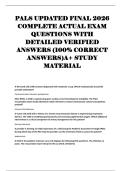
NURS2063
Essentials of Pathophysiology
Final Exam Review
(Questions & Solutions)
2025
1
,I. Multiple‐Choice Questions (10)
1. A 62-year-old smoker is admitted with sudden chest pain and dyspnea.
He is hypotensive and tachycardic. Echocardiogram shows right
ventricular dilation and McConnell’s sign. Which best explains his shock?
A) Distributive shock from sepsis
B) Cardiogenic shock from MI
C) Obstructive shock from massive pulmonary embolism
D) Hypovolemic shock from hemorrhage
Correct ANS: C
Rationale: Massive PE acutely increases pulmonary resistance, causing RV
failure and obstructive shock.
2. A 45-year-old alcoholic has acute pancreatitis and hypotension
refractory to fluids. Which mediator is most responsible for increased
vascular permeability?
A) Histamine
B) IL-10
C) Bradykinin
D) Nitric oxide
Correct ANS: A
Rationale: Histamine released from mast cells is an early mediator of
increased vascular permeability in acute inflammation.
3. A 30-year-old woman with systemic lupus erythematosus has immune
complex deposition in glomeruli leading to nephritis. What type of
hypersensitivity is this?
A) Type I
B) Type II
C) Type III
D) Type IV
Correct ANS: C
2
, Rationale: Deposition of antigen–antibody complexes in tissues is
characteristic of type III hypersensitivity.
4. A patient with chronic liver disease develops ascites and
hyponatremia. Which mechanism explains his fluid accumulation?
A) Decreased capillary hydrostatic pressure
B) Increased plasma oncotic pressure
C) Portal hypertension and hypoalbuminemia
D) Overproduction of ADH only
Correct ANS: C
Rationale: Portal hypertension raises hydrostatic pressure;
hypoalbuminemia lowers oncotic pressure, favoring ascites.
5. In acute tubular necrosis, FeNa is typically >2%. Why?
A) Intact tubule reabsorption
B) Tubular cell injury prevents Na⁺ reabsorption
C) Enhanced aldosterone action
D) Volume depletion exclusively
Correct ANS: B
Rationale: ATN damages renal tubular epithelium, reducing sodium
reabsorption and raising fractional excretion.
6. A 55-year-old with vomiting presents with pH 7.56, PaCO₂ 52 mm Hg,
HCO₃⁻ 44 mEq/L. What is primary disorder?
A) Metabolic alkalosis
B) Respiratory alkalosis
C) Metabolic acidosis
D) Respiratory acidosis
Correct ANS: A
Rationale: Elevated pH with high HCO₃⁻ and elevated PaCO₂
(compensation) indicates metabolic alkalosis.
7. A 68-year-old with insulin‐dependent diabetes presents with anion gap
metabolic acidosis, hyperglycemia, and ketonuria. Which best describes
his acid‐base disorder?
3
Essentials of Pathophysiology
Final Exam Review
(Questions & Solutions)
2025
1
,I. Multiple‐Choice Questions (10)
1. A 62-year-old smoker is admitted with sudden chest pain and dyspnea.
He is hypotensive and tachycardic. Echocardiogram shows right
ventricular dilation and McConnell’s sign. Which best explains his shock?
A) Distributive shock from sepsis
B) Cardiogenic shock from MI
C) Obstructive shock from massive pulmonary embolism
D) Hypovolemic shock from hemorrhage
Correct ANS: C
Rationale: Massive PE acutely increases pulmonary resistance, causing RV
failure and obstructive shock.
2. A 45-year-old alcoholic has acute pancreatitis and hypotension
refractory to fluids. Which mediator is most responsible for increased
vascular permeability?
A) Histamine
B) IL-10
C) Bradykinin
D) Nitric oxide
Correct ANS: A
Rationale: Histamine released from mast cells is an early mediator of
increased vascular permeability in acute inflammation.
3. A 30-year-old woman with systemic lupus erythematosus has immune
complex deposition in glomeruli leading to nephritis. What type of
hypersensitivity is this?
A) Type I
B) Type II
C) Type III
D) Type IV
Correct ANS: C
2
, Rationale: Deposition of antigen–antibody complexes in tissues is
characteristic of type III hypersensitivity.
4. A patient with chronic liver disease develops ascites and
hyponatremia. Which mechanism explains his fluid accumulation?
A) Decreased capillary hydrostatic pressure
B) Increased plasma oncotic pressure
C) Portal hypertension and hypoalbuminemia
D) Overproduction of ADH only
Correct ANS: C
Rationale: Portal hypertension raises hydrostatic pressure;
hypoalbuminemia lowers oncotic pressure, favoring ascites.
5. In acute tubular necrosis, FeNa is typically >2%. Why?
A) Intact tubule reabsorption
B) Tubular cell injury prevents Na⁺ reabsorption
C) Enhanced aldosterone action
D) Volume depletion exclusively
Correct ANS: B
Rationale: ATN damages renal tubular epithelium, reducing sodium
reabsorption and raising fractional excretion.
6. A 55-year-old with vomiting presents with pH 7.56, PaCO₂ 52 mm Hg,
HCO₃⁻ 44 mEq/L. What is primary disorder?
A) Metabolic alkalosis
B) Respiratory alkalosis
C) Metabolic acidosis
D) Respiratory acidosis
Correct ANS: A
Rationale: Elevated pH with high HCO₃⁻ and elevated PaCO₂
(compensation) indicates metabolic alkalosis.
7. A 68-year-old with insulin‐dependent diabetes presents with anion gap
metabolic acidosis, hyperglycemia, and ketonuria. Which best describes
his acid‐base disorder?
3