

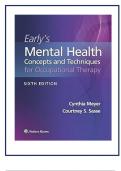
,MENTAL HEALTH CONCEPTS FOR OT
– EXAM PREP COMPANION, NCLEX®
STYLE (2025)
Comprehensive Review with NCLEX®-Style
Questions & Rationales – Cynthia Meyer &
Courtney Sasse, 6th Edition
• 23-Chapter Full Coverage | 20 MCQs Per
Chapter
• Verified Answers & Evidence-Based
Rationales
• Designed for OT/OTA Certification
Success
• Pass with Confidence – Ideal for
Coursework, Licensure & Board
,SECTION ONE: Principles of Occupational Therapy in Mental Health
Unit 1: History and Foundations
Chapter 1: History and Foundational Concepts
Chapter 2: Medical and Psychological Theories, Frames of Reference, and Models of Mental Health
and Mental Illness
Chapter 3: Occupational Therapy Frames of Reference and Practice Models
SECTION TWO: Mental Illness
Chapter 4: Understanding Psychiatric Diagnoses
SECTION THREE: Service Provision
Chapter 5: Human Occupation and Mental Health Throughout the Life Span With Those We Serve
SECTION THREE: Service Provision
Chapter 6: Methods and Models of Interaction and Intervention
Chapter 7: Service Areas, Environments, and Focuses
SECTION FOUR: Professional Practice Considerations
Chapter 8: Medications, Medical-Based Treatments, Complementary Practices, and Detoxification
Chapter 9: Safety Considerations and Techniques
Chapter 10: Using Evidence
Chapter 11: Professional Issues: Supervision, Teams, Roles, and Self-Management
Chapter 12: Evaluation and Data Collection
Chapter 13: Determining Type and Approach to Intervention
,Chapter 14: Matching Occupational Demands to Intervention Types
Chapter 15: Therapeutic Use of Self
Chapter 16: Group Concepts and Techniques in OT
Chapter 17: Facilitating Recovery Using Biopsychosocial Models
Chapter 18: Anxiety and Occupational Engagement
Chapter 20: Hallucinations, Delusions, and Paranoia
Chapter 22: Anger, Hostility, and Aggression
Chapter 23: Substance-Related and Addictive Disorders
,Chapter 1
Introduction
1. Which of the following best describes the foundational
focus of occupational therapy in mental health?
A. Restoring motor function through repetitive exercises
B. Using meaningful activity to promote psychological well-
being
C. Prescribing medication to stabilize mood
D. Analyzing dreams to uncover unconscious conflicts
Correct: B
Rationale: OT in mental health centers on engagement in
purposeful occupations to improve well-being; motor
exercises (A) and medication (C) are outside core OT
scope, and dream analysis (D) is a psychoanalytic
technique.
2. The Concept of “occupation” in early OT literature
primarily refers to:
A. Paid employment only
B. Any activity that gives life meaning
C. Structured cognitive tasks in a hospital setting
D. Exercises prescribed by a physician
Correct: B
Rationale: From the profession’s inception, “occupation”
meant all meaningful activities, not just work (A), cognitive
tasks (C), or physician-directed exercises (D).
, 3. Which publication in the early 20th century first
articulated the philosophical basis for occupation as
therapy?
A. Meyer’s “Philosophy of OT”
B. Lippincott’s “Mental Hygiene”
C. Freud’s “Interpretation of Dreams”
D. Dunton’s “Guide to Occupational Therapy”
Correct: D
Rationale: William Dunton’s manual laid out OT principles;
Meyer (A) came later, Lippincott (B) is a publisher, and
Freud’s work (C) is unrelated to OT.
Mental Health and Mental Illness
4. Which statement reflects the WHO definition of mental
health?
A. Absence of any psychiatric diagnosis
B. State of well-being in which an individual realizes
abilities, copes with stress, and works productively
C. Continuing hospitalization until behaviors are
normalized
D. Ability to avoid any negative emotions
Correct: B
Rationale: WHO defines mental health positively (B);
absence of diagnosis (A) or hospitalization (C) are outdated
views, and avoiding negative emotions (D) is unrealistic.
, 5. A client exhibits persistent depressive symptoms
affecting daily function. This presentation is classified as:
A. A mental health strength
B. A mental illness
C. A temporary mood fluctuation
D. A character flaw
Correct: B
Rationale: Persistent, impairing symptoms constitute
mental illness; it is not a strength (A), nor a brief
fluctuation (C) or moral failing (D).
6. In OT, distinguishing mental health from mental illness is
important because:
A. Insurance only covers treatment for illness
B. Wellness-based interventions can be applied to all
clients
C. Occupational performance is only relevant for mental
illness
D. Assessment tools differ entirely between the two
Correct: B
Rationale: OT promotes wellness interventions universally
(B); insurance (A) and performance relevance (C) are
inaccurate, and many tools overlap (D).
Relation of Occupation to Mental Health
7. Which mechanism best explains how meaningful
occupation improves mood?
, A. It increases neurotransmitter levels directly
B. It distracts clients from negative thoughts and builds
self-efficacy
C. It replaces the need for social support
D. It eliminates stress permanently
Correct: B
Rationale: Occupation distracts and fosters mastery (B). It
does not directly alter neurochemistry (A), substitute
social support (C), or eradicate stress (D).
8. An application-level scenario: A client with anxiety is
resistant to group craft activities. The OT’s best first step
is to:
A. Force participation to prove its value
B. Explore the client’s interests to tailor an activity
C. Discharge the client due to lack of cooperation
D. Switch to a purely cognitive intervention
Correct: B
Rationale: Tailoring to client interests promotes
engagement (B); forcing (A) and discharge (C) violate
client-centered principles, and abandoning occupation (D)
negates OT approach.
9. The term “occupational balance” refers to:
A. Spending equal time on all activities regardless of
preference
B. A harmonious mix of work, rest, and leisure aligned with
values
, C. Prioritizing leisure above all other roles
D. Eliminating all stressful tasks from a routine
Correct: B
Rationale: Occupational balance is about harmony and
value-alignment (B), not equal time (A), leisure only (C), or
stress avoidance (D).
A Few Words About Language
10. Why is person-first language (“a person with
schizophrenia”) preferred over label-first language (“a
schizophrenic”)?
A. It aligns with diagnostic manuals
B. It emphasizes the individual rather than the condition
C. It shortens documentation time
D. It is mandated by all insurance companies
Correct: B
Rationale: Person-first language reduces stigma by
highlighting the person (B); it doesn’t affect manual
alignment (A), documentation length (C), or insurance
mandates (D).
11. Which phrase is most appropriate when
documenting a client’s self-care challenges?
A. “Client is noncompliant with hygiene”
B. “Client refuses to bathe”
C. “Client demonstrates difficulty initiating hygiene tasks
due to low motivation”
, D. “Client lazy in self-care”
Correct: C
Rationale: C uses neutral, descriptive language; A and D
are judgmental, and B is pejorative without context.
12. Changing “aggressive behavior” to “behavior
presenting a risk of harm to others” exemplifies:
A. Overcomplication of language
B. Clinical precision and neutrality
C. Obscuring the issue
D. Informal documentation style
Correct: B
Rationale: It reframes behavior neutrally and precisely (B),
not complicating (A), obscuring (C), or informal (D).
Thoughts About Terminology
13. Which term correctly describes the OT’s role in a
multidisciplinary mental health team?
A. Advocate of only physical rehabilitation
B. Specialist in activity analysis and adaptation
C. Primary prescriber of psychotropic medication
D. Leader of group psychotherapy sessions exclusively
Correct: B
Rationale: OT’s unique contribution is activity
analysis/adaptation (B); medication (C) is
pharmacist/physician, and they don’t focus solely on
physical rehab (A) or psychotherapy (D).
– EXAM PREP COMPANION, NCLEX®
STYLE (2025)
Comprehensive Review with NCLEX®-Style
Questions & Rationales – Cynthia Meyer &
Courtney Sasse, 6th Edition
• 23-Chapter Full Coverage | 20 MCQs Per
Chapter
• Verified Answers & Evidence-Based
Rationales
• Designed for OT/OTA Certification
Success
• Pass with Confidence – Ideal for
Coursework, Licensure & Board
,SECTION ONE: Principles of Occupational Therapy in Mental Health
Unit 1: History and Foundations
Chapter 1: History and Foundational Concepts
Chapter 2: Medical and Psychological Theories, Frames of Reference, and Models of Mental Health
and Mental Illness
Chapter 3: Occupational Therapy Frames of Reference and Practice Models
SECTION TWO: Mental Illness
Chapter 4: Understanding Psychiatric Diagnoses
SECTION THREE: Service Provision
Chapter 5: Human Occupation and Mental Health Throughout the Life Span With Those We Serve
SECTION THREE: Service Provision
Chapter 6: Methods and Models of Interaction and Intervention
Chapter 7: Service Areas, Environments, and Focuses
SECTION FOUR: Professional Practice Considerations
Chapter 8: Medications, Medical-Based Treatments, Complementary Practices, and Detoxification
Chapter 9: Safety Considerations and Techniques
Chapter 10: Using Evidence
Chapter 11: Professional Issues: Supervision, Teams, Roles, and Self-Management
Chapter 12: Evaluation and Data Collection
Chapter 13: Determining Type and Approach to Intervention
,Chapter 14: Matching Occupational Demands to Intervention Types
Chapter 15: Therapeutic Use of Self
Chapter 16: Group Concepts and Techniques in OT
Chapter 17: Facilitating Recovery Using Biopsychosocial Models
Chapter 18: Anxiety and Occupational Engagement
Chapter 20: Hallucinations, Delusions, and Paranoia
Chapter 22: Anger, Hostility, and Aggression
Chapter 23: Substance-Related and Addictive Disorders
,Chapter 1
Introduction
1. Which of the following best describes the foundational
focus of occupational therapy in mental health?
A. Restoring motor function through repetitive exercises
B. Using meaningful activity to promote psychological well-
being
C. Prescribing medication to stabilize mood
D. Analyzing dreams to uncover unconscious conflicts
Correct: B
Rationale: OT in mental health centers on engagement in
purposeful occupations to improve well-being; motor
exercises (A) and medication (C) are outside core OT
scope, and dream analysis (D) is a psychoanalytic
technique.
2. The Concept of “occupation” in early OT literature
primarily refers to:
A. Paid employment only
B. Any activity that gives life meaning
C. Structured cognitive tasks in a hospital setting
D. Exercises prescribed by a physician
Correct: B
Rationale: From the profession’s inception, “occupation”
meant all meaningful activities, not just work (A), cognitive
tasks (C), or physician-directed exercises (D).
, 3. Which publication in the early 20th century first
articulated the philosophical basis for occupation as
therapy?
A. Meyer’s “Philosophy of OT”
B. Lippincott’s “Mental Hygiene”
C. Freud’s “Interpretation of Dreams”
D. Dunton’s “Guide to Occupational Therapy”
Correct: D
Rationale: William Dunton’s manual laid out OT principles;
Meyer (A) came later, Lippincott (B) is a publisher, and
Freud’s work (C) is unrelated to OT.
Mental Health and Mental Illness
4. Which statement reflects the WHO definition of mental
health?
A. Absence of any psychiatric diagnosis
B. State of well-being in which an individual realizes
abilities, copes with stress, and works productively
C. Continuing hospitalization until behaviors are
normalized
D. Ability to avoid any negative emotions
Correct: B
Rationale: WHO defines mental health positively (B);
absence of diagnosis (A) or hospitalization (C) are outdated
views, and avoiding negative emotions (D) is unrealistic.
, 5. A client exhibits persistent depressive symptoms
affecting daily function. This presentation is classified as:
A. A mental health strength
B. A mental illness
C. A temporary mood fluctuation
D. A character flaw
Correct: B
Rationale: Persistent, impairing symptoms constitute
mental illness; it is not a strength (A), nor a brief
fluctuation (C) or moral failing (D).
6. In OT, distinguishing mental health from mental illness is
important because:
A. Insurance only covers treatment for illness
B. Wellness-based interventions can be applied to all
clients
C. Occupational performance is only relevant for mental
illness
D. Assessment tools differ entirely between the two
Correct: B
Rationale: OT promotes wellness interventions universally
(B); insurance (A) and performance relevance (C) are
inaccurate, and many tools overlap (D).
Relation of Occupation to Mental Health
7. Which mechanism best explains how meaningful
occupation improves mood?
, A. It increases neurotransmitter levels directly
B. It distracts clients from negative thoughts and builds
self-efficacy
C. It replaces the need for social support
D. It eliminates stress permanently
Correct: B
Rationale: Occupation distracts and fosters mastery (B). It
does not directly alter neurochemistry (A), substitute
social support (C), or eradicate stress (D).
8. An application-level scenario: A client with anxiety is
resistant to group craft activities. The OT’s best first step
is to:
A. Force participation to prove its value
B. Explore the client’s interests to tailor an activity
C. Discharge the client due to lack of cooperation
D. Switch to a purely cognitive intervention
Correct: B
Rationale: Tailoring to client interests promotes
engagement (B); forcing (A) and discharge (C) violate
client-centered principles, and abandoning occupation (D)
negates OT approach.
9. The term “occupational balance” refers to:
A. Spending equal time on all activities regardless of
preference
B. A harmonious mix of work, rest, and leisure aligned with
values
, C. Prioritizing leisure above all other roles
D. Eliminating all stressful tasks from a routine
Correct: B
Rationale: Occupational balance is about harmony and
value-alignment (B), not equal time (A), leisure only (C), or
stress avoidance (D).
A Few Words About Language
10. Why is person-first language (“a person with
schizophrenia”) preferred over label-first language (“a
schizophrenic”)?
A. It aligns with diagnostic manuals
B. It emphasizes the individual rather than the condition
C. It shortens documentation time
D. It is mandated by all insurance companies
Correct: B
Rationale: Person-first language reduces stigma by
highlighting the person (B); it doesn’t affect manual
alignment (A), documentation length (C), or insurance
mandates (D).
11. Which phrase is most appropriate when
documenting a client’s self-care challenges?
A. “Client is noncompliant with hygiene”
B. “Client refuses to bathe”
C. “Client demonstrates difficulty initiating hygiene tasks
due to low motivation”
, D. “Client lazy in self-care”
Correct: C
Rationale: C uses neutral, descriptive language; A and D
are judgmental, and B is pejorative without context.
12. Changing “aggressive behavior” to “behavior
presenting a risk of harm to others” exemplifies:
A. Overcomplication of language
B. Clinical precision and neutrality
C. Obscuring the issue
D. Informal documentation style
Correct: B
Rationale: It reframes behavior neutrally and precisely (B),
not complicating (A), obscuring (C), or informal (D).
Thoughts About Terminology
13. Which term correctly describes the OT’s role in a
multidisciplinary mental health team?
A. Advocate of only physical rehabilitation
B. Specialist in activity analysis and adaptation
C. Primary prescriber of psychotropic medication
D. Leader of group psychotherapy sessions exclusively
Correct: B
Rationale: OT’s unique contribution is activity
analysis/adaptation (B); medication (C) is
pharmacist/physician, and they don’t focus solely on
physical rehab (A) or psychotherapy (D).


