

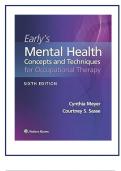
,Ultimate 2025 Exam Prep: 460 NCLEX®-
Style Questions for Early’s Mental Health
in OT
Comprehensive Review with NCLEX®-Style Questions &
Rationales – Cynthia Meyer & Courtney Sasse, 6th Edition
• 23-Chapter Full Coverage | 20 MCQs Per Chapter
• Verified Answers & Evidence-Based Rationales
• Designed for OT/OTA Certification Success
• Pass with Confidence – Ideal for Coursework, Licensure &
Board Prep
,SECTION ONE: Principles of Occupational Therapy in Mental Health
Unit 1: History and Foundations
Chapter 1: History and Foundational Concepts
Chapter 2: Medical and Psychological Theories, Frames of Reference, and Models of Mental Health
and Mental Illness
Chapter 3: Occupational Therapy Frames of Reference and Practice Models
SECTION TWO: Mental Illness
Chapter 4: Understanding Psychiatric Diagnoses
SECTION THREE: Service Provision
Chapter 5: Human Occupation and Mental Health Throughout the Life Span With Those We Serve
SECTION THREE: Service Provision
Chapter 6: Methods and Models of Interaction and Intervention
Chapter 7: Service Areas, Environments, and Focuses
SECTION FOUR: Professional Practice Considerations
Chapter 8: Medications, Medical-Based Treatments, Complementary Practices, and Detoxification
Chapter 9: Safety Considerations and Techniques
Chapter 10: Using Evidence
Chapter 11: Professional Issues: Supervision, Teams, Roles, and Self-Management
Chapter 12: Evaluation and Data Collection
Chapter 13: Determining Type and Approach to Intervention
Chapter 14: Matching Occupational Demands to Intervention Types
,Chapter 15: Therapeutic Use of Self
Chapter 16: Group Concepts and Techniques in OT
Chapter 17: Facilitating Recovery Using Biopsychosocial Models
Chapter 18: Anxiety and Occupational Engagement
Chapter 20: Hallucinations, Delusions, and Paranoia
Chapter 22: Anger, Hostility, and Aggression
Chapter 23: Substance-Related and Addictive Disorders
,Chapter 1
1–4. Introduction
1. Early’s definition of “occupation” in mental health OT
primarily emphasizes:
A. Physical exercise
B. Daily activities that give meaning
C. Psychiatric medication compliance
D. Recreational hobbies
Correct: B
Rationale: Early defines occupation as meaningful daily
activities; physical exercise and recreation are examples
but not the core definition.
2. The two foundational pillars of mental health OT include
meaningful occupation and:
A. Diagnostic testing
B. Therapeutic use of self
C. Family therapy
D. Electroconvulsive therapy
Correct: B
Rationale: The therapeutic use of self is a core OT pillar;
family therapy and ECT are not foundational OT
approaches.
3. In Early’s framework, occupational performance is best
described as:
A. A client’s ability to complete exams
B. The cognitive planning of tasks only
, C. The dynamic interaction of person, environment, and
occupation
D. Medication management skills
Correct: C
Rationale: Occupational performance occurs through the
person–environment–occupation interaction; cognitive
planning is only one aspect.
4. A primary goal of mental health OT is to restore or
enhance:
A. Intellectual quotient
B. Occupational engagement
C. Genetic predisposition
D. Pharmaceutical adherence
Correct: B
Rationale: Enhancing occupational engagement is central;
IQ and genetics are outside OT scope.
5–9. Mental Health and Mental Illness
5. According to Early, “mental health” is best defined as:
A. Absence of any psychiatric diagnosis
B. A state of well-being enabling function and coping
C. Solely biochemical brain balance
D. The use of relaxation techniques
Correct: B
Rationale: Mental health involves well-being and coping;
absence of diagnosis is too narrow.
,6. “Mental illness” differs from “mental health” in that it
denotes:
A. Temporary stress
B. A clinically significant syndrome marked by dysfunction
C. Cultural expressions of distress
D. All normal developmental phases
Correct: B
Rationale: Mental illness is a clinical syndrome with
dysfunction; stress and culture may contribute but aren’t
definitions.
7. Early warns against conflating distress with disease
because distress:
A. Always requires hospitalization
B. May be a normal response to life events
C. Is never pathological
D. Is best treated with ECT
Correct: B
Rationale: Distress can be normal; not all distress equals
pathology.
8. An application-level item: A client grieving a job loss shows
low mood but retains function. According to Early, this
condition is:
A. Major depressive disorder
B. Adjustment reaction, not necessarily mental illness
C. Bipolar II disorder
D. Schizoaffective disorder
, Correct: B
Rationale: Low mood with preserved function after a
stressor suggests adjustment reaction.
9. Which statement aligns with Early’s continuum model?
A. All presentations are either health or illness, nothing in
between
B. Everyone fluctuates between wellness and pathology
C. Mental health is fixed at birth
D. Illness is purely socially constructed
Correct: B
Rationale: The continuum model sees health/illness as
fluid; it isn’t binary or static.
10–14. Relation of Occupation to Mental Health
10. Early suggests that engagement in occupation fosters:
A. Neuroplasticity and identity formation
B. Short-term sedation only
C. Strict bed rest
D. Purely physical recovery
Correct: A
Rationale: Occupation promotes neuroplasticity and
identity; sedation and rest aren’t occupational goals.
11. Which occupation type is most therapeutic according
to Early?
A. Passive observation
, B. Goal-directed and client-centered activities
C. Unstructured time only
D. Isolation
Correct: B
Rationale: Goal-directed, client-centered tasks yield
therapeutic change; passive and unstructured alone are
less effective.
12. A vignette: A client with anxiety builds a birdhouse to
address fear of failure. What principle is illustrated?
A. Sensory modulation
B. Graded challenge through occupation
C. Psychoanalytic interpretation
D. Pharmacokinetic monitoring
Correct: B
Rationale: Graded challenge uses occupation to build
mastery; sensory modulation is different and others are
not OT core.
13. Early posits that occupational balance contributes to
mental health by:
A. Ensuring equal time for all activities
B. Allowing meaningful participation without overload
C. Avoiding leisure entirely
D. Isolating work and play strictly
Correct: B
Rationale: Balance means meaningful participation
without burnout; equal time or isolation isn’t required.
, 14. Application-level: Selecting an activity that matches a
client’s current abilities exemplifies:
A. Activity analysis and grading
B. Psychoeducation only
C. Forced adaptation
D. Diagnostic testing
Correct: A
Rationale: Activity analysis and grading tailor tasks; others
don’t describe this process.
15–18. A Few Words About Language
15. Early cautions that calling someone “crazy” is:
A. Clinically precise
B. Stigmatizing and non-therapeutic
C. Acceptable in all settings
D. Synonymous with “resilient”
Correct: B
Rationale: “Crazy” carries stigma and impedes rapport; it’s
not therapeutic.
16. Person-first language example:
A. “Schizophrenic patient”
B. “Person with schizophrenia”
C. “Insane individual”
D. “Crazy schizophrenic”
Correct: B
Style Questions for Early’s Mental Health
in OT
Comprehensive Review with NCLEX®-Style Questions &
Rationales – Cynthia Meyer & Courtney Sasse, 6th Edition
• 23-Chapter Full Coverage | 20 MCQs Per Chapter
• Verified Answers & Evidence-Based Rationales
• Designed for OT/OTA Certification Success
• Pass with Confidence – Ideal for Coursework, Licensure &
Board Prep
,SECTION ONE: Principles of Occupational Therapy in Mental Health
Unit 1: History and Foundations
Chapter 1: History and Foundational Concepts
Chapter 2: Medical and Psychological Theories, Frames of Reference, and Models of Mental Health
and Mental Illness
Chapter 3: Occupational Therapy Frames of Reference and Practice Models
SECTION TWO: Mental Illness
Chapter 4: Understanding Psychiatric Diagnoses
SECTION THREE: Service Provision
Chapter 5: Human Occupation and Mental Health Throughout the Life Span With Those We Serve
SECTION THREE: Service Provision
Chapter 6: Methods and Models of Interaction and Intervention
Chapter 7: Service Areas, Environments, and Focuses
SECTION FOUR: Professional Practice Considerations
Chapter 8: Medications, Medical-Based Treatments, Complementary Practices, and Detoxification
Chapter 9: Safety Considerations and Techniques
Chapter 10: Using Evidence
Chapter 11: Professional Issues: Supervision, Teams, Roles, and Self-Management
Chapter 12: Evaluation and Data Collection
Chapter 13: Determining Type and Approach to Intervention
Chapter 14: Matching Occupational Demands to Intervention Types
,Chapter 15: Therapeutic Use of Self
Chapter 16: Group Concepts and Techniques in OT
Chapter 17: Facilitating Recovery Using Biopsychosocial Models
Chapter 18: Anxiety and Occupational Engagement
Chapter 20: Hallucinations, Delusions, and Paranoia
Chapter 22: Anger, Hostility, and Aggression
Chapter 23: Substance-Related and Addictive Disorders
,Chapter 1
1–4. Introduction
1. Early’s definition of “occupation” in mental health OT
primarily emphasizes:
A. Physical exercise
B. Daily activities that give meaning
C. Psychiatric medication compliance
D. Recreational hobbies
Correct: B
Rationale: Early defines occupation as meaningful daily
activities; physical exercise and recreation are examples
but not the core definition.
2. The two foundational pillars of mental health OT include
meaningful occupation and:
A. Diagnostic testing
B. Therapeutic use of self
C. Family therapy
D. Electroconvulsive therapy
Correct: B
Rationale: The therapeutic use of self is a core OT pillar;
family therapy and ECT are not foundational OT
approaches.
3. In Early’s framework, occupational performance is best
described as:
A. A client’s ability to complete exams
B. The cognitive planning of tasks only
, C. The dynamic interaction of person, environment, and
occupation
D. Medication management skills
Correct: C
Rationale: Occupational performance occurs through the
person–environment–occupation interaction; cognitive
planning is only one aspect.
4. A primary goal of mental health OT is to restore or
enhance:
A. Intellectual quotient
B. Occupational engagement
C. Genetic predisposition
D. Pharmaceutical adherence
Correct: B
Rationale: Enhancing occupational engagement is central;
IQ and genetics are outside OT scope.
5–9. Mental Health and Mental Illness
5. According to Early, “mental health” is best defined as:
A. Absence of any psychiatric diagnosis
B. A state of well-being enabling function and coping
C. Solely biochemical brain balance
D. The use of relaxation techniques
Correct: B
Rationale: Mental health involves well-being and coping;
absence of diagnosis is too narrow.
,6. “Mental illness” differs from “mental health” in that it
denotes:
A. Temporary stress
B. A clinically significant syndrome marked by dysfunction
C. Cultural expressions of distress
D. All normal developmental phases
Correct: B
Rationale: Mental illness is a clinical syndrome with
dysfunction; stress and culture may contribute but aren’t
definitions.
7. Early warns against conflating distress with disease
because distress:
A. Always requires hospitalization
B. May be a normal response to life events
C. Is never pathological
D. Is best treated with ECT
Correct: B
Rationale: Distress can be normal; not all distress equals
pathology.
8. An application-level item: A client grieving a job loss shows
low mood but retains function. According to Early, this
condition is:
A. Major depressive disorder
B. Adjustment reaction, not necessarily mental illness
C. Bipolar II disorder
D. Schizoaffective disorder
, Correct: B
Rationale: Low mood with preserved function after a
stressor suggests adjustment reaction.
9. Which statement aligns with Early’s continuum model?
A. All presentations are either health or illness, nothing in
between
B. Everyone fluctuates between wellness and pathology
C. Mental health is fixed at birth
D. Illness is purely socially constructed
Correct: B
Rationale: The continuum model sees health/illness as
fluid; it isn’t binary or static.
10–14. Relation of Occupation to Mental Health
10. Early suggests that engagement in occupation fosters:
A. Neuroplasticity and identity formation
B. Short-term sedation only
C. Strict bed rest
D. Purely physical recovery
Correct: A
Rationale: Occupation promotes neuroplasticity and
identity; sedation and rest aren’t occupational goals.
11. Which occupation type is most therapeutic according
to Early?
A. Passive observation
, B. Goal-directed and client-centered activities
C. Unstructured time only
D. Isolation
Correct: B
Rationale: Goal-directed, client-centered tasks yield
therapeutic change; passive and unstructured alone are
less effective.
12. A vignette: A client with anxiety builds a birdhouse to
address fear of failure. What principle is illustrated?
A. Sensory modulation
B. Graded challenge through occupation
C. Psychoanalytic interpretation
D. Pharmacokinetic monitoring
Correct: B
Rationale: Graded challenge uses occupation to build
mastery; sensory modulation is different and others are
not OT core.
13. Early posits that occupational balance contributes to
mental health by:
A. Ensuring equal time for all activities
B. Allowing meaningful participation without overload
C. Avoiding leisure entirely
D. Isolating work and play strictly
Correct: B
Rationale: Balance means meaningful participation
without burnout; equal time or isolation isn’t required.
, 14. Application-level: Selecting an activity that matches a
client’s current abilities exemplifies:
A. Activity analysis and grading
B. Psychoeducation only
C. Forced adaptation
D. Diagnostic testing
Correct: A
Rationale: Activity analysis and grading tailor tasks; others
don’t describe this process.
15–18. A Few Words About Language
15. Early cautions that calling someone “crazy” is:
A. Clinically precise
B. Stigmatizing and non-therapeutic
C. Acceptable in all settings
D. Synonymous with “resilient”
Correct: B
Rationale: “Crazy” carries stigma and impedes rapport; it’s
not therapeutic.
16. Person-first language example:
A. “Schizophrenic patient”
B. “Person with schizophrenia”
C. “Insane individual”
D. “Crazy schizophrenic”
Correct: B


