100% satisfaction guarantee Immediately available after payment Both online and in PDF No strings attached 4.2 TrustPilot
logo-home
Summary

Summary European Union (EU) Law Masters (LLM): Supremacy of EU Law Notes

Rating
-
Sold
-
Pages
4
Uploaded on
04-10-2020
Written in
2019/2020

Masters module notes on the supremacy of European Union (EU) law. Such law surrounds the supremacy of EU law over national law in Germany; Italy; France; the UK; Poland and the Czech Republic.

Institution
Course


Whoops! We can’t load your doc right now. Try again or contact support.

Connected book

Written for

Institution
Study
Course

Document information

Summarized whole book?
Unknown
Uploaded on
October 4, 2020
Number of pages
4
Written in
2019/2020
Type
Summary

Subjects

Content preview

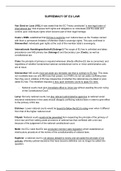
SUPREMACY OF EU LAW


Van Gend en Loos (VGL) It was stated that the EC Treaty constituted “a new legal order of
international law” that imposes both rights and obligations on individuals and the state and
confers upon individuals rights which become part of their legal heritage.

Costa v ENEL established that EU law is supreme over national laws as the Treaties carried
with them a permanent limitation of Member State’s sovereign rights. This was confirmed in
Simmenthal: individuals gain rights at the cost of the member state’s sovereignty.

Internationale Handelsgesellschaft (Solange I) The scope of EU law is unlimited and takes
precedence over MS primary law (Solange I) and Secondary Law (Costa), as well as
constitutional law.

Ciola: the principle of primacy is required whenever directly effective EU law is concerned, and
regardless of whether fundamental national constitutional norms or minor administrative acts
are at issue.

Simmenthal: MS courts must set aside any domestic law that is contrary to EU law. This does
not invalidate laws (as only MS have that power), but if MS’s do not set aside conflicting laws
then they are in violation of EU law irrespective of whether the national law pre-dated or post-
dated EU law. This therefore imposes a duty upon domestic courts to apply EU laws.

- National courts must give immediate effect to Union law without awaiting the prior ruling
of the Constitutional Court.

Larsy: Not only national courts, but also relevant administrative agencies (a national social
insurance institutions in this case) should disapply conflicting national laws in order to give effect
to the primacy of EU law.

Elchinov: Lower national courts would be bound to follow the ECJ’s ruling even when it differed
from that of the higher national court.

Filipiak: National courts could not be prevented from respecting the principle of the primacy of
Union law and from setting aside provisions of national law that conflicted with union law
because of the judgement of the national constitutional court.

Melki: the ECJ ruled that EU law precluded member state legislation which established an
interlocutory procedure of the review of the constitutionality of national laws.

Kapferer: a national court is not always obliged to review and set aside the principle of res
judicata, whereby judicial decisions that have become definitive can no longer be called into
question.

,Lucchini: EU law precluded the application of a provision of national law laying down the
principle of res judicata where this would prevent the recovery of state aid granted in breach of
EU law.

GERMANY

Honeywell: German Courts accept the supremacy of EU law but Member State’s law can
continue to apply if and to the degree that it retains an objective are of provision beyond the field
of application of pertinent union law i.e. the primacy of application of EU could not be
comprehensive.

- B v R (2661/06): the Ultra Vires review by the Federal constitutional court can moreover
only be considered if it is manifest that acts of EU bodies and institutions have taken
place outside the transferred competences’.

Re Wunsche Handelsgesellschaft (Solange II): so long as what the EU does is consistent
with rights protected under the german constitution, german courts will accept the supremacy of
EU law.

Brunner: The German Constitutional Court would not relinquish its power to decide on the
compatibility of Community law with the Constitution. German courts will intervene if the EU
goes further than the treaties will allow and will not give the law in question supremacy.


B v E (Lisbon Judgement) (2/08): The court defined defined five areas in which the state must
take a role: Criminal law; war and peach; public expenditures and taxation; welfare; culture and
religion.

ITALY

Frontini: Italy consents, on reciprocity with other states, to the limitation of sovereignty
necessary for an arrangement which may ensure peace and justice between nations.

Granital: In order to give effect to supremacy of EU Law, Italian courts must be prepared where
necessary to disregard conflicting national law and to apply EU law directly.

Fragd: The Italian constitutional court considered that an EU measure would not be applied in
Italy if it contravened a fundamental principle of the Italian constitution concerning human rights
protection. (similar to Solange II)


FRANCE

, Semoules: the Supreme Administrative Court, the Conseil d’etat, in effect rejected the
supremacy of EU law over national law as it had no jurisdiction to review the validity of Frenche
legislation.

Nicolo: the acceptance of the primacy of the Treaties over later statutes as Article 55 of the
French Constitution provided for the superiority of international treaties over national law.

- The Conseil d’Etat has since recognised the primacy of both EU regulations and
directives, but no over the constitution itself.

UNITED KINGDOM

The European Communities Act 1972:

- Section 2(1): Deems law under the EU treaties is to be given immediate legal effect and
directly enforceable in the UK (direct effect).

- Section 2(2): provides for the implementation of EU obligations, even when they are
intended to replace national legislation and Acts of Parliament.

Factortame (No.2): The acceptance of supremacy was voluntary and the UK agreed to be
bound by the supremacy of EU law in the European Communities Act 1972.

- Lord Bridge: ‘Thus whatever limitation of its sovereignty Parliament accepted when it
enacted the European Communities Act 1972 was entirely voluntary.’

Thoburn v Sunderland City Council: The UK parliament chose to be bound by EU law and so
courts must set aside conflicting domestic law.

- Laws LJ: the constitutional relationship between the EU and the UK was decided by the
common law in the light of any domestic statutes.

HS2: Lord Reed made clear that the application of the supremacy doctrine in UK law ‘itself
depends upon the 1972 Act’.

European Union Act 2011: introduced a far-reaching regime of statutory and referendum
‘locks’. S. 18 tells us that as far as Parliament is concerned the status of EU law is entirely as a
result of the 1972 Act,

R (Miller) v Secretary of State for Exiting the European Union: Domestic courts are under
an obligation to follow EU laws because the UK parliament has directed them to do so.

POLAND

Get to know the seller

Seller avatar
Reputation scores are based on the amount of documents a seller has sold for a fee and the reviews they have received for those documents. There are three levels: Bronze, Silver and Gold. The better the reputation, the more your can rely on the quality of the sellers work.
fvanrandwyck Universiteit Leiden
Follow You need to be logged in order to follow users or courses
Sold
18
Member since
5 year
Number of followers
13
Documents
22
Last sold
1 year ago

1.0

2 reviews

5
0
4
0
3
0
2
0
1
2

Recently viewed by you

Why students choose Stuvia

Created by fellow students, verified by reviews

Quality you can trust: written by students who passed their tests and reviewed by others who've used these notes.

Didn't get what you expected? Choose another document

No worries! You can instantly pick a different document that better fits what you're looking for.

Pay as you like, start learning right away

No subscription, no commitments. Pay the way you're used to via credit card and download your PDF document instantly.

Student with book image

“Bought, downloaded, and aced it. It really can be that simple.”

Alisha Student

Frequently asked questions