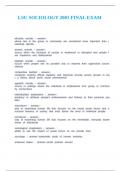
LSU SOCIOLOGY 2001 FINAL EXAM
QUESTIONS AND ANSWERS WELL
1. altruistic suicide: where ties to the group or community are considered more
important than individual identity
2. anomic suicide: occurs when the structure of society is weakened or disrupted
and people feel hopelesss and disillusioned
3. fatalistic suicide: occurs when people see no possible way to improve their
oppressive circumstances
4. comparitive method: compares existing official statistics and historical records
across groups to test a theory about some social phenomenon
5. egotistic suicide: occurs in settings where the individual is emphasized over
group or community connections
6. individualistic explanation: tendency to attribute people's achievements and
failures to their personal qualities
7. macrolevel: way of examining human life that focuses on the broad social forces
and structural features of society that exist above the level of individual people
8. microlevel: way of examining human life that focuses on the immediate, everyday
experiences of individuals
9. sociological imagination: ability to see the impact of social forces on our private
lives
10. sociology: systematic study of human societies
11. achieved status: social position earned
12. ascribed status: social status given at birth
13. coalition: subgroup of a triad, formed when two of the members unite against
the third
14. conflict perspective: views the structure of society as a source of inequality
that always benefits some groups at the expense of other groups
15. culture: language, values, beliefs, etc that characterize a society
16. dyad: group consisting of two people
17. feminist perspective: theoretical perspective that focuses on gender as the
most important source of conflict and inequality in social life
18. globalization: the process when people's lives all around the world become
economically, politically, environmentally and culturally interconnected
19. group: a set of people who interact more or less on a regular basis and who are
1/7
, conscious of their identity as a unit
20. in-groups: groups where we feel we belong, and a sense of loyalty
21. latent functions: unintended, unrecognized consequences of activities that
help some part of the social system
22. manifest function: intended, obvious consequences of activities that help some
part of the social system
23. norm: culturally defined standard or rule of conduct
2/7
QUESTIONS AND ANSWERS WELL
1. altruistic suicide: where ties to the group or community are considered more
important than individual identity
2. anomic suicide: occurs when the structure of society is weakened or disrupted
and people feel hopelesss and disillusioned
3. fatalistic suicide: occurs when people see no possible way to improve their
oppressive circumstances
4. comparitive method: compares existing official statistics and historical records
across groups to test a theory about some social phenomenon
5. egotistic suicide: occurs in settings where the individual is emphasized over
group or community connections
6. individualistic explanation: tendency to attribute people's achievements and
failures to their personal qualities
7. macrolevel: way of examining human life that focuses on the broad social forces
and structural features of society that exist above the level of individual people
8. microlevel: way of examining human life that focuses on the immediate, everyday
experiences of individuals
9. sociological imagination: ability to see the impact of social forces on our private
lives
10. sociology: systematic study of human societies
11. achieved status: social position earned
12. ascribed status: social status given at birth
13. coalition: subgroup of a triad, formed when two of the members unite against
the third
14. conflict perspective: views the structure of society as a source of inequality
that always benefits some groups at the expense of other groups
15. culture: language, values, beliefs, etc that characterize a society
16. dyad: group consisting of two people
17. feminist perspective: theoretical perspective that focuses on gender as the
most important source of conflict and inequality in social life
18. globalization: the process when people's lives all around the world become
economically, politically, environmentally and culturally interconnected
19. group: a set of people who interact more or less on a regular basis and who are
1/7
, conscious of their identity as a unit
20. in-groups: groups where we feel we belong, and a sense of loyalty
21. latent functions: unintended, unrecognized consequences of activities that
help some part of the social system
22. manifest function: intended, obvious consequences of activities that help some
part of the social system
23. norm: culturally defined standard or rule of conduct
2/7