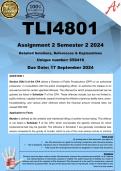
, HED4810 Assignment 2 (COMPLETE ANSWERS) 2025 (647881) - DUE 9
July 2025; 100% CORRECT AND TRUSTED SOLUTIONS
Question 1:
Exclusion in education persists despite the adoption of inclusive policies
(Clasquin-Johnson & Johnson, 2025). Write an essay in which you agree/disagree
with the statement above. Include five key reasons for your response, supported by
three recent references.
Title:
The Persistence of Exclusion in Education Despite Inclusive
Policies
Introduction
Inclusive education, in principle, is a transformative approach aimed
at restructuring the educational system to accommodate all learners,
irrespective of their diverse needs, backgrounds, and abilities.
Policies that advocate for inclusive education have been adopted
globally and in South Africa, with the aim of eliminating systemic
barriers and promoting equitable access to quality education.
However, despite these commendable policy frameworks—such as
the Education White Paper 6 (2001) and the Screening, Identification,
Assessment, and Support (SIAS) Policy—exclusion in education
remains a stubborn and pervasive challenge. This essay agrees with
the statement by Clasquin-Johnson & Johnson (2025) that exclusion
persists despite inclusive policies. Five key reasons will be presented
to support this stance, with recent references to strengthen the
discussion.
1. Inadequate Implementation of Inclusive Education Policies
Although inclusive education policies exist, their implementation is
often inconsistent and fragmented, especially in under-resourced
July 2025; 100% CORRECT AND TRUSTED SOLUTIONS
Question 1:
Exclusion in education persists despite the adoption of inclusive policies
(Clasquin-Johnson & Johnson, 2025). Write an essay in which you agree/disagree
with the statement above. Include five key reasons for your response, supported by
three recent references.
Title:
The Persistence of Exclusion in Education Despite Inclusive
Policies
Introduction
Inclusive education, in principle, is a transformative approach aimed
at restructuring the educational system to accommodate all learners,
irrespective of their diverse needs, backgrounds, and abilities.
Policies that advocate for inclusive education have been adopted
globally and in South Africa, with the aim of eliminating systemic
barriers and promoting equitable access to quality education.
However, despite these commendable policy frameworks—such as
the Education White Paper 6 (2001) and the Screening, Identification,
Assessment, and Support (SIAS) Policy—exclusion in education
remains a stubborn and pervasive challenge. This essay agrees with
the statement by Clasquin-Johnson & Johnson (2025) that exclusion
persists despite inclusive policies. Five key reasons will be presented
to support this stance, with recent references to strengthen the
discussion.
1. Inadequate Implementation of Inclusive Education Policies
Although inclusive education policies exist, their implementation is
often inconsistent and fragmented, especially in under-resourced