1.4 - Momentum
● ***Definition: a measure of how hard it is to stop a moving body
● p(momentum)=m( mass)× v ( velocity)
○ ∵ F (force )=m(mass) ×a (acceleration) ,
v ( velocity)
F (force )=m(mass) ×
t (time )
p (momentum)
F (force )=
t (time)
Δ p(impulse)
∴ F= (OR F∆t = m∆v)
∆t
■ ***Force is the rate of change in momentum of a body
● Types of impact (between bodies):
○ Collision - total momentum before can not be 0
○ Explosion - total momentum before = 0 (both bodies are stationary to start
with)
● (Ignoring frictional forces) momentum is ALWAYS conserved (ie m1 v 1=m 2 v 2)
○ “Total momentum before impact = total momentum after impact” (given that
total mass of closed system remains constant)
○ Elastic: total KE conserved, inelastic: total KE NOT conserved
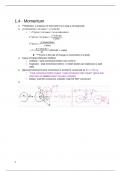
●
1
● ***Definition: a measure of how hard it is to stop a moving body
● p(momentum)=m( mass)× v ( velocity)
○ ∵ F (force )=m(mass) ×a (acceleration) ,
v ( velocity)
F (force )=m(mass) ×
t (time )
p (momentum)
F (force )=
t (time)
Δ p(impulse)
∴ F= (OR F∆t = m∆v)
∆t
■ ***Force is the rate of change in momentum of a body
● Types of impact (between bodies):
○ Collision - total momentum before can not be 0
○ Explosion - total momentum before = 0 (both bodies are stationary to start
with)
● (Ignoring frictional forces) momentum is ALWAYS conserved (ie m1 v 1=m 2 v 2)
○ “Total momentum before impact = total momentum after impact” (given that
total mass of closed system remains constant)
○ Elastic: total KE conserved, inelastic: total KE NOT conserved
●
1