📑
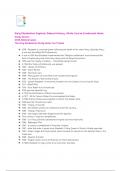
Early Elizabethan England, Edexcel History, Whole Course Condensed Notes
Study Saviour
GCSE (Edexcel spec)
The Only Elizabethan Study Notes You’ll Need
➔ 1558 - Elizabeth is crowned Queen following the death of her sister Mary I (bloody Mary -
it was she that killed 283 Protestants).
➔ It was in 1559 that Elizabeth implemented her ‘Religious settlement’ and introduced the
Acts of Supremacy and Uniformity, along with the Royal Injunctions.
➔ 1559 sees the Treaty of Cateau - Cambrésis being formed.
➔ In 1560 the Treaty of Edinburgh was passed.
➔ 1563 - statute of Artificers.
➔ 1566 - Dutch Revolt.
➔ 1568 - Genoese Loan.
➔ 1568 - Mary Queen of Scots flees from Scotland to England.
➔ 1559 - The Revolt of the Northern Earls.
➔ 1570 - Queen Elizabeth I is excommunicated from the Catholic Church by the Pope.
➔ 1571 - Ridolfi Plot.
➔ 1576 - Poor Relief Act is introduced.
➔ 1576 sees the Spanish Fury.
➔ In 1576 the Pacification of Ghent was passed.
➔ In 1577 - 80 Sir Francis Drake Circumnavigated the Globe.
➔ In 1580 Francis Drake was knighted on board The Golden Hind.
➔ 1583 sees the Throckmoron plot.
➔ 1584 - Treaty of Joinville.
➔ 1585 - all Catholic priests are ordered to leave the country.
➔ 1585 - Treaty of Nonsuch.
➔ 1585 - War begins between England and the Spanish.
➔ First colony in Virginia is established.
➔ 1586 - surviving colonists abandoned Virginia and returned home.
➔ 1586 - Babington Plot.
➔ 1587 - a colony is established in Roanoke, Virginia.
➔ 1587 - after the order is given from Elizabeth I, Mary Queen of Scots is finally executed.
➔ 1587 - Drake ‘singes the King’s beard’ when he leads an assault on the Spanish fleet in the
Cadiz port.
➔ 1588 - Spanish Armada.
➔ 1590 - English sailors arrive at Roanoke to find it abandoned.
➔ In 1603, Elizabeth I's reign came to an end when she died.
,➔ Elizabeth’s reign is often known as the ‘Golden Age’ and this term is used to
describe the manner in which she chose to rule England with a sort of ‘middle
way’ approach to religion, stabilising years of tumultuous reigns.
➔ 90% of England's population both lived and worked in the countryside at the
beginning of Elizabeth’s reign.
➔ The Secretary of State was the most important of the Queen’s privy counsellors
and advised the Queen on matters important to the Crown and the most
significant individual who held this role during Elizabeth’s reign was of course Sir
William Cecil.
➔ The Court: a body of people who lived in or near the same vicinity as the
monarch and were mostly members of the nobility and were the monarch’s key
servants, advisors and friends - attending court required the monarch’s
permission. Their role was to advise and entertain the monarch and they had
more influence with the monarch as opposed to actual power and were a public
display of both wealth and power.
➔ The Privy Council: was made up of leading courtiers and advisors, as well as
nobles and the most senior of government members. There were 19 members of
the council and they were appointed by the monarch, met at least 3 times per
week and these were often presided over by the monarch. Their role, as well as
debating current issues and advising the monarch on government policy, was to
ensure that all of the monarch's final decisions were carried out, monitoring JPs
and the proceedings of parliaments, and to oversee law and order, local
government and the security of England. In essence, they played a fairly crucial
role in how things were managed.
➔ Lords Lieutenant: Each country had one that was appointed by the monarch, they
were members of nobility and of the Privy council and they were vital in not only
maintaining the monarch’s power but also in maintaining English defences. They
were in charge of training local militia, oversaw the enforcement of policies, were
responsible for English defences and were also part of the local government.
➔ Parliament: comprising the Houses of Lords and Commons, it could only be called
and dismissed by the monarch and by nobody else, before each new parliament
elections with a very selective and minimal electorate were held. During her reign,
Elizabeth called upon parliament 10 times. Parliaments were involved in: granting
extraordinary taxation (in essence a fancy word for windfall tax), passed acts of
parliament and also offered advice to the monarch.
➔ Justices of the Peace (JPs): Were fairly large landowners who - to some extent -
kept law and order in their local areas. They were unpaid (more of a position of
status really) and reported into the Privy Council. Their role also involved making
sure that all socioeconomic policies were carried out, heard county court cases
every 3 months for slightly more serious crimes and were also part of the local
government.
➔ Elizabeth I managed to inherit £300,000 in debt (a very large sum for the time)
and the Crown’s annual income sat at around £286,667.
, ➔ During Elizabeth’s reign each coin contained a certain amount of precious metal
and in order to provide money for wars in the 1540s, they had been debased (the
amount of precious metal in them reduced) which in turn caused inflation as the
coins became more valuable and people began to want to hold on to the old
currency. This posed yet another challenge for Elizabeth.
➔ The monarch was able to raise money from the following: custom duties (whether
they were always paid or not is another matter entirely), crown lands, loans,
subsidies and extraordinary taxation and profits of justice.
➔ Problems encountered by the new Queen upon her ascension: Doubts about
female rule, financial weakness, issues of legitimacy, marriage / succession,
challenges from abroad (and less notably, Elizabeth’s temper and character).
➔ So what was the problem with her legitimacy? Her mother, Anne Boleyn, was only
recognized as the Queen of England following Henry VIII’s divorce from Catherine
of Aragon and the 1532 Reformation of the church of England - which allowed
Henry’s marriage to Boleyn but resulted in his excommunication on behalf of the
Pope - but the problem was that the Catholic Church did not believe in divorce ,
and so simply did not accept Elizabeth I as Queen.
➔ The ‘French threat’: with a wealthier and larger population than England at the
time, they were England’s traditional enemy and an ally of Scotland - it was this
friendship that came to be known as the Auld Alliance - and it proved somewhat
problematic for Elizabeth - and most certainly something she’s want to keep in
check. The Scottish monarch, of course being Mary Queen of Scots and none
other than her cousin - who notably just so happened to be a very strong
potential Catholic Claimant to the English throne was also French and married to
Francis (the very heir of the French throne) - this led MQS to become Queen of
France in 1559 - and her husband Francis II, King. When Mary I died, it was she
who proclaimed herself the claimant to the English throne and was the
granddaughter of Henry VIII’s sister - this was superfly fantastic for those
committed Catholics who refused to accept Boleyn’s marriage to the King (and
therefore Elizabeth as the new Queen - as previously discussed).
➔ England’s border with Scotland was indeed remote and difficult to defend and
saw constant conflict and raids, in 1558, it was Mary QS’s mother , Mary of Guise -
who at the time ruled Scotland for her daughter as regent) who had French
troops stationed there - of course to England’s discontent.
➔ The Role of the Church of England: controlled any religious (and therefore,
ultimately political) messages that were being preached, it gave guidance to local
communities when they turned to parish churches in times of struggle and
hardship, it enforced religious settlements, legitimised power to the monarch, and
it also ran Church courts.
➔ The Church was also of course responsible for enforcing the religious settlement
of Elizabth in 1559, and this meant that they carried out inspections of Churches
and of members of the clergy, in order to check that they were enforcing
Elizabth’s religious settlement according to her wishes, making sure that bishops
had taken the oath of supremacy etc - these came to be known as ‘visitations’.
Early Elizabethan England, Edexcel History, Whole Course Condensed Notes
Study Saviour
GCSE (Edexcel spec)
The Only Elizabethan Study Notes You’ll Need
➔ 1558 - Elizabeth is crowned Queen following the death of her sister Mary I (bloody Mary -
it was she that killed 283 Protestants).
➔ It was in 1559 that Elizabeth implemented her ‘Religious settlement’ and introduced the
Acts of Supremacy and Uniformity, along with the Royal Injunctions.
➔ 1559 sees the Treaty of Cateau - Cambrésis being formed.
➔ In 1560 the Treaty of Edinburgh was passed.
➔ 1563 - statute of Artificers.
➔ 1566 - Dutch Revolt.
➔ 1568 - Genoese Loan.
➔ 1568 - Mary Queen of Scots flees from Scotland to England.
➔ 1559 - The Revolt of the Northern Earls.
➔ 1570 - Queen Elizabeth I is excommunicated from the Catholic Church by the Pope.
➔ 1571 - Ridolfi Plot.
➔ 1576 - Poor Relief Act is introduced.
➔ 1576 sees the Spanish Fury.
➔ In 1576 the Pacification of Ghent was passed.
➔ In 1577 - 80 Sir Francis Drake Circumnavigated the Globe.
➔ In 1580 Francis Drake was knighted on board The Golden Hind.
➔ 1583 sees the Throckmoron plot.
➔ 1584 - Treaty of Joinville.
➔ 1585 - all Catholic priests are ordered to leave the country.
➔ 1585 - Treaty of Nonsuch.
➔ 1585 - War begins between England and the Spanish.
➔ First colony in Virginia is established.
➔ 1586 - surviving colonists abandoned Virginia and returned home.
➔ 1586 - Babington Plot.
➔ 1587 - a colony is established in Roanoke, Virginia.
➔ 1587 - after the order is given from Elizabeth I, Mary Queen of Scots is finally executed.
➔ 1587 - Drake ‘singes the King’s beard’ when he leads an assault on the Spanish fleet in the
Cadiz port.
➔ 1588 - Spanish Armada.
➔ 1590 - English sailors arrive at Roanoke to find it abandoned.
➔ In 1603, Elizabeth I's reign came to an end when she died.
,➔ Elizabeth’s reign is often known as the ‘Golden Age’ and this term is used to
describe the manner in which she chose to rule England with a sort of ‘middle
way’ approach to religion, stabilising years of tumultuous reigns.
➔ 90% of England's population both lived and worked in the countryside at the
beginning of Elizabeth’s reign.
➔ The Secretary of State was the most important of the Queen’s privy counsellors
and advised the Queen on matters important to the Crown and the most
significant individual who held this role during Elizabeth’s reign was of course Sir
William Cecil.
➔ The Court: a body of people who lived in or near the same vicinity as the
monarch and were mostly members of the nobility and were the monarch’s key
servants, advisors and friends - attending court required the monarch’s
permission. Their role was to advise and entertain the monarch and they had
more influence with the monarch as opposed to actual power and were a public
display of both wealth and power.
➔ The Privy Council: was made up of leading courtiers and advisors, as well as
nobles and the most senior of government members. There were 19 members of
the council and they were appointed by the monarch, met at least 3 times per
week and these were often presided over by the monarch. Their role, as well as
debating current issues and advising the monarch on government policy, was to
ensure that all of the monarch's final decisions were carried out, monitoring JPs
and the proceedings of parliaments, and to oversee law and order, local
government and the security of England. In essence, they played a fairly crucial
role in how things were managed.
➔ Lords Lieutenant: Each country had one that was appointed by the monarch, they
were members of nobility and of the Privy council and they were vital in not only
maintaining the monarch’s power but also in maintaining English defences. They
were in charge of training local militia, oversaw the enforcement of policies, were
responsible for English defences and were also part of the local government.
➔ Parliament: comprising the Houses of Lords and Commons, it could only be called
and dismissed by the monarch and by nobody else, before each new parliament
elections with a very selective and minimal electorate were held. During her reign,
Elizabeth called upon parliament 10 times. Parliaments were involved in: granting
extraordinary taxation (in essence a fancy word for windfall tax), passed acts of
parliament and also offered advice to the monarch.
➔ Justices of the Peace (JPs): Were fairly large landowners who - to some extent -
kept law and order in their local areas. They were unpaid (more of a position of
status really) and reported into the Privy Council. Their role also involved making
sure that all socioeconomic policies were carried out, heard county court cases
every 3 months for slightly more serious crimes and were also part of the local
government.
➔ Elizabeth I managed to inherit £300,000 in debt (a very large sum for the time)
and the Crown’s annual income sat at around £286,667.
, ➔ During Elizabeth’s reign each coin contained a certain amount of precious metal
and in order to provide money for wars in the 1540s, they had been debased (the
amount of precious metal in them reduced) which in turn caused inflation as the
coins became more valuable and people began to want to hold on to the old
currency. This posed yet another challenge for Elizabeth.
➔ The monarch was able to raise money from the following: custom duties (whether
they were always paid or not is another matter entirely), crown lands, loans,
subsidies and extraordinary taxation and profits of justice.
➔ Problems encountered by the new Queen upon her ascension: Doubts about
female rule, financial weakness, issues of legitimacy, marriage / succession,
challenges from abroad (and less notably, Elizabeth’s temper and character).
➔ So what was the problem with her legitimacy? Her mother, Anne Boleyn, was only
recognized as the Queen of England following Henry VIII’s divorce from Catherine
of Aragon and the 1532 Reformation of the church of England - which allowed
Henry’s marriage to Boleyn but resulted in his excommunication on behalf of the
Pope - but the problem was that the Catholic Church did not believe in divorce ,
and so simply did not accept Elizabeth I as Queen.
➔ The ‘French threat’: with a wealthier and larger population than England at the
time, they were England’s traditional enemy and an ally of Scotland - it was this
friendship that came to be known as the Auld Alliance - and it proved somewhat
problematic for Elizabeth - and most certainly something she’s want to keep in
check. The Scottish monarch, of course being Mary Queen of Scots and none
other than her cousin - who notably just so happened to be a very strong
potential Catholic Claimant to the English throne was also French and married to
Francis (the very heir of the French throne) - this led MQS to become Queen of
France in 1559 - and her husband Francis II, King. When Mary I died, it was she
who proclaimed herself the claimant to the English throne and was the
granddaughter of Henry VIII’s sister - this was superfly fantastic for those
committed Catholics who refused to accept Boleyn’s marriage to the King (and
therefore Elizabeth as the new Queen - as previously discussed).
➔ England’s border with Scotland was indeed remote and difficult to defend and
saw constant conflict and raids, in 1558, it was Mary QS’s mother , Mary of Guise -
who at the time ruled Scotland for her daughter as regent) who had French
troops stationed there - of course to England’s discontent.
➔ The Role of the Church of England: controlled any religious (and therefore,
ultimately political) messages that were being preached, it gave guidance to local
communities when they turned to parish churches in times of struggle and
hardship, it enforced religious settlements, legitimised power to the monarch, and
it also ran Church courts.
➔ The Church was also of course responsible for enforcing the religious settlement
of Elizabth in 1559, and this meant that they carried out inspections of Churches
and of members of the clergy, in order to check that they were enforcing
Elizabth’s religious settlement according to her wishes, making sure that bishops
had taken the oath of supremacy etc - these came to be known as ‘visitations’.