CHAPTER 9
MORE MACROECONOMIC THEORY AND POLICY:
The aggregate demand-aggregate supply model:
The AD (aggregate-demand)-AS (aggregate-supply) serves as a guide to policy-making.
Deals with the general level of prices in the economy (eg: consumer price index),
instead of the price of a particular good or service, and the total production of goods
and services (eg: gross domestic product).
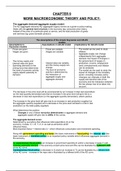
The assumptions of the simple Keynesian and AD-AS
models
Assumptions in Assumptions in AD-AS model Implications for AD-AS model
Keynesian models
- Prices are given - Prices are variable - The model can be used to study
- Wages are given - Wages are variable inflation
- Aggregate supply can change
independently from aggregate
demand; the impact of changes in
- The money supply and the general level of wages on
interest rates are given - Interest rates are variable, production, income, employment
- Spending (demand) is the and the money supply can (and unemployment) and inflation
driving force that determines change can be analysed.
the level of economic activity; - The level of economic - The model can be used to study the
supply adjusts passively to activity is determined by impact of changes in the monetary
demand. the interaction of sector, including monetary policy
aggregate supply and - Changes can originate on both the
aggregate demand. supply and demand side of the
economy and the interaction between
the two always has to be taken into
account.
The decrease in the price level will be accompanied by an increase in total real expenditure
(or the total quantity demanded) and that an increase in the price level will give rise to a
decrease in total real expenditure (or the aggregate quantity demanded), ceteris paribus.
The increase in the price level will give rise to an increase in real production supplied (or
the aggregate quantity supplied) and a decrease in the price level will lead to a fall in real
production (or the total quality supplied).
What determines the position:
- Changes in any of these non-price determinants or aggregate demand and
aggregate supply will give rise to shifts of the curves.
The aggregate demand curve:
Determined by everything that influences total expenditure (A) in the
economy. Include: C, I, G, T, X, Z. As well as all factors which
influence these.
Most important factor = Interest rate (i) – which influences consumption and investment spending.
Along with government spending and taxes (the basic instruments of fiscal policy) the interest rate (the
basic instrument of monetary policy) is an important policy variable which influences aggregate demand in
the economy.
An expansionary fiscal policy (an increase in government spending G and/or a decrease in taxes T) will
increase aggregate demand in the economy at each price level and this can be illustrated by rightward shift
of the AD curve.
Contractionary fiscal policy (a decrease in G and/or an increase in T) can be illustrated by a leftward shift
of the AD curve – increase in the repo rate is illustrated by a leftward shift of the AD curve.
, Decrease in the repo rate (expansionary monetary policy) by a rightward shift of the AD curve.
Change Impact on AD curve
Price level P increases Upward movement along the curve
Price level P decreases Downward movement along the curve
Autonomous consumption C increases Shift to the right
Investment spending I increases Shift to the right
Government spending G increases Shift to the right
Taxes T decreases Shift to the right
Net exports (X-Z) increase Shift to the right
Interest rate (i) decreases Shift to the right
Autonomous consumption C decreases Shift to the left
Investment spending I decreases Shift to the left
Government spending G decreases Shift to the left
Taxes T increases Shift to the left
Net exports (X-Z) decreases Shift to the left
Interest rate (i) increases Shift to the left
The aggregate supply curve:
AS curve is primarily governed by the cost of production. – concerned with the cost of
producing the total output of goods and services (GDP)
An increase in factor prices or import prices and/or a decrease in productivity will shift the
aggregate supply curve upward - to the left.
A decrease in factor prices and/or an increase in productivity will shift the aggregate
supply curve downward – to the right.
AS is not usually affected directly by expansionary or contractionary monetary and fiscal policies.
Change Impact on AS curve
Price level P increases Upward movement along the curve
Price level P decreases Downward movement along the curve
Prices of factors of production (eg: wages)
increase Curve shifts upward (to the left)
Prices of imported capital and intermediate goods
(eg: Oil) increase Curve shifts upward (to the left)
Productivity decreases Curve shifts upward (to the left)
Weather conditions deteriorate Curve shifts upward (to the left)
Prices of factors of production (eg: wages)
decrease Curve shifts downward (to the right)
Prices of imported capital and intermediate goods
(eg: Oil) decrease Curve shifts downward (to the right)
Productivity increases Curve shifts downward (to the right)
Weather conditions improve Curve shifts downward (to the right)
Changes in aggregate demand:
When the AS curve is very flat, an increase in aggregate demand (rightward shift of the AD curve), leads to
an increase in real output or income (Y) with little of no increase in the price level (P).
When the AS curve is very steep – an increase in aggregate demand will result in an increase in the price
level with little or no increase in production.
MORE MACROECONOMIC THEORY AND POLICY:
The aggregate demand-aggregate supply model:
The AD (aggregate-demand)-AS (aggregate-supply) serves as a guide to policy-making.
Deals with the general level of prices in the economy (eg: consumer price index),
instead of the price of a particular good or service, and the total production of goods
and services (eg: gross domestic product).
The assumptions of the simple Keynesian and AD-AS
models
Assumptions in Assumptions in AD-AS model Implications for AD-AS model
Keynesian models
- Prices are given - Prices are variable - The model can be used to study
- Wages are given - Wages are variable inflation
- Aggregate supply can change
independently from aggregate
demand; the impact of changes in
- The money supply and the general level of wages on
interest rates are given - Interest rates are variable, production, income, employment
- Spending (demand) is the and the money supply can (and unemployment) and inflation
driving force that determines change can be analysed.
the level of economic activity; - The level of economic - The model can be used to study the
supply adjusts passively to activity is determined by impact of changes in the monetary
demand. the interaction of sector, including monetary policy
aggregate supply and - Changes can originate on both the
aggregate demand. supply and demand side of the
economy and the interaction between
the two always has to be taken into
account.
The decrease in the price level will be accompanied by an increase in total real expenditure
(or the total quantity demanded) and that an increase in the price level will give rise to a
decrease in total real expenditure (or the aggregate quantity demanded), ceteris paribus.
The increase in the price level will give rise to an increase in real production supplied (or
the aggregate quantity supplied) and a decrease in the price level will lead to a fall in real
production (or the total quality supplied).
What determines the position:
- Changes in any of these non-price determinants or aggregate demand and
aggregate supply will give rise to shifts of the curves.
The aggregate demand curve:
Determined by everything that influences total expenditure (A) in the
economy. Include: C, I, G, T, X, Z. As well as all factors which
influence these.
Most important factor = Interest rate (i) – which influences consumption and investment spending.
Along with government spending and taxes (the basic instruments of fiscal policy) the interest rate (the
basic instrument of monetary policy) is an important policy variable which influences aggregate demand in
the economy.
An expansionary fiscal policy (an increase in government spending G and/or a decrease in taxes T) will
increase aggregate demand in the economy at each price level and this can be illustrated by rightward shift
of the AD curve.
Contractionary fiscal policy (a decrease in G and/or an increase in T) can be illustrated by a leftward shift
of the AD curve – increase in the repo rate is illustrated by a leftward shift of the AD curve.
, Decrease in the repo rate (expansionary monetary policy) by a rightward shift of the AD curve.
Change Impact on AD curve
Price level P increases Upward movement along the curve
Price level P decreases Downward movement along the curve
Autonomous consumption C increases Shift to the right
Investment spending I increases Shift to the right
Government spending G increases Shift to the right
Taxes T decreases Shift to the right
Net exports (X-Z) increase Shift to the right
Interest rate (i) decreases Shift to the right
Autonomous consumption C decreases Shift to the left
Investment spending I decreases Shift to the left
Government spending G decreases Shift to the left
Taxes T increases Shift to the left
Net exports (X-Z) decreases Shift to the left
Interest rate (i) increases Shift to the left
The aggregate supply curve:
AS curve is primarily governed by the cost of production. – concerned with the cost of
producing the total output of goods and services (GDP)
An increase in factor prices or import prices and/or a decrease in productivity will shift the
aggregate supply curve upward - to the left.
A decrease in factor prices and/or an increase in productivity will shift the aggregate
supply curve downward – to the right.
AS is not usually affected directly by expansionary or contractionary monetary and fiscal policies.
Change Impact on AS curve
Price level P increases Upward movement along the curve
Price level P decreases Downward movement along the curve
Prices of factors of production (eg: wages)
increase Curve shifts upward (to the left)
Prices of imported capital and intermediate goods
(eg: Oil) increase Curve shifts upward (to the left)
Productivity decreases Curve shifts upward (to the left)
Weather conditions deteriorate Curve shifts upward (to the left)
Prices of factors of production (eg: wages)
decrease Curve shifts downward (to the right)
Prices of imported capital and intermediate goods
(eg: Oil) decrease Curve shifts downward (to the right)
Productivity increases Curve shifts downward (to the right)
Weather conditions improve Curve shifts downward (to the right)
Changes in aggregate demand:
When the AS curve is very flat, an increase in aggregate demand (rightward shift of the AD curve), leads to
an increase in real output or income (Y) with little of no increase in the price level (P).
When the AS curve is very steep – an increase in aggregate demand will result in an increase in the price
level with little or no increase in production.