1 - 5 Chemical formulae, equations and
calculations: part 1
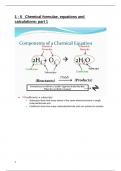
● ***Coefficients ≠ subscripts
○ Subscripts show how many atoms of the same element present in single
molecule/formula unit
○ Coefficient show how many molecules/formula units are present in reaction
1
, Balancing equations***
State symbols
● (s): solid
● (l): liquid
● (g): gas
● (aq): aqueous solution (dissolved in water)
● E.g.: 2K(s) + 2H2O(l) → 2KOH(aq) + H2(g)
2 potassium atoms + 2 water molecules → 2 potassium hydroxide units
(dissolved in water) + 1 hydrogen gas molecule
Relative atomic mass (Ar) (also known as mass number)
● ***Definition: weighted average mass of an atom compared to 1/12 mass of one 12C
atom
(mass × % abundance)+......
● ***Calculation of Ar:
100
● Reason for choosing carbon-12 as standard of Ar:
1. Carbon-12 isotope has very high abundance within element compared to
other elements’
2. No other nuclides (核素) other than carbon-12 have exactly/very-near
whole-number masses in this scale
3. Carbon-12 can be found in many places in Earth (abundant [豐富] - in
terms of amount of resources)
Relative formula mass (Mr)
● Sum of RAMs of atoms in a substance, accounting for their quantities in the formula
2
calculations: part 1
● ***Coefficients ≠ subscripts
○ Subscripts show how many atoms of the same element present in single
molecule/formula unit
○ Coefficient show how many molecules/formula units are present in reaction
1
, Balancing equations***
State symbols
● (s): solid
● (l): liquid
● (g): gas
● (aq): aqueous solution (dissolved in water)
● E.g.: 2K(s) + 2H2O(l) → 2KOH(aq) + H2(g)
2 potassium atoms + 2 water molecules → 2 potassium hydroxide units
(dissolved in water) + 1 hydrogen gas molecule
Relative atomic mass (Ar) (also known as mass number)
● ***Definition: weighted average mass of an atom compared to 1/12 mass of one 12C
atom
(mass × % abundance)+......
● ***Calculation of Ar:
100
● Reason for choosing carbon-12 as standard of Ar:
1. Carbon-12 isotope has very high abundance within element compared to
other elements’
2. No other nuclides (核素) other than carbon-12 have exactly/very-near
whole-number masses in this scale
3. Carbon-12 can be found in many places in Earth (abundant [豐富] - in
terms of amount of resources)
Relative formula mass (Mr)
● Sum of RAMs of atoms in a substance, accounting for their quantities in the formula
2